
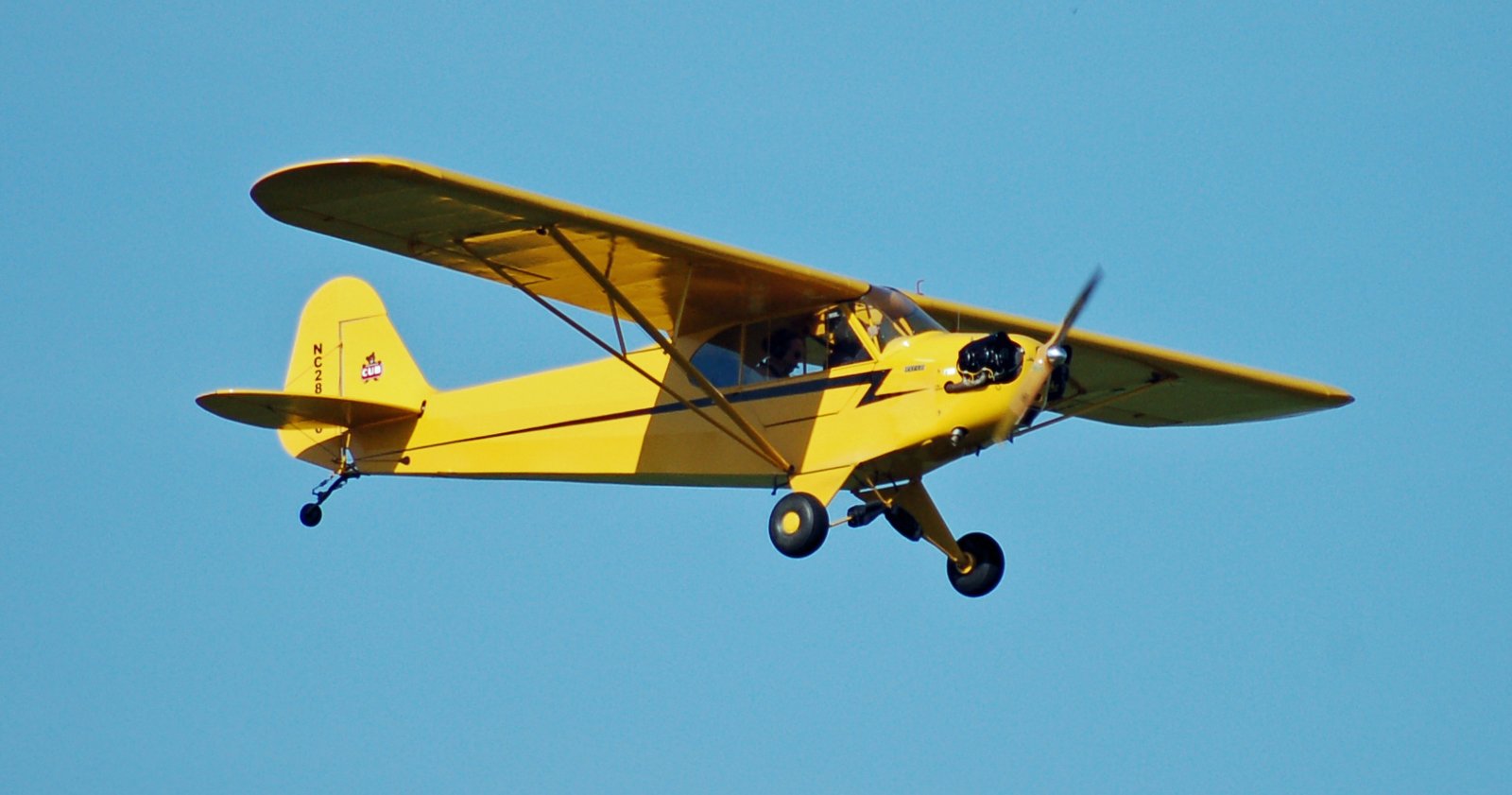
Service History
The J-4 Cub Coupe found its primary calling in civilian flight training, particularly through the U.S. Civilian Pilot Training Program launched in 1939. This federal initiative, designed to prepare pilots for anticipated wartime needs, relied heavily on the J-4's side-by-side configuration, which allowed instructors to better monitor and guide student pilots compared to the tandem-seat J-3 Cub. By the end of 1939, several hundred J-4s were operating across the United States and Canada, training thousands of future military aviators before America's entry into World War II.
Unlike its famous sibling the J-3 Cub, which saw extensive military service as the L-4 Grasshopper with over 5,000 units built for liaison and observation duties, the J-4 remained purely civilian. Production ceased in December 1941 when Piper shifted entirely to military contracts, and the model never resumed manufacture after the war.
The Manufacturer
Piper Aircraft Company emerged from the financial ashes of Taylor Brothers Aircraft, founded in 1927 by C.G. Taylor. When Taylor's company faced bankruptcy in 1935, Pennsylvania businessman William T. Piper acquired the assets and renamed it Piper Aircraft Company. The company had already relocated from Bradford to Lock Haven, Pennsylvania, following a devastating 1937 factory fire that destroyed the original facilities.
Under Piper's leadership, the company demonstrated remarkable production capabilities. In April 1941, the Lock Haven facility completed 49 Cubs in just 12 days, showcasing the efficient manufacturing processes that would serve the company well during wartime production. Piper also pioneered international licensing agreements, notably with Danish entrepreneurs Jack Hedegaard and Christian Bohnstedt-Petersen in 1937, establishing Cub Aircraft Co. Ltd. at Lundtofte to assemble aircraft from American-supplied kits for the Scandinavian market.
Today, Piper Aircraft, Inc. continues operations from Vero Beach, Florida, having survived various mergers, including acquisition by Bangor Punta Corporation in 1969 and post-bankruptcy restructuring in 1992.
Engine & Technical Details
The J-4 evolved through several engine configurations during its brief production run. Initial 1938-1939 models featured 75-horsepower Continental engines, while the 1940 J-4A variant adopted the 65-horsepower Continental A65 with fully enclosed cowling and auxiliary fuel capacity. The J-4B offered a 60-horsepower Franklin 4AC-171 option, and the final 1941 J-4E returned to the 75-horsepower Continental.
Continental Motors Corporation, founded in 1905 with its aircraft division active from 1929 through the 1960s, supplied most J-4 powerplants. The reliable A65 engine, weighing approximately 130 pounds, provided excellent power-to-weight ratio for the aircraft's training mission while enabling respectable short-field performance.
The J-4's design represented a significant departure from C.G. Taylor's original tandem-seat concept. Engineering focused on widening the fuselage to accommodate side-by-side seating, adding hydraulic brakes, installing a complete instrument panel, and incorporating navigation lights—features that enhanced its training capabilities. Construction followed proven Piper methods with welded steel-tube fuselage and spruce spars supporting aluminum wings.
Pilot Perspective
Pilots praised the J-4's docile handling characteristics and forgiving low-speed behavior, inherited from the broader Cub family. The enclosed cabin provided weather protection superior to open-cockpit contemporaries, while side-by-side seating facilitated natural communication between instructor and student. With a maximum speed of 93 mph, range of 249 miles, and service ceiling around 10,000 feet, performance suited primary training requirements perfectly.
The aircraft's gentle stall characteristics and stable flight behavior made it ideal for introducing new pilots to aviation, contributing significantly to the rapid expansion of American pilot training before World War II.
Production & Legacy
Piper manufactured approximately 1,250 J-4 Cubs between 1938 and 1941, with additional units assembled from kits in Denmark. The Danish operation completed at least one aircraft (registered LN-HAD) in March 1940, though German occupation in April 1940 ended Scandinavian production when Wehrmacht forces seized remaining inventory.
The J-4's most significant contribution lay in pioneering side-by-side seating in light aircraft training, directly influencing postwar designs including the PA-18 Super Cub, which remained in production until 1981 with approximately 35,000 total Cubs of all variants manufactured.
Nearly 200 J-4s remain airworthy today, testament to their robust construction and enduring appeal. Notable museum examples include a J-4A displayed at the Pima Air & Space Museum in Tucson, Arizona. The type's legacy extends beyond mere numbers—it bridged pre-war civilian aviation with wartime training demands, helping establish the foundation for America's massive pilot training programs that would prove crucial during World War II.