
Market Revolution
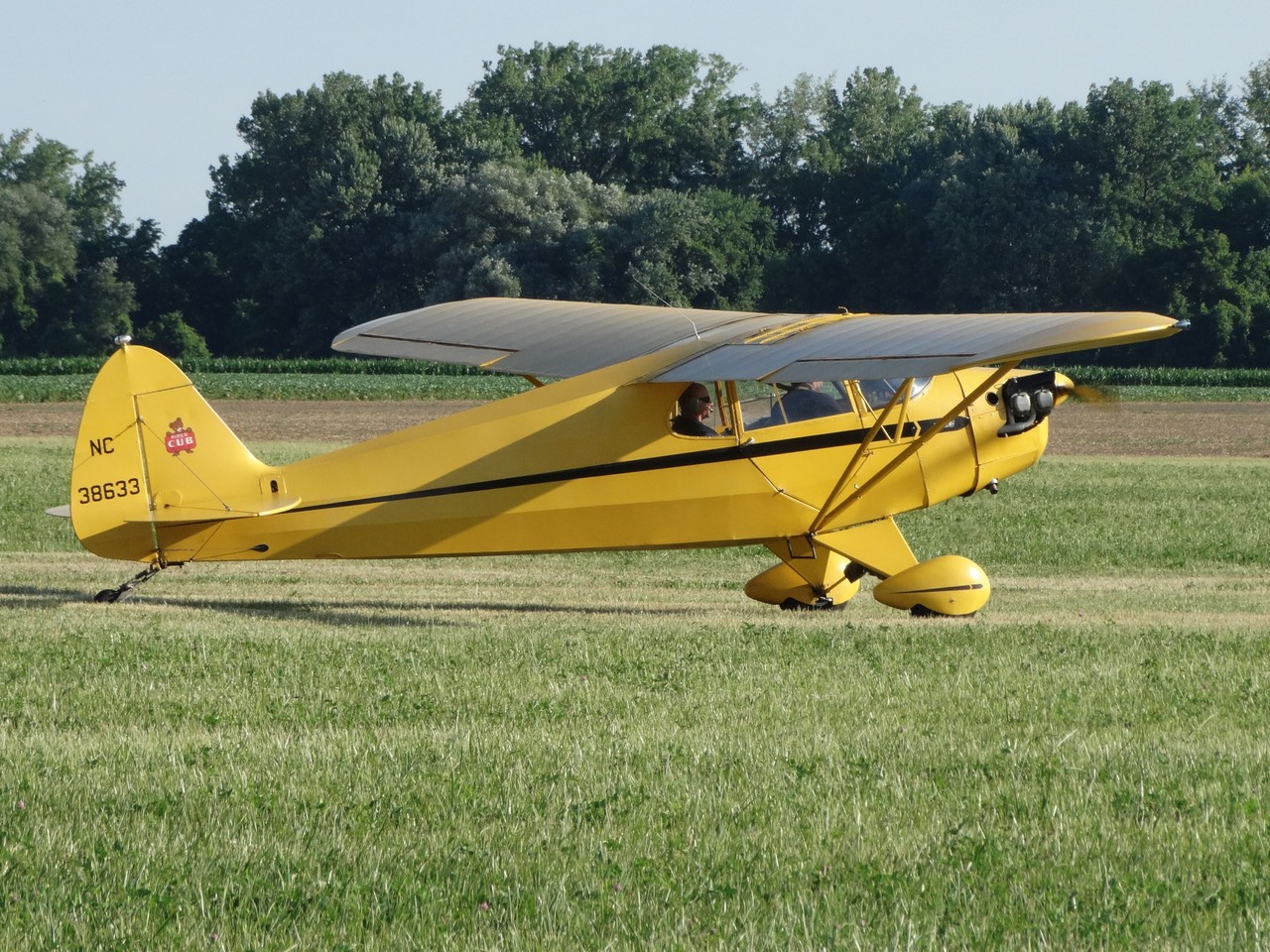
The J-5 Cub Cruiser transformed Piper Aircraft from a training-focused manufacturer into a serious competitor in the personal transportation market. While the company's J-3 Cub dominated flight schools nationwide, the J-5's three-seat configuration opened entirely new markets. The aircraft featured a widened fuselage compared to the J-3, positioning the pilot in front with two passengers seated side-by-side in the rear. This layout proved ideal for flight instruction with two students or family cross-country travel.
Production occurred in two distinct phases separated by World War II. Early versions with external bungee landing gear rolled off the Lock Haven assembly line between 1940 and early 1942, totaling 783 aircraft. When civilian production resumed in 1944, Piper incorporated internal bungee gear systems and continued manufacturing through 1946.
Wartime Service
The United States Navy recognized the J-5C's potential as a medical transport, adapting it for military service as the HE-1 flying ambulance. Later redesignated AE-1, these aircraft featured hinged rear fuselage decking to accommodate stretcher patients. The Navy procured over 100 HE-1 variants, utilizing them for medical evacuation and training missions throughout the Pacific theater.
Civilian J-5C production virtually ceased during wartime, with only 35 aircraft completed before Piper shifted entirely to military contracts in 1942. This scarcity makes wartime civilian J-5Cs particularly sought after by collectors today.
Engineering Excellence
Piper designed the J-5 with remarkable parts commonality to the J-3 Cub. Wings, tail surfaces, and landing gear components remained interchangeable between the two models, reducing manufacturing costs and simplifying maintenance for operators. This engineering philosophy proved prescient, as many J-5 owners could source parts from the more numerous J-3 fleet.
The J-5A utilized various Lycoming engines during its production run, with continuous improvements throughout World War II. The J-5B standardized on the 75-horsepower Lycoming GO-145-C2, while the definitive J-5C featured the fully cowled 100-horsepower Lycoming O-235-2 military variant or O-235-B civilian version. The O-235 engine proved exceptionally durable, remaining in production for decades and powering Cessna 152 trainers well into the 1980s.
Performance and Capabilities
The J-5A delivered respectable performance for its era, achieving 95 mph maximum speed and 85 mph cruise with a 40 mph landing speed. Initial climb rate reached 450 feet per minute, with a service ceiling of 10,000 feet and 425-mile range. The aircraft could carry 380 pounds of payload within its 1,450-pound gross weight limit.
Upgraded J-5C models with the 100-horsepower O-235 engine improved cruise speeds to 95-100 mph, representing a substantial performance gain. Standard fuel capacity included an 18-gallon wing tank, with provisions for additional 7 or 18-gallon auxiliary tanks for extended range operations.
Post-War Evolution
In 1946, Piper abandoned the J-designation system in favor of PA (Piper Aircraft) model numbers. The J-5C evolved into the PA-12 Super Cruiser with increased gross weight to 1,750 pounds and upgraded chrome-moly fuselage tubing replacing the original 1020 mild steel structure. This transformation proved remarkably successful, with 3,759 PA-12s manufactured between 1946 and 1947—nearly triple the original J-5 production.
Piper also developed the four-seat PA-14 Family Cruiser powered by a 115-horsepower engine. However, this variant failed to capture market interest, with only 238 examples built during 1948 and 1949 before discontinuation.
The Manufacturer Legacy
Piper Aircraft Corporation, founded by William T. Piper, established itself as a dominant force in general aviation through the Cub series. The company's Lock Haven facility became synonymous with American light aircraft manufacturing, producing thousands of Cubs for military and civilian operators worldwide. Today's Piper Aircraft, Inc. continues this legacy, manufacturing modern general aviation aircraft while maintaining support for vintage Piper products.
Enduring Popularity
More than 500 J-5 Cub Cruisers remained on Federal Aviation Administration registry rolls as of 2018, with approximately 327 listed as active. This survival rate reflects the aircraft's robust construction and continued utility for recreational flying. Many J-5s serve with vintage aircraft enthusiasts who appreciate the type's docile handling characteristics and classic fabric-and-tube construction.
The J-5's practical amenities, including electric starter and navigation lights, made it genuinely suitable for cross-country travel—a significant advancement over earlier Cubs. This capability, combined with reasonable operating costs and straightforward maintenance requirements, ensures the J-5 Cub Cruiser's continued presence at airports nationwide, representing a pivotal chapter in American aviation's transition from purely utilitarian flying to personal transportation.