
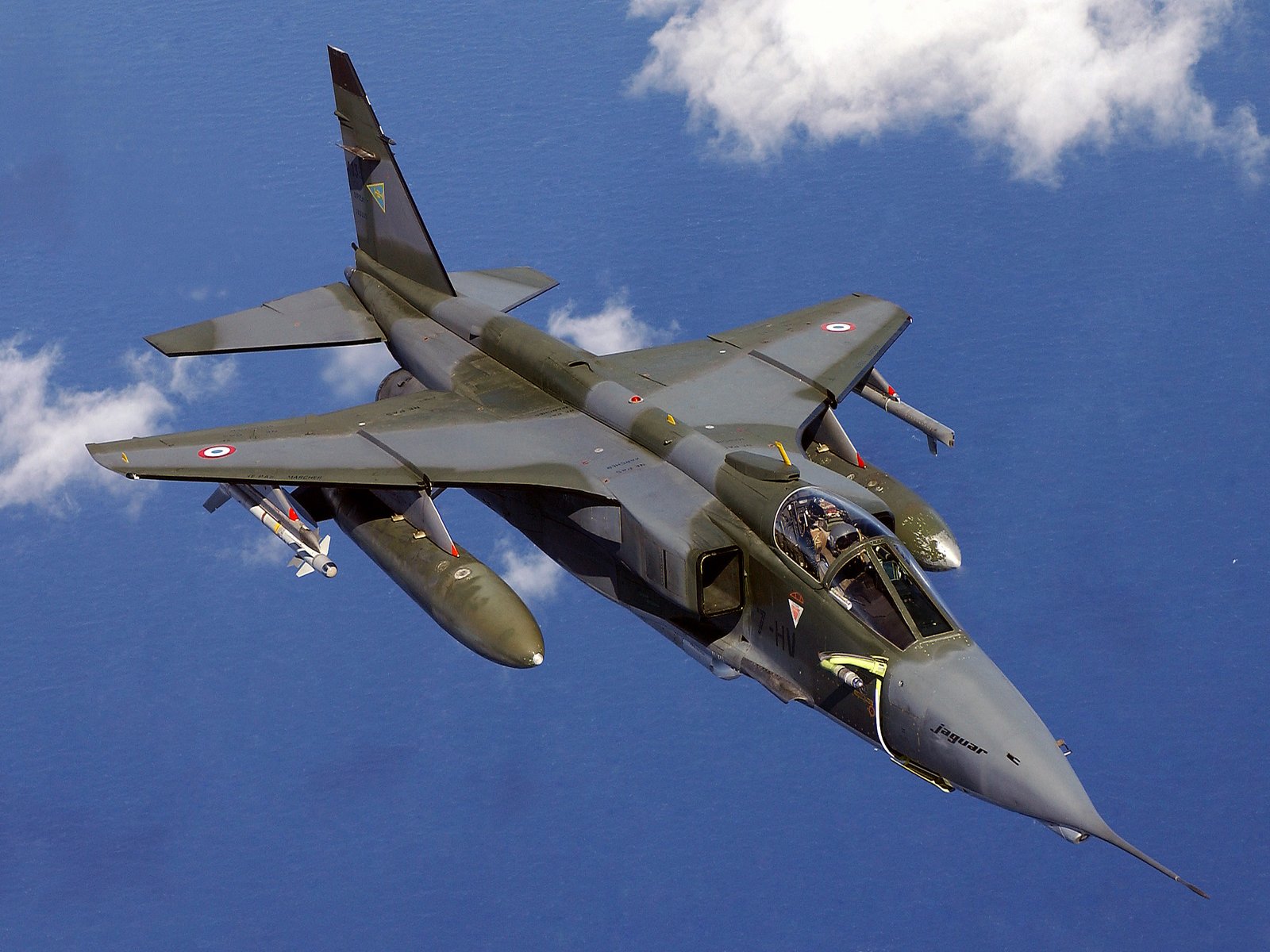
The SEPECAT Jaguar was the result of a cooperative construction agreement signed on May 17, 1965, between the United Kingdom and France. Produced by SEPECAT—a joint venture involving the British Aircraft Corporation (BAC) and Breguet Aviation (which was later absorbed into Dassault Aviation)—the aircraft was originally conceived in the mid-1960s as a jet trainer with light ground-attack capabilities. However, requirements evolved during development to include supersonic performance, tactical reconnaissance, and nuclear strike capabilities, transitioning the Jaguar into a dedicated strike/attack aircraft.
The prototype first flew on September 8, 1968, and the first production Jaguar A rolled off the assembly line in May 1972. Total production reached 573 aircraft, including 403 for the UK and France, 54 exported to Nigeria, Ecuador, and Oman, and 116 for India, 70 of which were license-built by Hindustan Aeronautics Limited (HAL). The aircraft is powered by two Rolls-Royce/Turbomeca Adour low-bypass afterburning turbofans. Designed for robustness in harsh environments, the Jaguar is capable of reaching speeds of approximately Mach 1.6 and features a twin-engine layout for increased redundancy during low-level operations.
Operational service began with the French Armée de l’Air in 1973 and the Royal Air Force (RAF) in 1974. The RAF utilized the aircraft in eight first-line squadrons, with the Jaguar serving as a primary component of RAF Germany's Cold War capability until 1985. In combat, the Jaguar proved highly effective during Operation Desert Storm in 1991, where the RAF's Coltishall Strike Wing destroyed Iraqi missile positions and artillery. Other operational theaters included Bosnia, Chad, and Mauritania. While France retired its fleet on July 1, 2005, and the RAF retired its aircraft in April 2007, the Indian Air Force continues to operate the type as of 2023. The Jaguar's legacy is defined by its role as a precursor to later multinational projects like the Tornado and Eurofighter, proving the viability of large-scale European aerospace partnerships.