
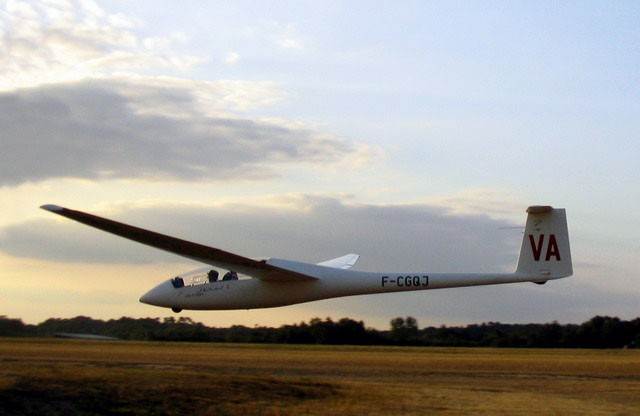
Revolutionary Design Philosophy
The Janus CM emerged from the vision of Dipl-Ing. Klaus Holighaus, who joined Schempp-Hirth as development engineer in 1965 and became managing director in 1972. Holighaus recognized the potential for creating a self-launching variant of his groundbreaking Janus series, which had already established itself as the first high-performance two-seat glider built entirely from fiberglass composite materials. The motorized version represented a quantum leap in soaring technology, eliminating the need for tow planes or winch launches while maintaining the exceptional soaring performance that made the Janus famous.
The original Janus prototype first flew in May 1974, with production models entering service in January 1975. By 1978, Holighaus had developed the motor glider variant, culminating in the first flight of the Janus CM that same year. The design challenge was substantial: integrating a powerplant without compromising the aircraft's remarkable gliding capabilities or structural integrity.
Technical Innovation
The Janus CM utilized a Rotax 535C two-stroke piston engine manufactured by BRP-Rotax GmbH & Co KG of Austria. This powerplant choice proved ideal for the self-launching application, providing sufficient thrust for takeoff while remaining light enough not to severely penalize gliding performance. The engine installation was carefully integrated into the aircraft's sleek fuselage design, maintaining the aerodynamic efficiency that characterized the entire Janus family.
The aircraft featured the same advanced composite construction as its unpowered siblings, with a glass-fiber monocoque fuselage similar to the Nimbus-2 but lengthened to accommodate the tandem cockpit configuration. The wing design incorporated forward-swept two-piece construction with innovative camber-changing flaps capable of adjustment from +12° to -7°. Upper-surface airbrakes provided precise control during approach and landing phases.
Performance Characteristics
With its 20-meter wingspan, the Janus CM achieved a maximum glide ratio of 43, representing a significant improvement over early models' 39.5 ratio. The aircraft could reach maximum speeds of 250 km/h and supported a maximum takeoff weight of 700 kg. These performance figures placed it firmly in the high-performance category, making it competitive with pure gliders while offering the operational flexibility of self-launching capability.
The tandem seating arrangement provided excellent training opportunities, with full dual controls allowing experienced instructors to work with students in cross-country and competition flying scenarios. This configuration proved particularly valuable for the newly established FAI 20-meter two-seater class, which the Janus series had effectively created.
Limited Production Legacy
Production of the Janus CM remained highly exclusive throughout its manufacturing run from 1978 through the 1990s. Only three units had been completed by early 1980, with production lists indicating approximately 35 total examples built across various years including 1988 and 1990. This limited production reflected both the specialized nature of the aircraft and its premium positioning in the market.
The broader Janus family achieved greater production success, with approximately 100 units of all variants manufactured between 1974 and 1996. The final Janus variant, the CT model (registration D-KLAY), was completed in 1996, marking the end of an era for this pioneering design.
Manufacturer Heritage
Schempp-Hirth Flugzeugbau GmbH brought exceptional credentials to the Janus project, tracing its roots to 1932-1935 when Martin Schempp and Wolf Hirth began producing gliders in Stuttgart. Their early successes included the Gö-3 "Minimoa" and other innovative designs that established the company's reputation for advanced sailplane development. By 1936, the company was producing one "Wolf" glider every 14 days, leading to relocation to larger facilities in Kirchheim/Teck in 1937-1938.
Under Klaus Holighaus's leadership, the company pioneered the use of composite materials in glider construction, with the Janus series representing the culmination of this technological evolution. Today, Schempp-Hirth continues operations as one of the world's largest glider manufacturers, producing approximately 100 gliders annually.
Current Status
Many Janus CM aircraft remain airworthy today, with examples like D-KXLF continuing to demonstrate the design's enduring appeal. The used aircraft market reflects the type's continued desirability, with 1990s-era examples commanding prices around €58,000, while earlier 1975 models trade for approximately €30,000.
The Janus CM's legacy extends beyond its limited production numbers. As the first series-produced high-performance motorized glider, it established design principles and performance standards that influenced subsequent developments including the Duo Discus (1993) and Arcus (2009). The aircraft proved that self-launching capability need not compromise soaring performance, opening new possibilities for cross-country flying and competition participation.