
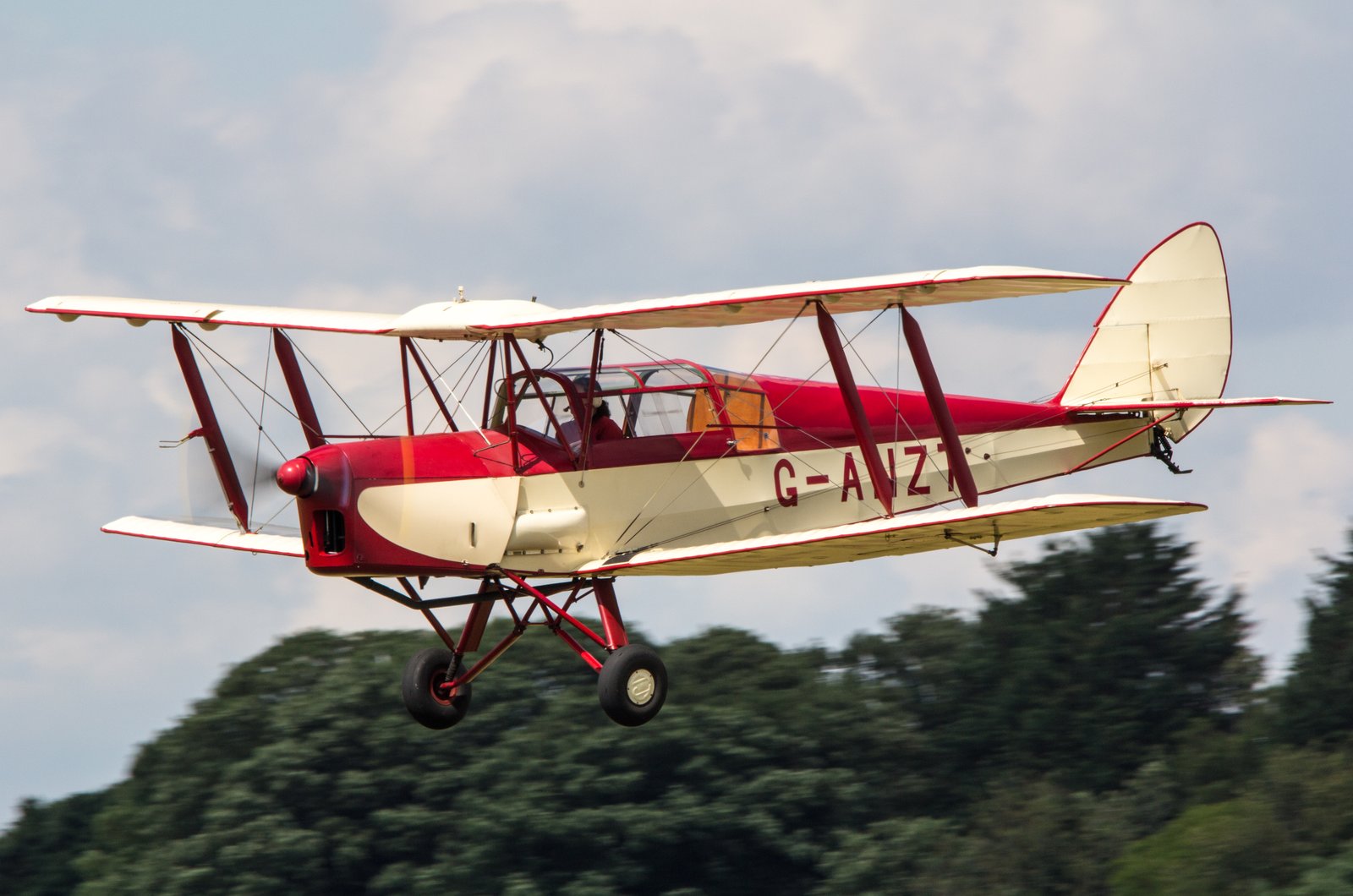
The Thruxton Jackaroo emerged in the 1950s as a specialized civil conversion of the widely available de Havilland Tiger Moth trainer. Developed by Jackaroo Aircraft Limited and later Rollason Aircraft and Engines Limited, the aircraft was designed to transform a two-seat trainer into a practical four-seat cabin biplane. This was achieved by widening the center fuselage, which allowed passengers to be seated side-by-side in two rows, providing a significantly more functional cabin arrangement than the original Tiger Moth layout. The first documented conversion of this type took flight on 2 March 1957.
Production of the Jackaroo was carried out at two primary locations: Thruxton Aerodrome and Croydon Airport. While a comprehensive production timeline is not fully detailed in available records, one source identifies the aircraft as being among an original group of 16 converted aeroplanes. Marketed as "the cheapest four-seat aircraft in the world," the Jackaroo was intended for a variety of civil roles, including touring, training, and light freight operations. Notably, the design featured a dual-purpose capability; by utilizing interchangeable top deckings, the aircraft could be converted into a single-seat agricultural plane equipped with a hopper capable of carrying 550 lb (250 kg) of dust for top-dressing and crop-spraying.
Technically, the Thruxton Jackaroo was powered by a de Havilland Gipsy Major, a four-cylinder, air-cooled, inverted inline piston engine producing 130 hp (97 kW). The aircraft's physical dimensions varied slightly across sources, with a length recorded between 25 ft 0 in (7.62 m) and 25 ft 9 in (7.85 m), and a wingspan of approximately 30 ft 4.5 in (9.25 m). Its height was listed between 8 ft 10 in (2.69 m) and 9 ft 6 in (2.90 m). With an empty weight of 1,360 lb (617 kg), the aircraft had a maximum takeoff weight of approximately 2,181 lb (989 kg).
Performance specifications indicate a maximum speed ranging from 102 to 104 mph (164–167 km/h) and a cruise speed between 85 and 90 mph (137–140 km/h). The aircraft possessed a range of 250 mi (400 km) and a rate of climb of 600 ft/min. The cabin was configured to accommodate one crew member and three passengers. The legacy of the Thruxton Jackaroo remains its status as a unique, small-run postwar effort to repurpose a military trainer into a versatile, low-cost utility aircraft.