
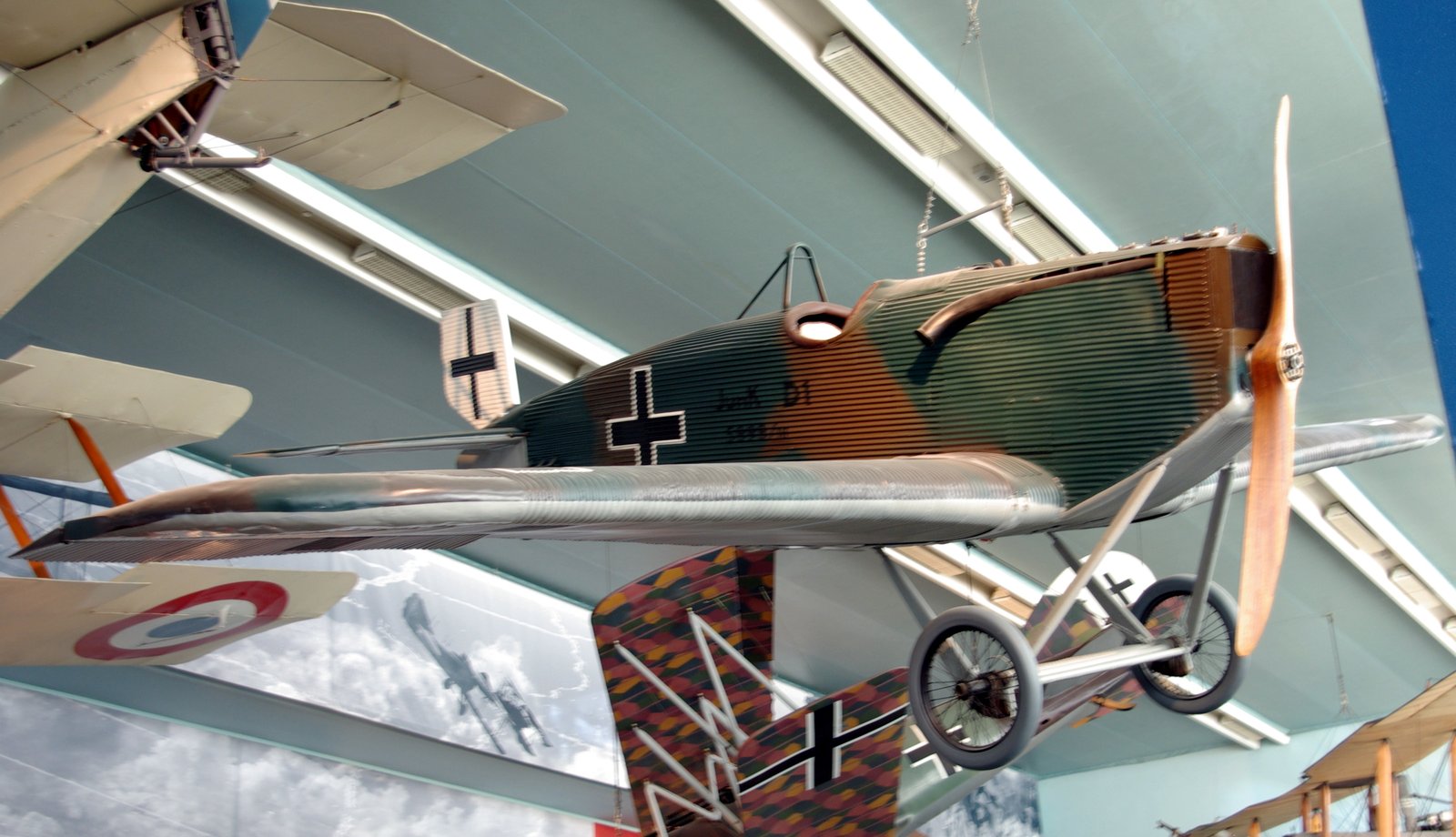
The Junkers D.I (factory designation J 9) was a pioneering German fighter aircraft developed during the latter stages of World War I. It is historically significant as the first all-metal fighter to enter operational service, representing a radical departure from the wood-and-fabric biplanes that dominated the era. The aircraft's design was rooted in a 1912 patent by Professor Hugo Junkers for a thick cantilever wing, which allowed for a strong structure without the need for external bracing or struts.
Production began in 1918 through Junkers & Co and the affiliated Junkers-Fokker firm. While early records suggest a total of 28 aircraft were built (15 by Junkers and 13 by Junkers-Fokker), more recent research indicates that approximately 40 aircraft were completed. Production continued into early 1919, ending abruptly when the Allies ordered the cessation of all German military aircraft manufacturing. The D.I was powered by water-cooled inline piston engines, most commonly the 160 hp Mercedes D.IIIa, though some units utilized a BMW inline engine rated at approximately 180 hp.
In military service, the D.I was operated by the Luftstreitkräfte. It entered the Western Front late in the war, with at least four aircraft dispatched to the Flanders sector on October 2, 1918. Due to its late arrival, it saw limited combat before the Armistice. However, the aircraft proved its durability in adverse weather, with operational reports noting that the metal construction avoided the rapid deterioration seen in canvas-and-wood aircraft. Following the war, the D.I saw further action in the spring of 1919, where German Freikorps forces used them to assist Baltic governments against Bolshevik forces. Lt. Gotthard Sachsenberg, a division commander, specifically praised the D.I as the optimal choice for the harsh weather conditions encountered during these operations.
Technically, the D.I was armed with two 7.92 mm LMG 08/15 "Spandau" machine guns synchronized to fire through the propeller. Performance varied by source, with maximum speeds cited between 176 km/h and 185 km/h, a service ceiling of 6,000 meters, and a climb rate to 5,000 meters of 9 minutes and 30 seconds. Although it did not influence the outcome of World War I, the D.I served as a technological milestone that anticipated the all-metal monoplane designs of the inter-war and World War II periods.