
Design and Development
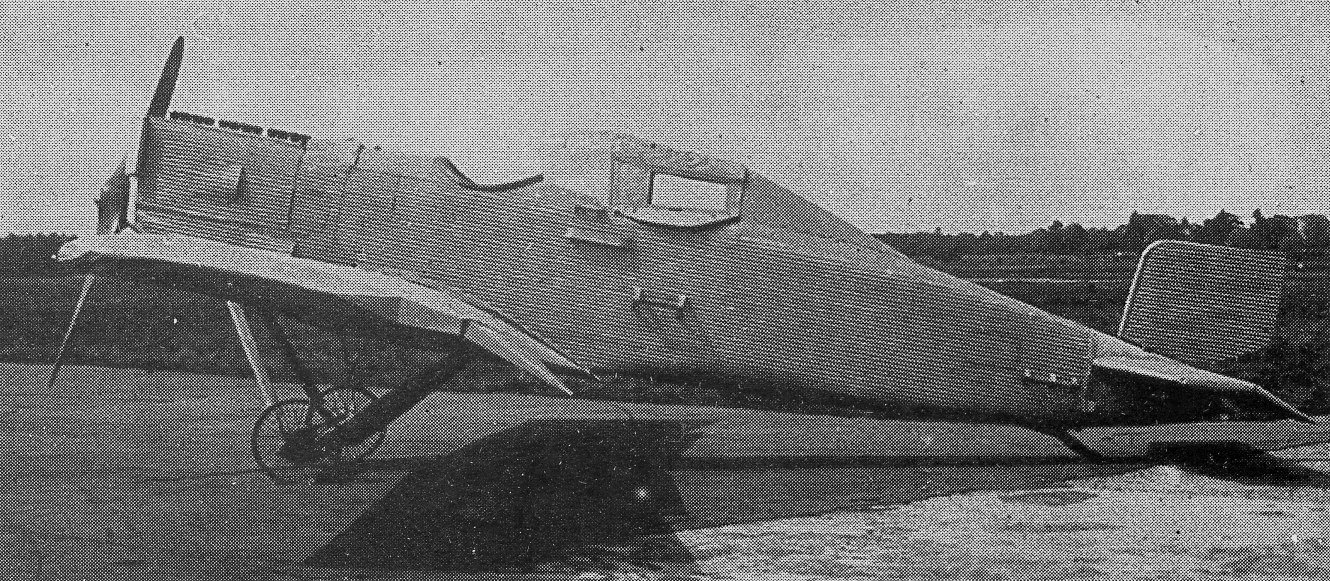
Developed under the leadership of Professor Hugo Junkers, the Junkers CL.I (factory designations J 8 and J 10) was the final wartime evolution of the company's all-metal monoplane series. The prototype first flew on December 10, 1917. Breaking from the conventional wood-and-fabric construction of the period, the CL.I featured a cantilever monoplane wing without external bracing or wires, covered in corrugated duralumin skin over a metal structure. This design significantly increased the aircraft's robustness and resistance to weather and combat damage.
Production and Technical Specifications
Production took place at the Junkers Flugzeugwerke plant in Dessau, Germany, beginning in the second half of 1918 and continuing into early 1919. Production numbers vary across sources; while some records indicate 50 aircraft were ordered, others state 47 were delivered by the Armistice, with a minimum of 37 completed. A floatplane derivative, designated the CLS.I (factory designation J 11), was also produced for the Imperial German Navy.
The aircraft was powered by a single six-cylinder, liquid-cooled inline Mercedes D.IIIa engine producing 180 hp (134 kW). This powerplant enabled a maximum speed of 161 km/h (100 mph) and a service ceiling of approximately 6,000 meters (19,700 ft), with an endurance of roughly two hours. The airframe featured a two-seat tandem open cockpit arrangement and a taildragger undercarriage.
Military and Civil Service
Designed for the German "CL" class (light two-seat armed aircraft), the CL.I served as a ground-attack, close-support, and escort fighter. Its standard armament included two fixed, synchronized 7.92 mm Spandau machine guns for the pilot and one flexible 7.92 mm Parabellum machine gun for the observer, with the capacity to carry approximately 30 kg of small bombs. While the Imperial German Army Air Service deployed the type in ground-attack squadrons on the Western Front in autumn 1918, detailed combat records from this period are scarce.
Following World War I, the CL.I saw notable service in the 1919 Baltic War. The Geschwader Sachsenberg, a volunteer unit led by Oberleutnant Gotthard Sachsenberg, utilized the CL.I against Bolshevik forces, where the aircraft's all-metal durability was highly valued in severe climatic conditions. The Latvian Air Force also operated the type post-war. In a limited civil capacity, one or two aircraft were converted for mail or passenger transport by enclosing the rear cockpit under a canopy.
Legacy
Though no complete original airframes are known to survive today, the CL.I remains historically significant as one of the first practical all-metal combat monoplanes. Its success in harsh environments foreshadowed the durability of later Junkers designs, such as the F 13 and Ju 52, and marked a critical transition toward the rugged metal attack aircraft of the inter-war period.