
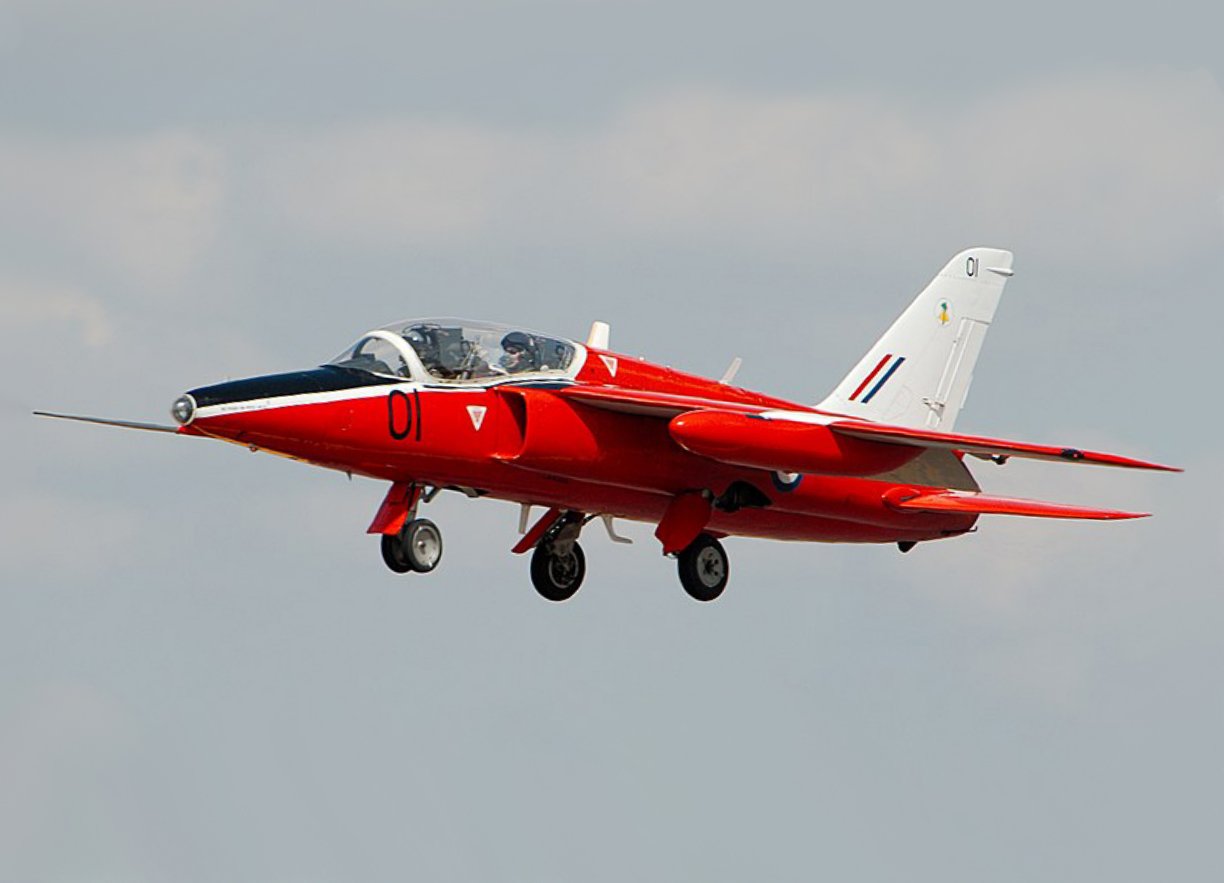
Service History
The Jet Provost T Mk.5 represented the culmination of the RAF's transition to all-jet pilot training, serving as the backbone of British military aviation education from 1969 to 1993. Operating from major training bases including RAF Cranwell, Little Rissington, and Linton-on-Ouse, the aircraft equipped No. 1, 2, 3, and 6 Flying Training Schools. The T Mk.5's pressurized cockpit distinguished it from earlier variants, enabling realistic high-altitude training that prepared pilots for frontline jet aircraft operations during the Cold War era.
The Manufacturer
The Jet Provost originated as a private venture by Hunting Percival Aircraft Limited at Luton Airport in the early 1950s. When British Aircraft Corporation acquired Hunting Percival in 1960, production of the advanced T Mk.5 variant transferred to BAC's Warton factory. BAC itself formed through the 1960 merger of Bristol Aeroplane Company, English Electric, and Vickers-Armstrongs, representing Britain's consolidation of aerospace manufacturing. Following BAC's 1977 merger with Scottish Aviation to create British Aerospace, the company eventually became BAE Systems in 1999, continuing operations today as one of the world's largest defense contractors.
Development and Design Innovation
Hunting Percival's design team conceived the Jet Provost as a jet-powered evolution of their successful piston-engine Provost trainer. The prototype XD674 achieved first flight on June 26, 1954, with test pilot Dick Wheldon at the controls from Luton Airport. The design emphasized reliability and low operating costs while incorporating modern features including tricycle landing gear and ejection seats from the T.3 variant onward.
The T Mk.5 introduced pressurization as its primary advancement, utilizing a more powerful Viper 201 engine compared to the Viper A.S.V.11 powering the preceding T.4. This enhancement enabled training operations at altitudes exceeding 30,000 feet, better preparing student pilots for operational jet aircraft capabilities.
Engine and Technical Specifications
Armstrong Siddeley's Viper 201 turbojet powered the T Mk.5, delivering 2,500 pounds of thrust through its reliable axial-flow design. The Viper engine family, produced from 1951 through the 1970s, accumulated over 5,000 units across all variants, establishing a reputation for exceptional reliability and economical operation. The compact powerplant enabled the Jet Provost's role versatility while maintaining the low maintenance requirements essential for intensive training operations.
The aircraft's tandem seating arrangement placed instructor and student in optimal positions for effective flight training, with dual controls enabling seamless transition of aircraft authority. The pressurized cockpit environment of the T Mk.5 provided realistic preparation for modern jet operations while maintaining the excellent maneuverability characteristics that made the Jet Provost series renowned among training aircraft.
Pilot Perspective and Performance
Pilots praised the Jet Provost T Mk.5 for its forgiving handling characteristics combined with genuine jet performance capabilities. The aircraft's 440-mile-per-hour maximum speed provided adequate performance for advanced training maneuvers including aerobatics and tactical exercises. Its stable flight characteristics allowed student pilots to focus on jet flying techniques without excessive workload managing aircraft systems.
The pressurized cockpit of the T Mk.5 enabled realistic high-altitude operations, teaching pilots essential skills for operating modern military jets. Instructors valued the aircraft's predictable responses and wide operating envelope, which provided safety margins during training while still challenging students with authentic jet flying experiences.
Export Variants and International Service
While the T Mk.5 remained dedicated to RAF training duties, armed export variants demonstrated the design's versatility. The T.51 and T.52 variants carried twin 0.303-inch machine guns, serving air forces including Ceylon (Sri Lanka), Kuwait, Sudan, and Iraq in light attack roles alongside training missions.
A notable incident occurred on February 1, 1960, when Sri Lankan Air Force pilot Noel Lokuge became his nation's first successful ejection seat survivor after his T.51 suffered engine failure over Negombo Lagoon. This event demonstrated the safety systems effectiveness that protected countless training pilots throughout the aircraft's service life.
Production and Legacy
Total Jet Provost production reached 734 aircraft across all variants between 1958 and 1967, with T Mk.5 deliveries commencing from Warton on September 3, 1969. The series provided the foundation for the successful BAC Strikemaster, an armed variant that achieved significant export success.
Several T Mk.5 aircraft continue flying today in private ownership, including G-BWSG operated by Viper Classic Aircraft Ltd for airshow demonstrations. These survivors preserve the legacy of an aircraft that trained virtually every RAF pilot for nearly four decades, establishing the jet training methodology that influenced military aviation education worldwide. The Jet Provost's combination of reliability, economy, and performance created the template for successful jet trainers that continues influencing aircraft design today.