
Revolutionary Home Construction Approach
John F. Taylor revolutionized amateur aircraft construction by designing the JT-1 entirely around the constraints of home building. Working from his 16 by 11 foot upstairs living room in Ilford, Essex, Taylor established a fundamental requirement that no component could exceed 4.5 feet diagonally, ensuring builders could transport parts through second-story windows. This innovative approach to design constraints made aircraft construction accessible to average-skilled individuals using minimal tools in cramped spaces.
The prototype's construction began in April 1958, with Taylor methodically crafting each component in his modest workspace. The design calculations received professional validation from the engineering team at Hunting Percival Aircraft Limited, lending credibility to what might otherwise have been dismissed as a backyard project. Douglas Edward Bianchi of Personal Plane Services Limited provided crucial support by sourcing materials, offering assembly guidance, and obtaining the initial powerplant.
First Flight and Performance Validation
On 4 July 1959, experienced RAF pilot O.V. "Titch" Holmes lifted the prototype off the runway at White Waltham, Berkshire, marking a milestone in British aviation history. The flight validated Taylor's ambitious goal of creating a £250 aircraft that ordinary enthusiasts could build and fly. Despite initial power limitations with the original J.A.P. 99 inline engine producing only 37 horsepower, the aircraft demonstrated promising handling characteristics that pilots compared to a "mini-Spitfire."
The powerplant solution came through Volkswagen automotive engine conversions, specifically an 1834cc unit modified with an ARDEM 4CO2 conversion system producing approximately 45 horsepower. This engine change transformed the aircraft's performance, enabling a maximum speed of 115 mph, cruise speed of 100 mph, and a practical range of 290 miles. The low stalling speed of 40 mph provided comfortable landing characteristics for amateur pilots.
Technical Innovation and Construction
Taylor incorporated several innovative design elements that balanced performance with buildability. The aircraft featured a Warren Truss rib structure shared with combat aircraft including the Fiat CR.42 and Hawker Hurricane, providing exceptional strength with a +9/-9G rating. The two-spar wing design utilized RAF 45 airfoil sections optimized for low-speed handling, while the plywood-covered box fuselage construction technique borrowed from the successful DH80 Puss Moth.
The all-wood structure combined traditional materials with modern engineering principles. Wings featured plywood leading edges with fabric covering aft of the main spar, while the fuselage employed stressed plywood skin construction for optimal strength-to-weight ratios. Fixed landing gear with coil spring suspension kept mechanical complexity minimal, though builders could optionally install flaps for improved short-field performance.
Global Expansion and Production Legacy
Following the prototype's success, Taylor made construction plans available to homebuilders starting in 1959. The design quickly gained international recognition, with completed aircraft appearing in the United Kingdom, United States, Portugal, Finland, Australia, and the Azores. By the early 2010s, more than 200 examples had been completed worldwide, with over 110 documented as flying.
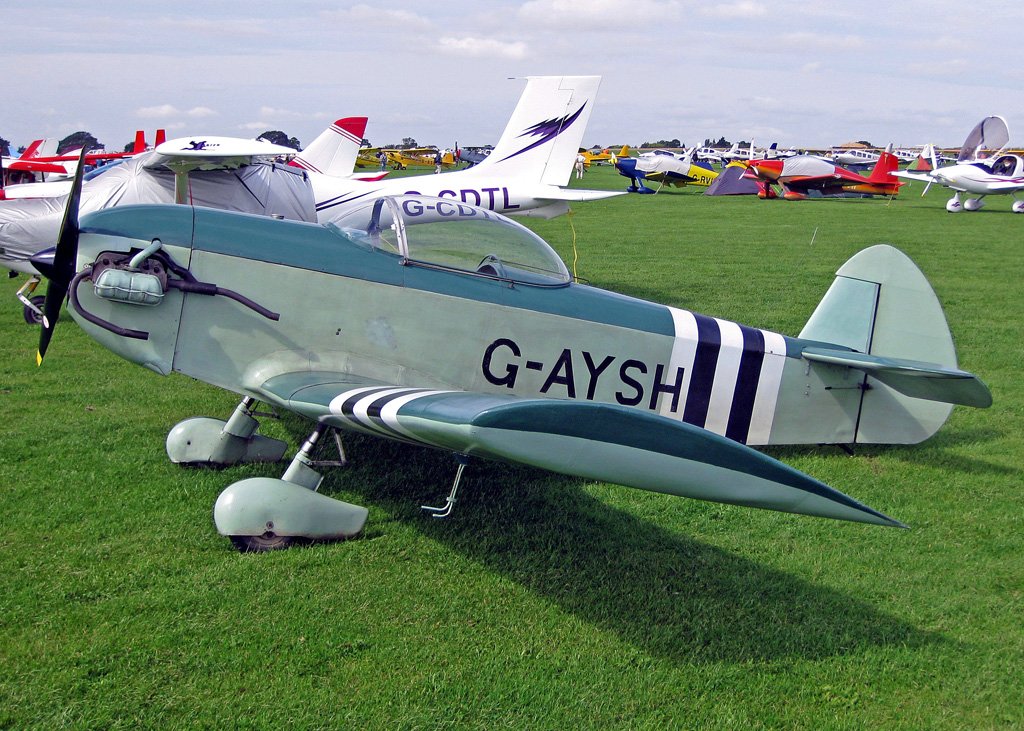
Notable examples include the original prototype G-APRT, which was displayed at the 1971 Popular Flying Association Rally at Sywell before later registration in Portugal as CS-AXB from 1985 to 1989. G-AYSH gained attention for its authentic Royal Navy Korean War color scheme replica, while other registered aircraft including G-BGHY, G-CEKB, and G-BDAD demonstrated the design's continued popularity among sport aviation enthusiasts.
Designer and Historical Context
John F. Taylor, working as a draftsman and pilot, recognized the post-war desire among British aviation enthusiasts to build and fly their own aircraft. Unlike pre-war homebuilding efforts that often resulted in marginally airworthy machines, Taylor applied rigorous engineering principles to create an aircraft that met professional performance and safety standards while remaining within amateur construction capabilities.
The JT-1's success established the template for modern homebuilt aircraft development, proving that proper design could democratize aviation access. Taylor never established a formal manufacturing company, instead maintaining the aircraft as a plans-built design that individual constructors could undertake at their own pace and budget. This approach influenced subsequent homebuilt aircraft development and helped establish the Popular Flying Association movement in Britain.
Enduring Legacy
The Taylor JT-1 Monoplane remains significant as proof that innovative design constraints can expand rather than limit possibilities. By accepting the challenge of home construction limitations, Taylor created an aircraft that performed comparably to factory-built machines while costing a fraction of commercial alternatives. The design continues to attract builders worldwide, with plans remaining available more than six decades after the prototype's first flight, testament to the enduring appeal of accessible, high-performance aviation.