
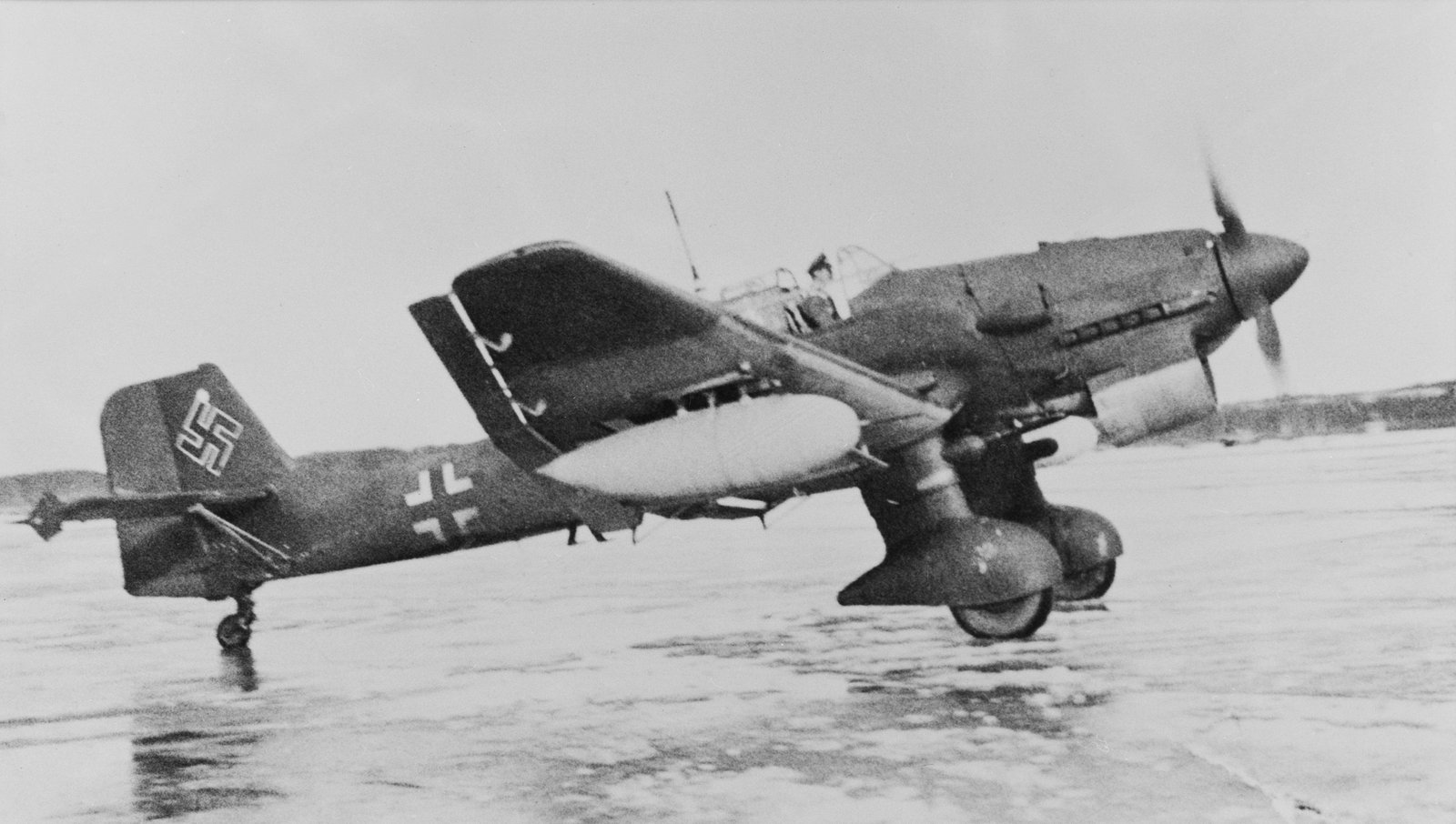
Designed by Hermann Pohlmann for Junkers Flugzeug- und Motorenwerke AG, the Ju 87 Stuka was developed in the mid-1930s to meet requirements for a dedicated dive bomber. The V1 prototype first flew on September 17, 1935. The aircraft's most striking design feature was its inverted-gull wings, which allowed for shorter, sturdier landing gear while maintaining stability during steep dives. To protect pilots from G-force induced blackouts, the Ju 87 incorporated an automatic dive-recovery system that could pull the aircraft out of a dive after the bomb was released. Early variants, specifically the Ju 87B, were equipped with "Jericho-Trompete" sirens on the undercarriage to intimidate targets during descent.
Production began in 1936 and continued until 1944, with approximately 6,500 aircraft built. Manufacturing was centered at the Dessau plant, with additional production occurring at satellite sites such as Bernburg. The aircraft was powered by liquid-cooled, inverted-V12 piston engines produced by the Jumo engine division. Early A-series models used the 600 hp Jumo 210, while the main production B and D series utilized the Jumo 211 family. The Ju 87D-5, for example, was powered by the Jumo 211J, delivering roughly 1,400 hp and reaching a maximum speed of 410 km/h.
Combat service began in late 1937 during the Spanish Civil War with the Condor Legion. The Stuka played a pivotal role in the early stages of World War II; on September 1, 1939, three Ju 87B-1s led by Lt. Bruno Dilley bombed the Dirschau bridge, marking the first Luftwaffe attacks of the conflict. The aircraft proved highly effective during the 1940 Norwegian campaign and the invasion of France. However, during the Battle of Britain, the Ju 87 suffered unsustainable losses against RAF fighters, leading to its withdrawal from operations over Britain by late August 1940. On the Eastern Front, the aircraft remained a feared asset, particularly in the Ju 87G anti-tank variant introduced in 1943. This version replaced bombs with twin 37 mm BK 37 cannons, famously flown by Hans-Ulrich Rudel, the most decorated German combat pilot.
By 1944, the Ju 87 was being replaced by Fw 190 ground-attack aircraft. Today, the original manufacturer is defunct, and only a few non-airworthy airframes survive in European and Russian museums.