
Development and Design
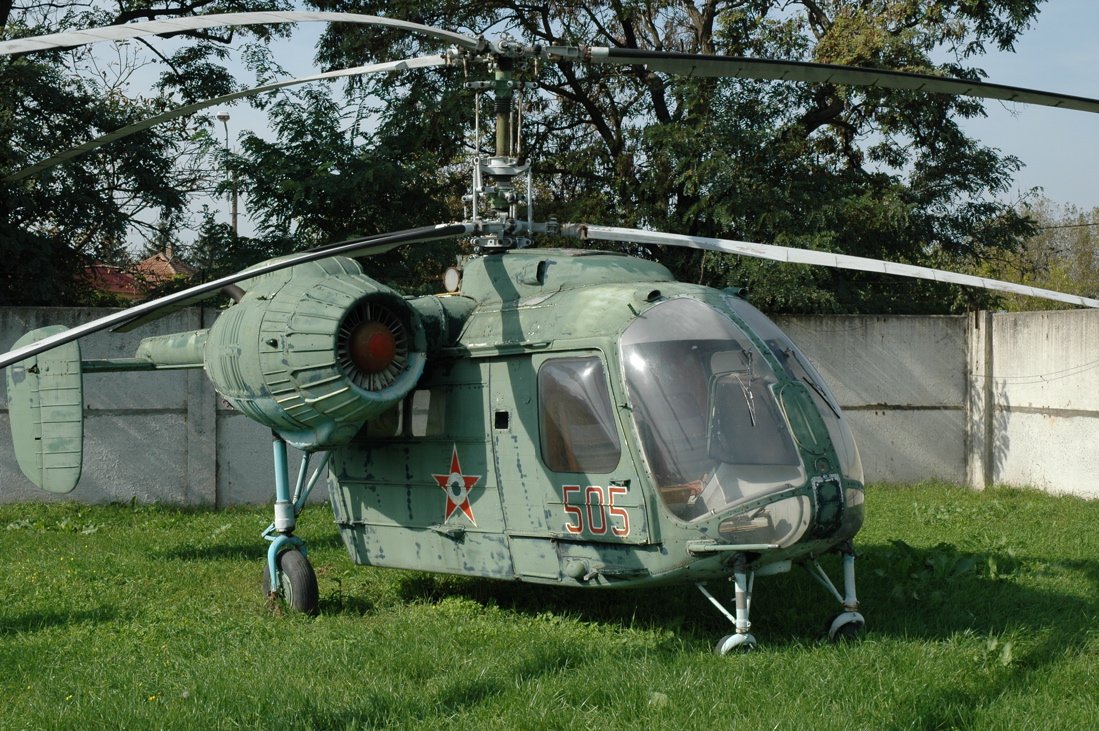
The Ka-126 emerged from Kamov's efforts to modernize their successful Ka-26 light helicopter by replacing its twin piston engines with a single turboshaft powerplant. Nikolai Kamov's design team removed the engine pods from the Ka-26's stub wings and mounted a single TVO-100 turboshaft engine atop the fuselage, while incorporating modified rotor blades and an entirely new fuel system. The helicopter retained Kamov's signature contrarotating coaxial three-blade rotors, eliminating the need for a tail rotor and allowing for a more compact design.
Innovative features included hingeless rotor heads constructed from titanium and composite materials, along with GFRP/CFRP rotor blades equipped with electrothermal anti-icing systems. The powerplant drove the rotors through a three-stage planetary gearbox, providing smooth power transmission throughout the aircraft's operational envelope.
International Collaboration
The Ka-126 program represented a significant Soviet-Romanian partnership, formalized through an agreement signed in October 1985. This collaboration allowed Romania's Industria Aeronautică Română facility in Brașov to undertake series production while Kamov handled prototype development and testing. The Romanian variant utilized engines produced by Turbomecanica București rather than the original Omsk-manufactured powerplants.
The first Romanian-built Ka-126 successfully completed its maiden flight on December 22, 1988, just two months after the first Soviet preproduction aircraft took to the air on October 19, 1988.
Engine and Performance
Powering the Ka-126 was the TVO-100 turboshaft engine, manufactured by Omsk Engine Manufacturing Bureau. This powerplant delivered 522 kW (700 horsepower) and featured electronic-hydraulic two-channel control systems for enhanced reliability. The engine installation in the central streamline fairing provided excellent balance and allowed for the helicopter's modular payload system.
The aircraft achieved a maximum speed of 180 km/h with a more economical cruise speed of 160 km/h. Service ceiling reached 3,850 meters, while the climb rate of 6.6 meters per second provided respectable vertical performance. With internal fuel capacity of 800 liters supplemented by 320 liters of external tankage, the Ka-126 achieved a range of 713 kilometers.
Operational Versatility
The Ka-126's modular design allowed rapid reconfiguration for various missions. In passenger configuration, it accommodated six occupants in addition to one or two pilots. For cargo operations, the helicopter could handle 1,000 kg as a slung load or carry a 1,000-liter chemical hopper for agricultural spraying. Medical evacuation variants provided space for two stretchers plus two seated passengers and an attendant.
The aircraft featured non-retractable four-wheel oleo-pneumatic landing gear, with the rear wheels mounted on stub wings. Optional equipment included skis for snow operations or pontoons for water-based missions, expanding operational flexibility across diverse environments.
Limited Production and Cancellation
Total Ka-126 production reached approximately 21 aircraft before the program's cancellation around 1991. The Soviet Union contributed two prototypes and four preproduction units, while Romanian facilities completed 17 helicopters, including 15 series aircraft and two additional prototypes. This modest production run severely limited the type's commercial impact and prevented widespread adoption in civil utility roles.
The program's termination coincided with broader economic disruptions following the Soviet Union's collapse, which affected many collaborative aerospace projects between Soviet and Eastern European partners.
The Kamov Legacy
Kamov Design Bureau, originally founded by Nikolai Ilyich Kamov in 1929, had established itself as the Soviet Union's premier coaxial helicopter specialist. Kamov became chief designer at the Soviet Union's first rotorcraft factory in 1940, pioneering the coaxial rotor configuration that became the company's signature. Following various mergers, Kamov became part of Russian Helicopters, a subsidiary of Rostec, in 2007, while maintaining its distinct identity within the larger organization.
Legacy and Successor
Despite its limited production, the Ka-126 served as a crucial stepping stone in Kamov's evolution from piston to turbine power. The experience gained from this program directly contributed to the development of the Ka-226, which first flew in 1997. The Ka-226 addressed the Ka-126's limitations by incorporating twin engines for improved safety and reliability, ultimately achieving production numbers exceeding 269 aircraft by 2026.
No Ka-126 examples are known to remain in flying condition today, and the type's brief production run means few examples exist in museums or private collections. The aircraft's primary significance lies in advancing Kamov's coaxial turboshaft technology and demonstrating international aerospace cooperation during the final years of the Soviet era.