
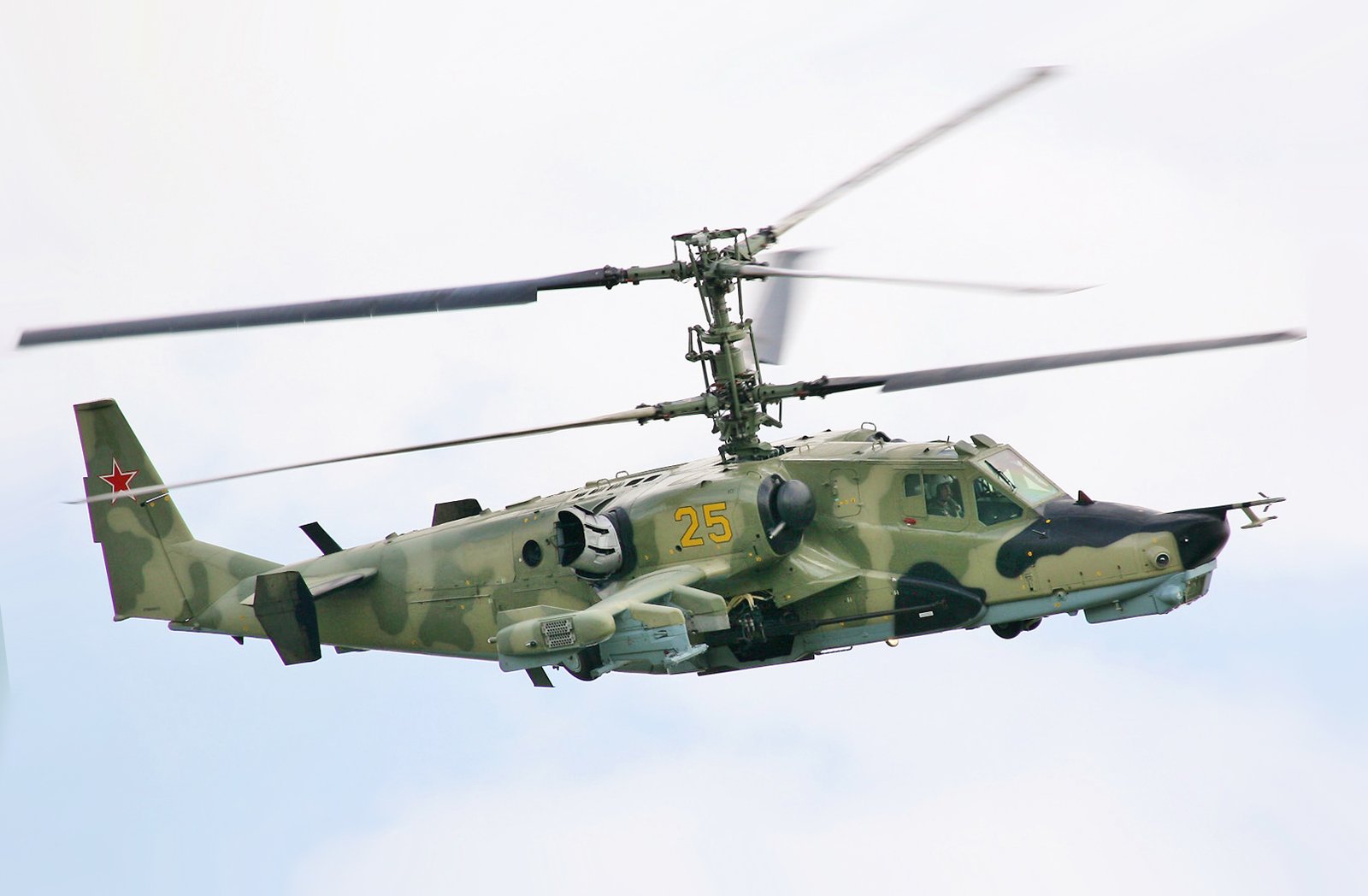
The Kamov Ka-50, known as the "Werewolf" or "Black Shark," is a Soviet-Russian attack helicopter that challenged conventional aviation paradigms as the world's first single-seat close-support helicopter. Developed by the Kamov Design Bureau, the aircraft originated as the V-80 prototype, which conducted its maiden flight on June 17, 1982, in Arsenyev. The design was selected for production in October 1986, with formal production orders following in December 1987. The aircraft was manufactured at the Progress Arsenyev Aviation Company (Sazykin Aviation Company Progress) in Primorsky Krai, Russia.
Technically, the Ka-50 is defined by its coaxial rotor system, consisting of two contra-rotating main rotors that eliminate the need for a tail rotor. This configuration provides a compact footprint and exceptional agility, allowing for a maximum vertical load factor of approximately 3.5 g. Furthermore, the Ka-50 is the first operational helicopter to incorporate a rescue ejection system, which jettisons the canopy and rotor blades before ejecting the pilot. To enable a single pilot to manage both flight and combat systems, the aircraft was designed with advanced digital fire-control automation.
Power is provided by two Klimov TV3-117VMA turboshaft engines, each producing 2,200 hp. This propulsion system allows the Ka-50 to reach a maximum speed of 310 km/h, with a combat range of 460 km and a ferry range of 1,160 km. The aircraft is heavily armed, capable of carrying 2,000 to 2,300 kg of weaponry on its stub wings. Its standard armament includes a 30 mm 2A42 cannon with a muzzle velocity of 980 m/s and an effective range of 4 km. Additionally, it can deploy up to 12 9A4172 "Vikhr" anti-tank missiles, which can penetrate up to 900 mm of armor, as well as S-8 or S-13 rockets and air-to-air missiles such as the R-73 or Igla.
Adopted by the Russian Army in 1995, the Ka-50 saw limited operational employment. Three units were deployed to Mozdok in 1999 for the Second Chechen War, with the first recorded firing of weapons against guerrilla forces occurring on January 6, 2001. While the Ka-50 was produced in very small numbers—estimated between 12 and 15 airframes—it served as the technological foundation for the two-seat Ka-52 "Alligator," which became the primary production attack helicopter for Russian forces. Today, the Kamov design organization continues to operate as part of the Russian Helicopters holding group.