
Development Origins
The Ka-52 emerged from the troubled history of its predecessor, the single-seat Ka-50 Black Shark. When the original V-80 prototype lost a flyoff competition to the Mi-28 in 1986, political influence within the Soviet Ministry of Defense secured production orders despite the aircraft's inferior performance. This setback drove Kamov engineers to completely reimagine their attack helicopter concept, leading to the twin-seat Ka-52 design that would address the operational shortcomings of the single-pilot configuration.
Construction of the first Ka-52 airframe began in mid-1996, with the completed prototype rolling out in December of that year. Test pilots Aleksandr Smirnov and Dmitriy Titov took the helicopter aloft for its maiden flight on June 25, 1997, marking the beginning of a decade-long development process that would transform Russian attack aviation.
Design Innovation
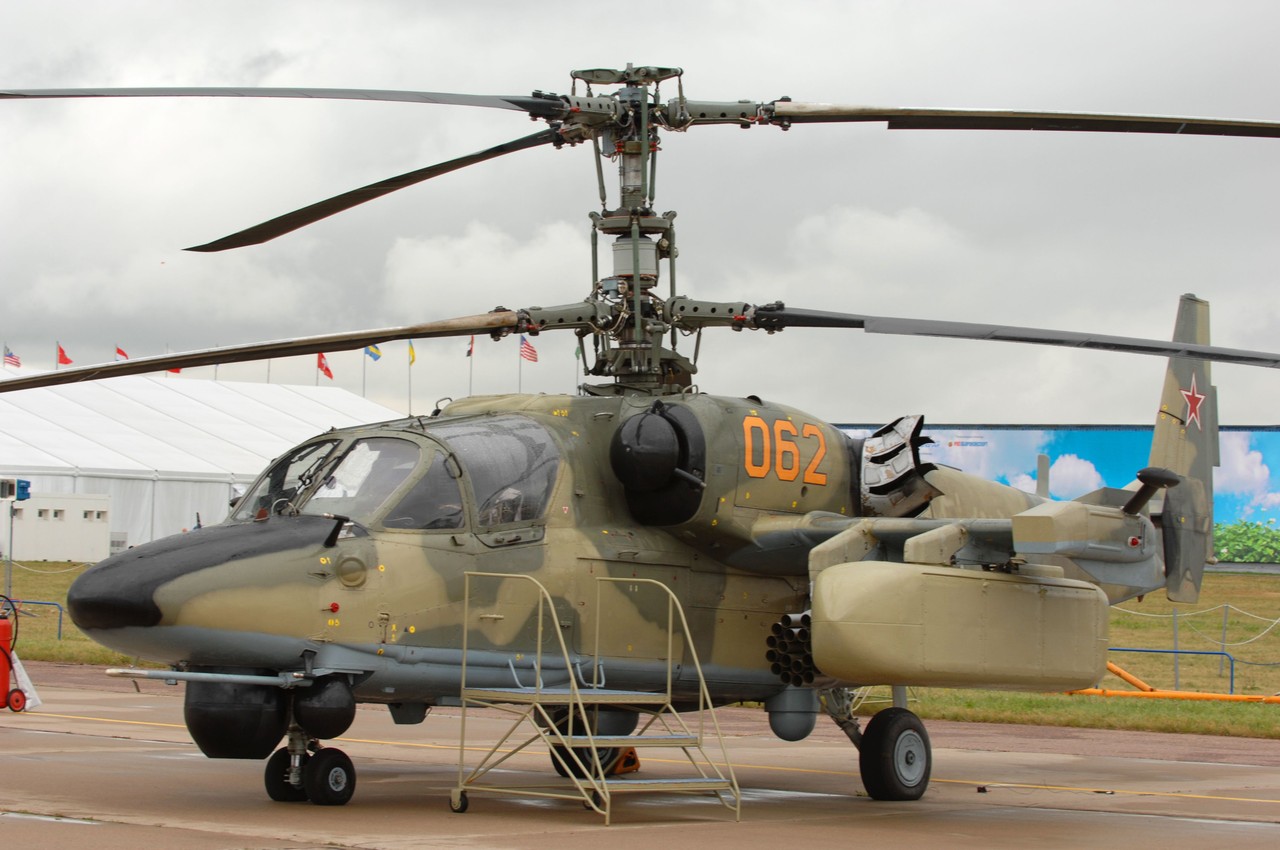
The Ka-52's most distinctive feature remains its side-by-side cockpit arrangement, a departure from the tandem seating common in Western attack helicopters. This configuration allows both pilots to share operational duties more effectively, with one focusing on flying while the other manages weapons systems and reconnaissance equipment. To accommodate the wider fuselage while maintaining performance equivalent to the Ka-50, engineers reduced cockpit armor thickness and ammunition capacity while developing the more powerful VK-2500 engine.
The coaxial rotor system, inherited from decades of Kamov design philosophy, eliminates the need for a tail rotor and provides exceptional maneuverability in confined spaces. This design allows the Ka-52 to perform combat operations in all weather conditions, day or night, making it particularly valuable for special missions requiring precise positioning.
Manufacturing and Production
Serial production commenced in October 2008 at the Progress Arsenyev Aviation plant in Primorsky Territory, located in Russia's Far East. This facility, part of the Rostec State Corporation through Russian Helicopters holding company, became the sole source for Ka-52 manufacturing. By 2008, the design had evolved sufficiently to warrant a new product code, izdeliye 826, reflecting numerous improvements over the original prototype.
Russian military procurement followed an aggressive timeline, with orders exceeding 140 helicopters by 2011. In August of that year, Oboronprom and Russian Helicopters signed a comprehensive contract for 140 Ka-52s destined for the Armed Forces. The Russian Defense Ministry's appetite for the platform continued growing, with requests for an additional 114 helicopters under the 2018-2027 State Armament Program.
Military Service
The Ka-52 achieved operational status in May 2011 following successful completion of state acceptance trials. The 575th Army Aviation Base at Chernikovka in the Russian Far East became the first operational unit to receive the new helicopters, taking delivery of four aircraft on May 19, 2011. This milestone marked the beginning of the Ka-52's replacement of aging Ka-50 Black Shark helicopters that had seen combat in Chechnya.
Training operations centered at the 344th Combat Training & Aircrew Conversion Centre in Torzhok, which received three pre-production Ka-52s in December 2010. This facility became responsible for converting pilots from other helicopter types to the unique characteristics of coaxial rotor operations and the Ka-52's advanced mission systems.
Naval Aviation
Recognizing the potential for shipboard operations, Kamov developed the Ka-52K variant specifically for naval aviation. First revealed at the 49th Paris Air Show on June 20, 2011, this version incorporated modifications necessary for maritime operations. Construction of Ka-52K prototypes began on August 7, 2012, with the aircraft designated for operations aboard Russia's planned amphibious assault ships and the aircraft carrier Admiral Kuznetsov.
Export Efforts
International interest in the Ka-52 led to several export campaigns, though with limited success. South Korea evaluated a specialized export variant featuring French, Belgian, and Israeli avionics systems tailored to customer specifications. Korean pilots participated in demonstration flights including live-fire exercises, but no orders materialized. China similarly evaluated the platform but preferred acquiring manufacturing licenses rather than purchasing completed aircraft.
Technical Specifications
The Ka-52's twin Klimov VK-2500 engines provide exceptional power-to-weight ratio, enabling a maximum takeoff weight of 11,900 kilograms while maintaining a service ceiling of 5,500 meters. The helicopter's 14.5-meter rotor diameter and overall length of 16 meters create a substantial platform capable of carrying diverse weapon loads while maintaining a climb rate of 13.2 meters per second.
With a range of 1,200 kilometers and maximum speed of 310 kilometers per hour, the Ka-52 possesses the endurance and performance necessary for extended combat operations. The NATO reporting name Hokum-B distinguishes it from the earlier Ka-50 Hokum-A, while the naval variant carries the designation Hokum-B Mod.
Operational Legacy
The Ka-52 represents the culmination of Russian attack helicopter development, combining lessons learned from decades of coaxial rotor experience with modern avionics and weapons systems. Its continued production into the 2020s demonstrates the platform's value to Russian military aviation, while the development of naval variants shows Kamov's commitment to expanding the aircraft's operational envelope. As Russia's premier attack helicopter, the Ka-52 Alligator stands as a testament to the evolution of rotorcraft design and the persistence of innovative engineering solutions.