
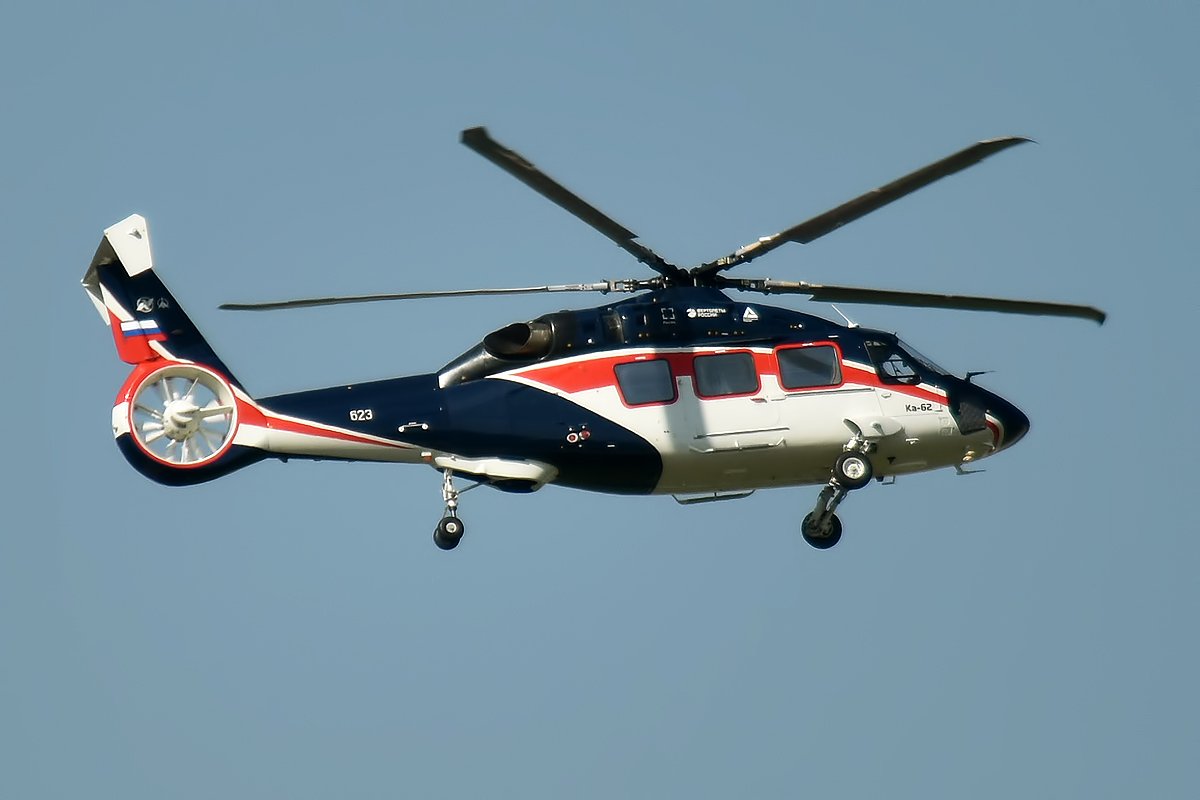
Development and Design Philosophy
The Ka-62 emerged from a 1992 program to create a civilian variant of Kamov's military Ka-60 transport helicopter. The Kamov design bureau, founded in 1948 by Nikolai Kamov and integrated into Russian Helicopters in 2007, approached this project with their hallmark coaxial rotor philosophy. This configuration provides enhanced maneuverability and eliminates the complexity and vulnerability of tail rotors, a design principle that has distinguished Kamov aircraft for over seven decades.
Development proved lengthy and challenging. An initial prototype begun in 1990 was never completed, and the program languished until renewed focus in the 2010s. A static test article was displayed in August 2013, signaling serious commitment to the project. The Russian government allocated 62 million rubles for development and 51 million rubles for production launch between 2002 and 2010, demonstrating state backing for the civilian helicopter initiative.
Technical Innovation and Performance
The Ka-62's powerplant represents a significant departure from traditional Russian helicopter engines. Two Safran Ardiden 3G turboshaft engines, each rated at 1,776 shaft horsepower with maximum output reaching 1,941 shaft horsepower, provide substantial power for the aircraft's 6-tonne maximum takeoff weight. This French engine selection reflected pragmatic engineering decisions prioritizing performance and international certification prospects over domestic sourcing.
The aircraft incorporates extensive composite materials in its construction, modernizing the basic Ka-60 airframe with larger windows, revised cabin layouts, and contemporary avionics systems. Design objectives emphasized versatility, with configurations supporting passenger transport, medical evacuation, cargo operations with external hooks and winches, and specialized missions requiring anti-icing systems.
Flight Testing and Certification
Flight testing began with the first hover on April 28, 2016, followed by the maiden flight in May 2017 lasting 15 minutes. Three flying prototypes accumulated 434 test flights totaling over 700 hours, demonstrating the aircraft's basic airworthiness and performance characteristics. This extensive testing program led to Russian certification by Rosaviatsia on November 30, 2021, marking a significant milestone for the program.
The certification process targeted not only Russian approval but also European Aviation Safety Agency validation planned for 2020, reflecting export ambitions for Latin American and Southwest Asian markets. A Brazilian customer placed a firm order in late 2015, indicating international confidence in the aircraft's commercial potential.
Manufacturing and Production Challenges
Progress Arsenyev Aviation Company in Russia's Far East was designated as the primary production facility, with potential involvement from Kumertau Aviation Production Association and RSK "MiG" subsidiaries. Initial production plans called for modest but growing output: six units in 2022, eight in 2023, and ten in 2024, eventually reaching 35 units annually at peak production.
These ambitious plans encountered severe disruption in late 2022 when Western sanctions targeting Russia's aerospace sector effectively halted the program. Approximately 60 percent of the Ka-62's components, including the critical Safran engines, originated from foreign suppliers now prohibited from conducting business with Russian manufacturers. This supply chain disruption forced production suspension despite successful certification.
Market Position and Intended Service
The Ka-62 was positioned to compete in the medium helicopter market with its 14-passenger capacity and multi-role versatility. Planned customers included the Russian Ministry of Defence with an order for 16 units, plus 12 units destined for South American civilian operators. The aircraft's coaxial rotor system offered unique advantages in confined area operations and adverse weather conditions compared to conventional single-rotor competitors.
Capability planning emphasized modularity, with interchangeable mission equipment supporting passenger transport, cargo operations, medical evacuation with stretcher configurations, and search-and-rescue missions. This flexibility aimed to maximize utilization rates for commercial operators across diverse mission profiles.
Current Status and Future Prospects
As of late 2023, no serial production aircraft have been delivered despite initial certification success. The three flying prototypes remain the only completed examples, with their current operational status unclear following program suspension. Design work continues to identify Russian-sourced substitutes for sanctioned foreign components, particularly the Safran engines which represent the most significant technical challenge.
The Ka-62 represents both the potential and limitations of Russia's civilian aerospace ambitions. While demonstrating technical competence in modern helicopter design and successful navigation of international certification processes, the program's dependence on foreign suppliers ultimately proved its vulnerability to geopolitical tensions. Whether redesigned variants using purely domestic components can achieve equivalent performance and certification remains an open question for Russia's helicopter industry.