
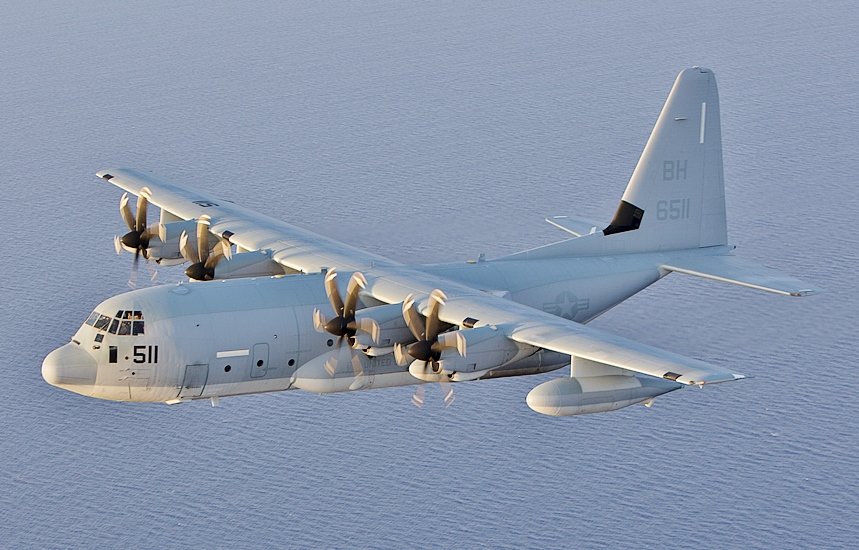
The Lockheed KC-130 is the specialized aerial refueling tanker variant of the C-130 Hercules family, a lineage of tactical transport aircraft that stands as the longest continuously produced military aircraft in history. Developed primarily for the United States Marine Corps (USMC), the KC-130 incorporates probe-and-drogue refueling systems via underwing pods and often utilizes a removable fuselage fuel tank to increase offload capacity. The broader C-130 family, which began with prototypes contracted on July 2, 1951, has seen over 2,700 aircraft produced, with the 2,700th unit—a KC-130J—delivered in June 2024.
The aircraft was designed under the leadership of Willis M. Hawkins, head of Lockheed’s Advanced Design department, with a team including Art Flock, Dick Pulver, and Bill Statler. The YC-130 prototype first flew on August 23, 1954, from Burbank, California. The design features a high-wing configuration, a large rear cargo ramp for vehicle and troop loading, and robust high-flotation landing gear for short-field performance. While prototypes were built in Burbank, serial production shifted to the Lockheed-Georgia Company (now Lockheed Martin) facility in Marietta, Georgia.
Powerplant evolution defines the transition from legacy models to the modern fleet. Legacy variants, such as the KC-130F, H, R, and T, utilized Allison T56 turboprop engines, with later versions producing approximately 4,591 shp. The contemporary KC-130J is powered by four Rolls-Royce AE 2100D3 turboprops, delivering between 4,637 and 4,700 shp each, paired with six-bladed Dowty composite scimitar propellers for improved efficiency.
In military service, the KC-130 has been integral to USMC Marine Aerial Refueler Transport Squadrons (VMGR). The KC-130F entered service in 1962, followed by the KC-130R in 1976 and the KC-130T in 1983. The KC-130J achieved initial operational capability around 2005. These aircraft saw extensive action during the Vietnam War, the Gulf War, and operations in Iraq and Afghanistan. A notable historical milestone occurred in October–November 1963, when a KC-130F, flown by Lt. James H. Flatley III, performed 29 touch-and-go landings and 21 unarrested full-stop landings aboard the USS Forrestal, becoming the heaviest aircraft to operate from a carrier deck at that time.
Today, the USMC operates an all-KC-130J fleet, having retired legacy variants by 2021. Current operational squadrons include VMGR-152, VMGR-153, VMGR-252, VMGR-352, and the reserve VMGR-234. The KC-130F used in the 1963 carrier trials is preserved at the National Naval Aviation Museum in Pensacola, Florida.