
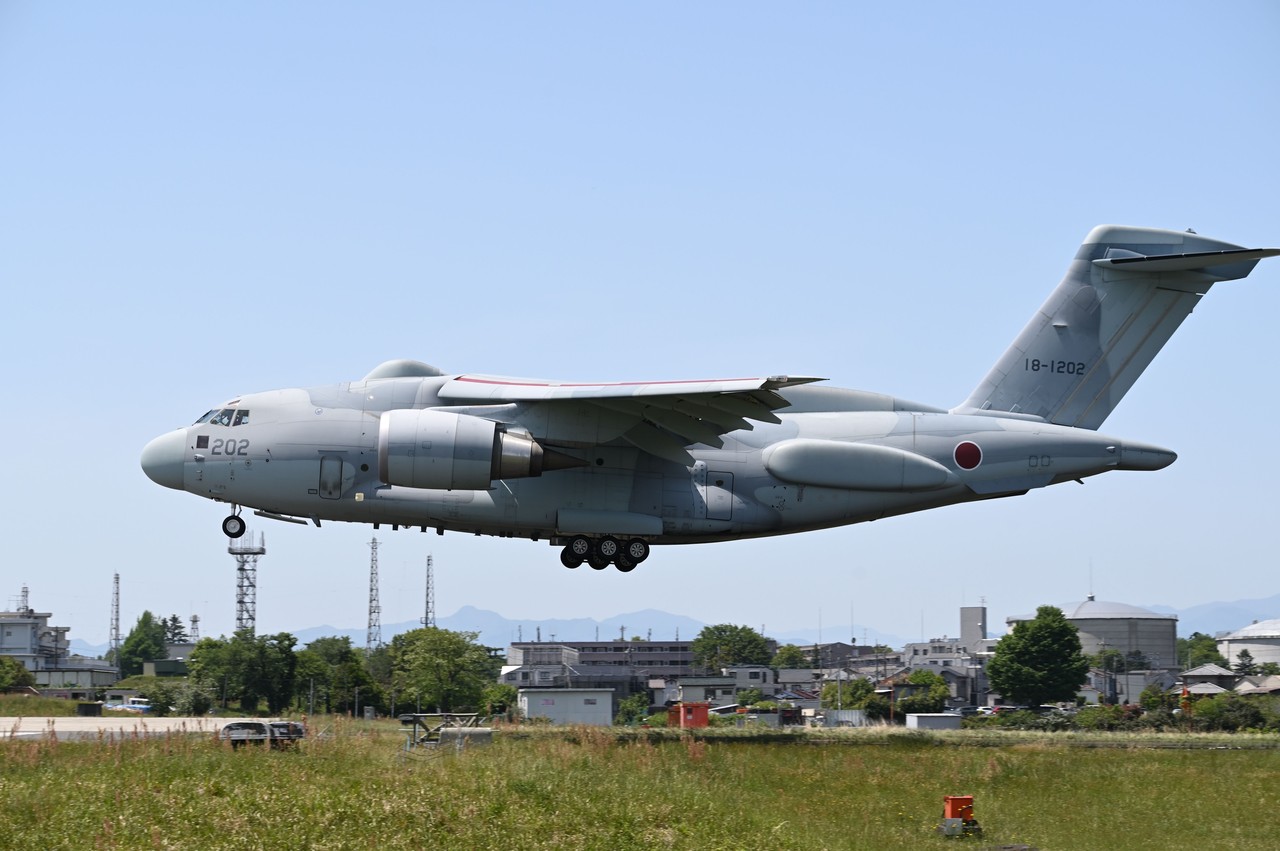
Service History
The C-2 officially entered Japan Air Self-Defense Force service in March 2017, marking a significant milestone in Japanese military aviation. By June 2019, at least 11 aircraft had been produced, with 7 operational units serving JASDF squadrons and 60 total aircraft on order. The transport replaced both the aging Kawasaki C-1, which had served since the 1970s, and supplemented Lockheed C-130 Hercules aircraft dating to the 1950s era. This modernization program addressed critical gaps in Japan's strategic airlift capacity amid increasing regional security challenges.
The aircraft made its international debut at the Dubai Airshow in 2017, followed by appearances at the Paris Air Show in 2019. New Zealand evaluated the C-2 in 2018 as part of their transport aircraft modernization program, demonstrating international interest in Japanese aerospace capabilities.
The Manufacturer
Kawasaki Heavy Industries traces its aerospace heritage to the pre-World War II Kawasaki Aircraft Company, established at Kakamigahara Works. The company demonstrated early mass production capabilities with the Ki-10 Type 95 fighter, manufacturing approximately 580 units of Types 1 and 2 by late 1938. Following postwar reconstruction, Kawasaki continued aircraft development with programs like the P-2J maritime patrol aircraft, completing 82 units by 1979.
Today's Kawasaki Heavy Industries, Ltd. operates as a major aerospace contractor, producing components for Boeing's 777X program while maintaining facilities including the KMM Lincoln Plant in the United States. The Ministry of Defense selected Kawasaki as prime contractor for the C-X program in November 2001, recognizing their technical capabilities and domestic industrial base requirements.
Engine & Technical Innovation
Powering the C-2 are two General Electric CF6-80C2K1F turbofan engines, each generating 59,740 pounds of thrust. These high-bypass engines enable cruise speeds reaching 890 kilometers per hour with a service ceiling of 12,200 meters, representing substantial improvements over the C-1's performance envelope. The powerplant selection reflected Japanese requirements for proven reliability combined with international parts availability.
Design innovations focused on reducing crew workload through centralized cargo handling systems and advanced low-altitude flight management capabilities. Engineers incorporated short and unprepared runway performance requirements, essential for Japan's diverse operational environments. The C-2 shares numerous components with the Kawasaki P-1 maritime patrol aircraft, achieving significant cost efficiencies through common systems and maintenance procedures.
Development Timeline
Development commenced in fiscal year 2001, with prototype construction beginning at Kawasaki's Gifu Works facility. The first XC-2 prototype, designated 08-1201, achieved completion in March 2010, followed by the second prototype 18-1202 in March 2011. Initial flight testing validated basic performance parameters and system integration.
Mass production authorization came with delivery of the first production aircraft, serial 68-1203, on June 30, 2016. This milestone represented nearly 15 years from initial program launch to operational capability, reflecting the complexity of developing Japan's first indigenous jet transport design.
Operational Variants
Beyond the standard transport configuration, Japanese planners developed specialized variants addressing evolving mission requirements. The RC-2 reconnaissance variant converts the second prototype for electronic intelligence gathering, featuring specialized sensor equipment. Military planners anticipate a standoff jamming variant entering service around 2025, expanding the platform's electronic warfare capabilities.
A proposed C-2 Commercial variant remains in planning stages, targeting potential civilian cargo and passenger markets. However, no firm development timeline exists for commercial certification and production.
Strategic Significance
The C-2 program demonstrates Japan's commitment to indigenous aerospace capabilities amid regional security challenges, particularly concerning Chinese military expansion. Successfully developing a domestic transport aircraft reduces dependence on foreign suppliers while supporting Japan's defense industrial base. The aircraft's 6,500-kilometer range enables operations throughout the Western Pacific region, supporting humanitarian missions and alliance operations.
With production continuing at Gifu Works, the C-2 represents a foundation for future Japanese transport aircraft development. Its technological achievements in avionics, systems integration, and manufacturing processes position Kawasaki Heavy Industries among international military transport producers, marking Japan's emergence as a comprehensive aerospace manufacturing nation.