
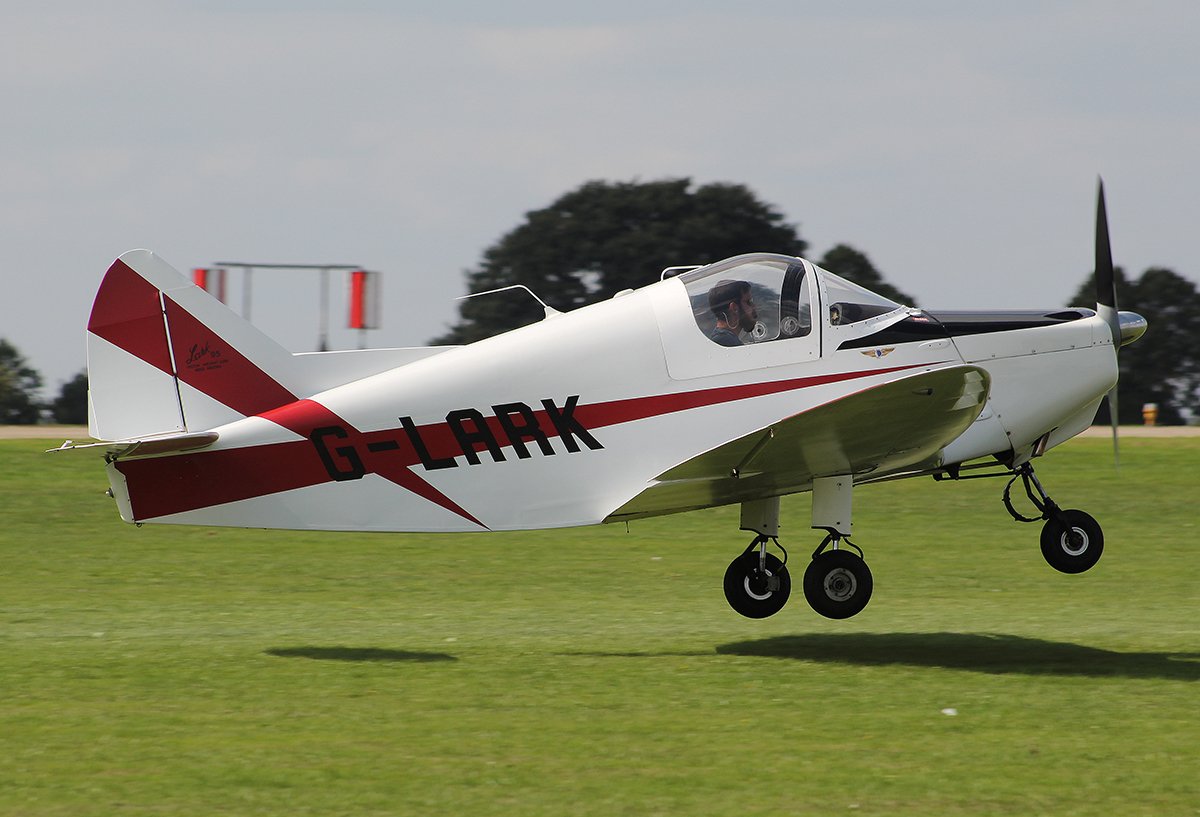
Design and Development
The Keleher JK-1 Lark was designed in the early 1960s by an individual identified as Keleher. The aircraft was conceived as a single-seat sport plane optimized for aerobatics, specifically described as being intended for "gentlemen's aerobatics." A key evolution of the design occurred in 1963 with the introduction of the Lark 1B. Plans for this revised version were subsequently offered for sale starting in 1968 and remained available through the 1980s.
Technically, the Lark is characterized by a relatively uncommon strut-braced mid-wing monoplane configuration. Its structural composition is mixed: the fuselage and empennage are constructed from welded steel tubing, while the wings utilize wooden spars and ribs. Both the fuselage and wings are finished with fabric covering. The aircraft employs a fixed tailwheel undercarriage, which is standard for its role as a sport taildragger.
Technical Specifications and Performance
As a plans-built aircraft, the Lark's powerplant varies by individual build. While typical design specifications cite various 65 hp flat-4 piston engines, actual installations have ranged from 65 to 100 hp. Documented examples include the use of the Continental O-200, a 100 hp four-cylinder air-cooled flat piston engine.
Performance figures vary based on the engine used. General characteristics for the type include a wingspan of 23 feet, a length of 17 feet, and a height of 5 feet 5 inches. The wing area is 81 square feet, with an empty weight of approximately 550 to 555 lb and a gross weight of 855 lb. Depending on the configuration, the Lark can achieve a maximum speed between 132 and 135 mph, with a cruise speed of 122 mph and a stall speed of 55 mph. Its rate of climb is estimated between 900 and 1,000 ft/min, and it has a service ceiling of 19,500 feet. Fuel capacity is listed at 12 U.S. gallons, providing a range of 300 miles.
Production and Legacy
Because the Lark was sold as a set of plans, there was no centralized factory production or formal production run. Consequently, the total number of aircraft completed worldwide is unknown. However, the design gained recognition within the American homebuilt movement; notably, a Lark 1B built by L. C. Koetkemeyer won the "Outstanding Workmanship" award at the 1968 EAA Fly-In. By 2008, records indicated that six examples remained registered in the United States.