
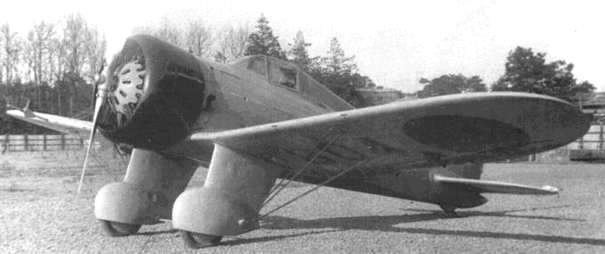
Design and Development
The Nakajima Ki-11 was conceived during a transitional period in aviation history when air forces were shifting from traditional biplane designs to more streamlined monoplanes. Developed by the Nakajima Aircraft Company in Japan, the project was led by Hideo Itokawa and his design team. The aircraft first took to the skies in 1935, serving as a modern fighter proposal intended to meet the evolving requirements of the Japanese military.
Technically, the Ki-11 was configured as a single-seat fighter. Its propulsion was provided by a Nakajima Kotobuki 2, an air-cooled radial piston engine manufactured by Nakajima. While the aircraft demonstrated the potential of the low-wing monoplane layout, it remained an experimental effort rather than a finalized weapon system. The design process for the Ki-11 was instrumental in shaping the engineering philosophy that Nakajima would apply to subsequent projects.
Production and Evaluation
Despite its role in advancing fighter technology, the Ki-11 never entered series production. The Nakajima Aircraft Company produced only a small number of prototypes and evaluation airframes. Because it remained in the prototype and evaluation phase, there is no confirmed total production count available in historical records. The aircraft was primarily used for competitive testing and evaluation against other fighter requirements of the era.
Service History and Legacy
The Ki-11 did not enter operational service and, consequently, saw no frontline military action. It was not associated with any combat units or wartime sorties. Instead, its primary military role was limited to the testing phase, where it competed for Army fighter contracts. Ultimately, the Ki-11 lost the competition that led to the adoption of the Ki-27.
Though it was not mass-produced, the Ki-11 is historically significant for its influence on the evolution of Japanese fighter development. It provided the necessary design experience that eventually led to the successful Ki-27 family. Today, there are no confirmed surviving airframes or museum examples of the Ki-11, but it remains a notable example of Japan's prewar aeronautical ambition.