
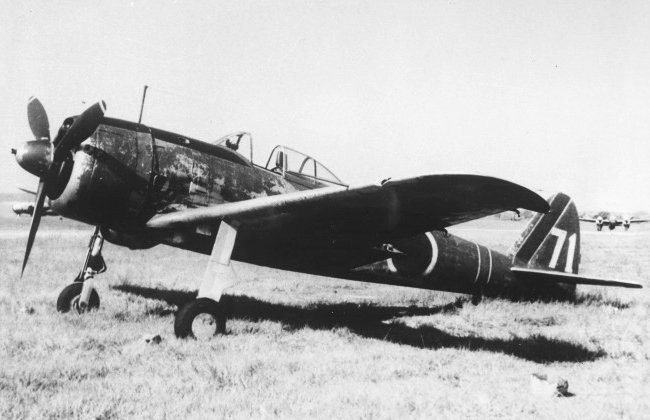
The Nakajima Ki-43, known by the Allied code name "Oscar," was the most important fighter of the Imperial Japanese Army Air Force (IJAAF) during World War II. Developed to replace the Ki-27, the aircraft originated from specifications issued to Nakajima Hikoki K.K. in December 1937. Full-scale production began in April 1941, and the aircraft remained in production until August 1945. A total of 5,919 units were manufactured by Nakajima, primarily at the Ōta plant, and Tachikawa, making it the most-produced Japanese aircraft of the war after the Mitsubishi Zero.
Designed as a light, tidy airframe to maximize agility, the Ki-43 was perhaps the most maneuverable fighter of the conflict. This performance was achieved through a low gross weight and the implementation of specialized "butterfly flaps" (combat flaps) that increased lift and decreased the turning radius during engagements. However, these performance gains came at the cost of survivability; the aircraft lacked armored protection and self-sealing fuel tanks. Early versions, such as the Ki-43-I which entered service in February 1941, were lightly armed with two 7.7 mm synchronized machine guns. Later variants, specifically the Ki-43-IIb introduced in the summer of 1943, upgraded this armament to two 12.7 mm Ho-103 heavy machine guns and added the capacity to carry up to 500 kg of bombs.
Powerplants evolved across the production run. The Ki-43-II and early Ki-43-III utilized the 1,300 hp Nakajima Ha-115 14-cylinder air-cooled radial engine. In April 1944, a more powerful variant, the Ki-43-III, was introduced featuring the Nakajima Ha-115-II engine. Representative performance figures for the type include a maximum speed of 330 mph, a service ceiling of 36,700 feet, and a range of 1,090 miles.
The Hayabusa saw extensive combat across all Army theaters, including China, Burma, India, the Philippines, the Dutch East Indies, and the Japanese home islands. While early in the war it surprised Allied pilots with its agility, it eventually lost its advantage as newer Allied fighters appeared. In the final stages of the war, many Ki-43s were deployed in kamikaze attacks over Okinawa and Formosa. Post-war, some abandoned aircraft were utilized by the Indonesian Air Force and French units in Vietnam. Today, the aircraft is preserved in several institutions, including the Smithsonian National Air and Space Museum and the Museum of Flight, the latter of which displays a Ki-43-IIIa reproduction.