
Service History
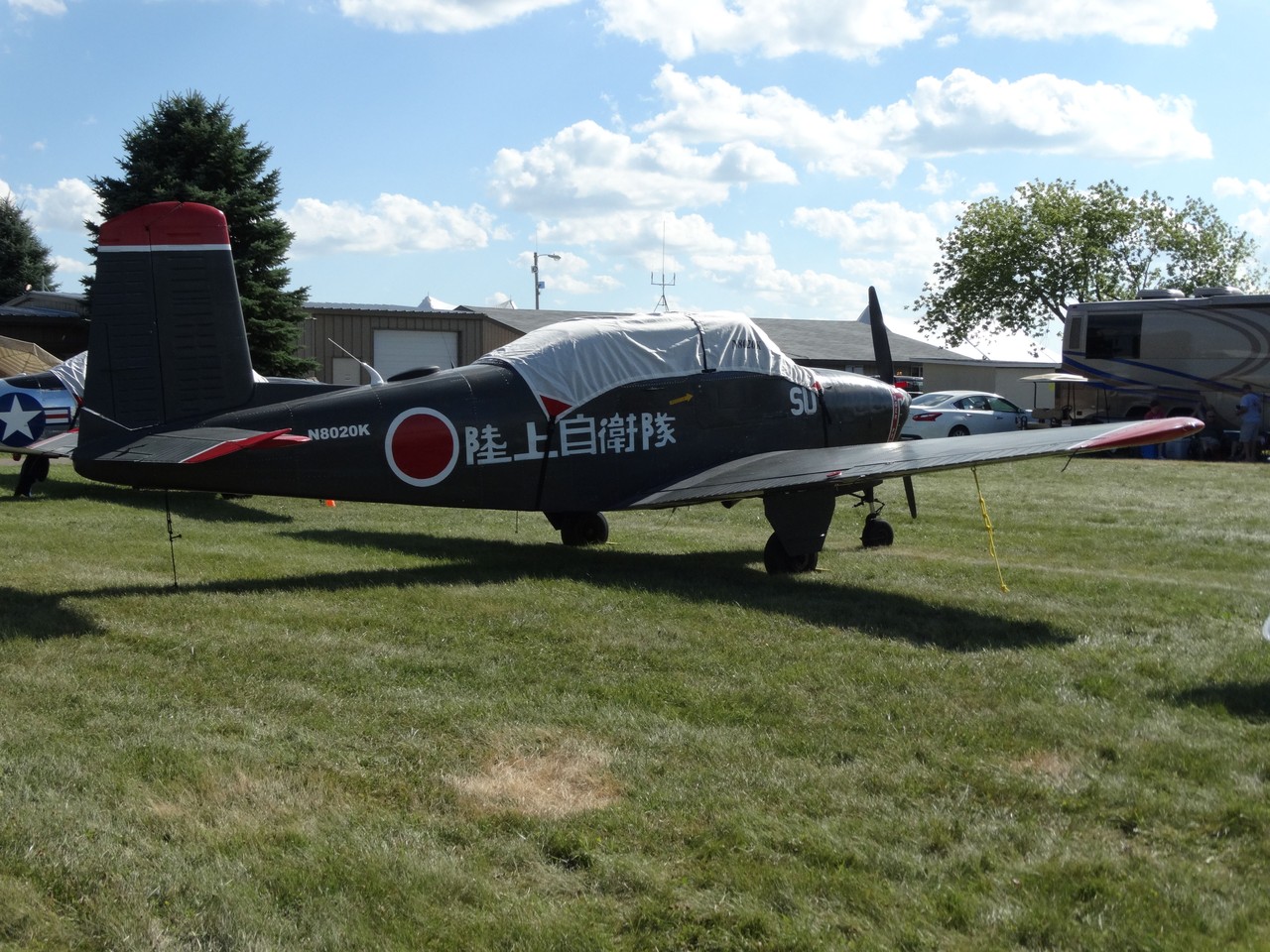
The KM-2 established itself as the backbone of Japanese military pilot training during the 1960s and 1970s. The Japan Maritime Self-Defense Force received its first deliveries in 1962, replacing older training aircraft with this modern side-by-side configuration trainer. In 1975, the Japan Air Self-Defense Force selected the improved KM-2B variant, demonstrating the aircraft's versatility across Japan's military aviation branches.
The aircraft served exclusively in peacetime training roles, with no combat deployment or wartime service. Its primary mission focused on basic flight training for naval aviators, providing a stable platform for students to develop fundamental flying skills before advancing to more complex aircraft.
The Manufacturer
Fuji Heavy Industries developed the KM-2 as part of Japan's postwar aviation renaissance. Founded in 1955 from the remnants of the wartime Nakajima Aircraft Company, Fuji Heavy Industries emerged as a significant player in Japan's rebuilt aerospace industry. The company's aviation division operated for over six decades before merging into Subaru Corporation in 2017, which continues aerospace operations today.
The KM-2 represented Fuji's approach to practical aircraft development, focusing on proven designs adapted for specific Japanese requirements rather than revolutionary innovation. This philosophy proved successful, leading to a family of trainers that would serve Japanese forces for decades.
Engine & Technical Details
Early KM-2 and KM-2B models utilized reliable Lycoming piston engines, providing adequate power for primary training missions. The aircraft's design emphasized simplicity and cost-effective operation, crucial factors for a training platform expected to accumulate high flight hours with student pilots.
The two-seat side-by-side configuration allowed effective communication between instructor and student, a significant advantage over tandem arrangements for basic training. This layout facilitated better instruction during critical learning phases, contributing to the aircraft's effectiveness as a primary trainer.
Fuji engineers later explored turboprop propulsion with the KM-2D prototype, which first flew on June 28, 1984, powered by an Allison Model 250 turboprop engine producing 317 shaft horsepower. This variant received certification on February 14, 1985, demonstrating improved performance characteristics that would influence future trainer development.
Production & Variants
Production of the KM-2B variant totaled approximately 60 aircraft beginning in 1978. While exact production figures for the original KM-2 remain unclear in available records, the aircraft established a foundation for subsequent developments that would prove more significant than the initial production numbers might suggest.
The KM-2 spawned several important derivatives, most notably the turboprop-powered variants that evolved into the T-5 (KM-2Kai) and T-7 (KM-2F) series. These successors incorporated lessons learned from KM-2 operations while offering enhanced performance through modern powerplants.
Legacy and Current Status
No original KM-2 aircraft are confirmed to remain in active service, having been retired from Japanese military operations. The type's significance lies not in longevity but in its role as a stepping stone in Japan's postwar trainer aircraft development.
The KM-2's influence extended through its derivatives, particularly the T-5, which served the JMSDF's 201st Air Training Squadron at Ozuki Air Field until recently. A total of 66 T-5 aircraft plus one prototype were produced between 1988 and 2015, while 50 T-7 variants served the JASDF until retirement around 2008.
The aircraft bridged Japan's transition from piston-engine to turboprop trainer technology, representing a crucial phase in the nation's aerospace industry development. While the KM-2 itself had a relatively modest production run, its design foundation supported nearly two decades of Japanese military pilot training through its more numerous successors.
Today, the KM-2's legacy lives on through the experience gained by Japanese aerospace engineers and the pilots who learned to fly in these reliable trainers. The aircraft exemplified the practical approach that characterized much of Japan's postwar aviation development, prioritizing proven reliability over innovation for its own sake.