
Service History
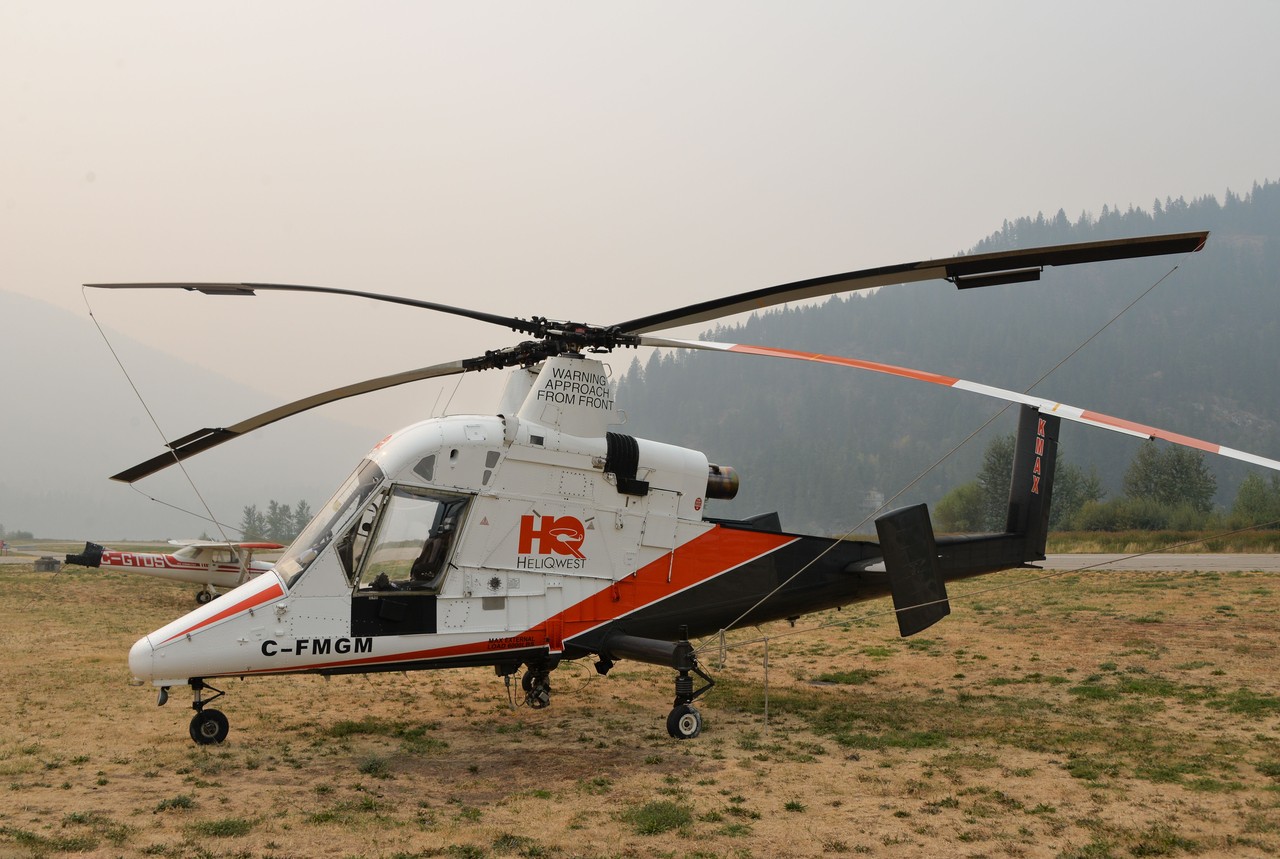
The K-Max carved out a specialized niche in commercial aviation as an aerial truck for demanding heavy-lift operations. Unlike conventional helicopters adapted for cargo work, the K-Max was purpose-built from the ground up for repetitive medium-tonnage transport missions. Its unique intermeshing rotor configuration eliminated the need for a tail rotor, allowing all engine power to contribute to lift. The aircraft found its primary market among logging companies, construction firms, and firefighting organizations requiring precise placement of heavy external loads.
Production peaked at six aircraft annually in 1996 at Kaman's Bloomfield facility. Notable early operators included Heliswiss, which took delivery of aircraft HB-XHJ in 1995. This aircraft later served with Rotex Helicopter AG, founded on April 1, 1997, by pilots Heinz Leibundgut and David Vogt specifically to exploit the K-Max's medium-lift capabilities. When production resumed in 2015 after a twelve-year hiatus, the first two new aircraft were delivered in May 2017 to Guangdong Juxiang General Aviation through Hong Kong distributor Lectern Aviation Supplies for forest firefighting operations in China.
Military Innovation
While the K-Max never saw traditional military service, it achieved unprecedented recognition as an unmanned cargo drone. Lockheed Martin converted several aircraft into CQ-24A autonomous variants for the U.S. Marine Corps. Two of these unmanned K-Max helicopters deployed to Afghanistan from 2011 to 2014, conducting autonomous resupply missions in combat zones without human pilots aboard. This groundbreaking application earned recognition from Time magazine as one of 2011's "50 Most Important Innovations."
The success of the unmanned trials led Kaman to announce the Titan variant in 2021, an enhanced drone version that could be retrofitted to existing airframes. The U.S. Navy also evaluated the manned K-Max for vertical replenishment operations, though it did not enter regular naval service.
The Manufacturer
Kaman Aerospace Corporation traced its origins to December 12, 1945, when Charles H. Kaman founded the company with just $2,000 and his revolutionary servo-flap controlled rotor invention. Starting as Kaman Aircraft Laboratory in his mother's garage in West Hartford, Connecticut, Kaman rapidly expanded after the successful first flight of the K-125 two-seater on January 15, 1947. The company became a leading helicopter manufacturer, with the K-Max representing the culmination of decades of intermeshing rotor development.
Production was split between Kaman's Bloomfield, Connecticut facility, which handled rotors, components, assembly, and flight testing, and Jacksonville, Florida, where fuselages were manufactured. The Carlyle Group acquired Kaman Corporation in 2021, but Kaman Aerospace continues operations today as part of the larger Kaman Corporation structure.
Engine and Technical Innovation
The K-Max's single Honeywell T53-17B turboshaft engine, derived from the proven T53 series that powered thousands of UH-1 Huey helicopters, provided the reliability essential for sling-load operations. During certification testing, the powerplant demonstrated capability at 110 percent of design power, ensuring adequate reserves for demanding lift missions.
The aircraft's most distinctive feature remained its intermeshing rotor system with 48-foot 3-inch diameter rotors. This synchropter configuration, combined with Charles Kaman's servo-flap control system, delivered exceptional lifting efficiency. The Vertical Reference Flight system allowed the single pilot unprecedented visibility of external loads during precision placement operations, addressing a critical limitation of conventional helicopters in cargo work.
Certification proceeded with remarkable speed, achieving FAA Part 27 type certificate approval on August 30, 1994, less than three years after first flight. Tiedown testing began November 2, 1993, validating the aircraft's structural integrity under heavy load conditions.
Performance Characteristics
The K-Max demonstrated a maximum speed of approximately 100 knots with a service ceiling exceeding 15,000 feet and operational range of 300 nautical miles when carrying sling loads. The aircraft's 42-foot overall length and 13-foot 8-inch height allowed operation from relatively confined sites while maintaining the lifting capacity that made it valuable for commercial operators.
Design refinements during production included evolution from flat to curved windscreen and incorporation of a dynamic horizontal stabilizer to improve aerodynamic efficiency during forward flight with external loads.
Production Legacy
Kaman's decision to terminate K-Max production on January 20, 2023, marked the end of a unique chapter in rotorcraft history. The modest production total of 60 aircraft over nearly three decades reflected the specialized nature of the heavy-lift market rather than any technical shortcomings. The company cited annual cost savings of approximately $25 million through production consolidation as the primary factor in the shutdown decision.
Approximately 15 to 20 K-Max helicopters remain active today, representing one of the more unusual success stories in modern aviation. The aircraft proved that specialized design could create viable market niches, even with limited production volumes. Its pioneering role in autonomous cargo operations established precedents that continue influencing unmanned aircraft development for both military and civilian applications.