
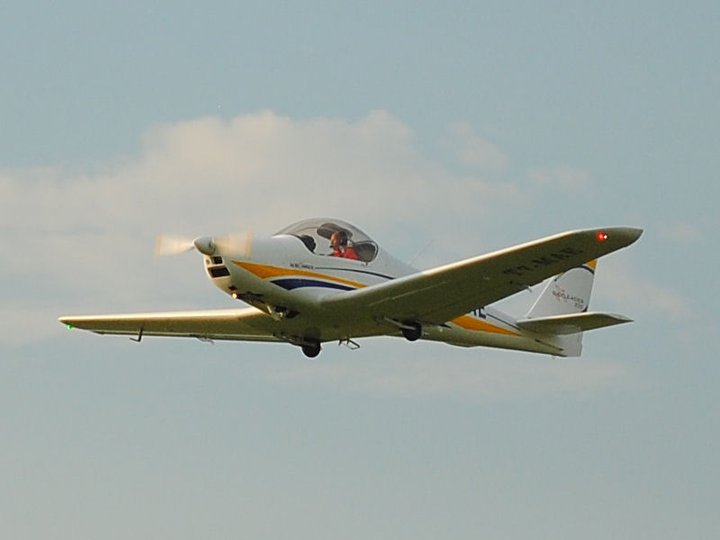
Design Heritage and Development
The Skyleader 400's origins trace back to early 1990s concepts at Brno Technical University's Institute of Aerospace Engineering, where engineers initially developed all-metal four-seat designs designated Z90/TP41 to replace Moravan's aging Z40 series. This academic foundation provided the technical groundwork for what would eventually become the ultra-light KP-2U Sova, first flown on May 26, 1996. The development team included former employees from Aero Holding Jihlavan, bringing substantial manufacturing experience to the project.
Design objectives emphasized practical performance characteristics often missing in ultralight aircraft: retractable landing gear suitable for grass and unpaved runways, cruise speeds exceeding 200 kilometers per hour, and low stall speeds achieved through Fowler flaps. The engineers chose an all-metal construction approach using thin duralumin sheets joined with blind rivets, featuring integral fuel tanks and a carbon fiber cockpit frame that elevated the design beyond typical ultralight standards.
Manufacturing Evolution
Jihlavan Airplanes s.r.o. assumed production responsibilities for the Skyleader family after acquiring the KP-2U Sova design from Kappa 77 a.s. in 1997, gaining full marketing rights following Kappa 77's insolvency in 2005. The company, named after the Czech city of Jihlava, formed as a direct successor in March 2005 and became a subsidiary of Skyleader Aircraft by 2008. Prior to aircraft manufacturing, the facility produced Airbus A320 doors and other aviation components, demonstrating existing aerospace manufacturing capabilities.
By 2024, the company operates as Zall Jihlavan Airplanes s.r.o., continuing production under the Skyleader trademark with support from Brno University of Technology's Institute of Aerospace Engineering. Production expanded internationally with licensed manufacturing beginning in Bulgaria in July 2015 and Tanzania in October 2023, indicating sustained global demand for the design.
Technical Specifications
The Skyleader 400 measures 7 meters in length with a 9.9-meter wingspan and stands 2.60 meters high. Empty weight totals 302 kilograms, while maximum takeoff weight reaches 450 kilograms, conforming to Light Sport Aircraft limitations. The two-spar wing design incorporates 6 degrees of dihedral angle and distinctive Küchemann wingtips, paired with a swept vertical stabilizer and rudder configuration.
Power typically comes from Rotax 912 series engines, particularly the 912 ULS variant, though Jabiru 2200 and 3300 engines serve as alternatives. The Austrian-manufactured Rotax 912, produced by Bombardier Rotax GmbH since approximately 1989, delivers 80 to 100 horsepower through a four-cylinder, liquid-cooled configuration. With over 50,000 units produced across all variants, the Rotax 912 series established itself as the standard powerplant for modern light sport aircraft due to its reliability and low vibration characteristics.
Operational Service
The Skyleader 400 serves exclusively in civil roles, primarily for recreational flying and pilot training under Visual Flight Rules operations. No military applications have been recorded for this aircraft or its variants. Civil registrations appear across multiple countries, with recent examples including N400PZ, which received FAA certification on August 28, 2024, and earlier registrations such as N440JM in 2016 and SP-SKYL in Poland in 2009.
By mid-2010, European civil registers showed 145 Sova aircraft plus 12 Skyleader variants in active service, excluding Russian registrations. The aircraft's appeal lies in combining sports-car-like performance with practical grass-field operations, achieved through features such as gull-wing doors and retractable landing gear uncommon in the ultralight category.
Production Numbers and Legacy
Total production figures for the specific KP-5 Skyleader 400 variant remain undocumented, though the broader Sova/Skyleader family exceeded 210 units by November 2010. Manufacturing continues as of 2024 in both factory-built and kit forms, with ongoing international expansion indicating sustained market acceptance.
The aircraft family earned Czech certification in September 1997 for the original Sova variant, followed by FAA Light Sport Aircraft approval in July 2005. Variants within the Skyleader series include models designated 200, 400, 500, and 600, plus experimental versions including a hydrogen-electric prototype that achieved first flight on May 20, 2010.
At least one Skyleader 400 remains airworthy as of 2024, with the design representing a successful bridge between traditional Czech aviation manufacturing heritage and modern light sport aircraft requirements. The aircraft's significance lies not in revolutionary innovations, but in the successful integration of proven technologies into an accessible, high-performance package that maintains relevance nearly three decades after the original concept's development.