
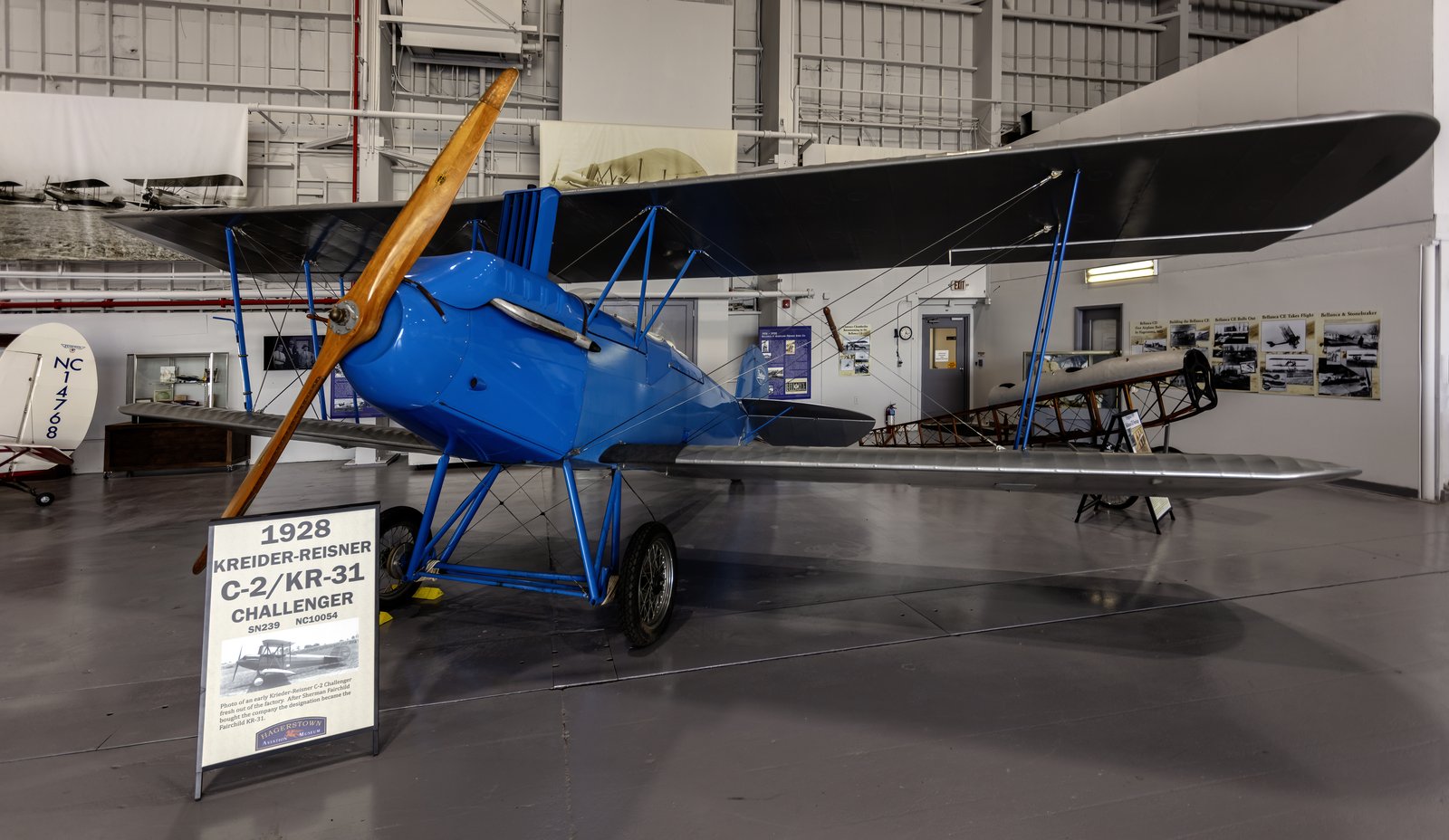
The Kreider-Reisner C-2 Challenger, also designated as the KR-31, was an American three-seat, open-cockpit biplane introduced in the late 1920s. Developed as a versatile light aircraft for both sport and commercial use, the C-2 was the first model in the "Challenger" aircraft line. It was designed to replace aging World War I-era trainers and utility aircraft, such as the Standard and Curtiss Jenny, by offering superior flying qualities and modern efficiency.
Production took place in Hagerstown, Maryland, where the Kreider-Reisner Aircraft Company had been established in 1923. The aircraft was marketed as a high-value option for private owners and small commercial operators; in 1928, the airframe was priced at $2,240, with the engine cost added separately. The design leadership for the Challenger series is attributed to the company's co-founders, Amron Kreider and Lewis Reisner. While the C-2 was in production by 1928, the company underwent a major corporate transition on April 1, 1929, when it was acquired by the Fairchild Airplane Manufacturing Company. Following this acquisition, Kreider-Reisner became a Fairchild subsidiary, and later derivatives of the Challenger line, such as the C-4C, were redesignated as the Fairchild KR-34.
Technically, the C-2 was a single-engine landplane configured to carry a pilot and two passengers. It was powered by an air-cooled radial piston engine, with the broader Challenger family utilizing Wright J-series radials (such as the 150 hp Wright J-6 found in the C-4C variant). In civil service, the C-2 and its successors were employed in various roles, including air taxis, press planes, and sport aircraft. The series was noted for its favorable performance and handling, which helped the C-2 establish a reputation as a reliable and good-flying aircraft.
Today, the legacy of the C-2 is preserved through a small number of surviving airframes. According to FAA registry data, 14 KR-31s are listed, though it is estimated that only approximately four exist as complete aircraft. A notable example of the C-2 Challenger is currently exhibited at the Yanks Air Museum in Chino, California.