
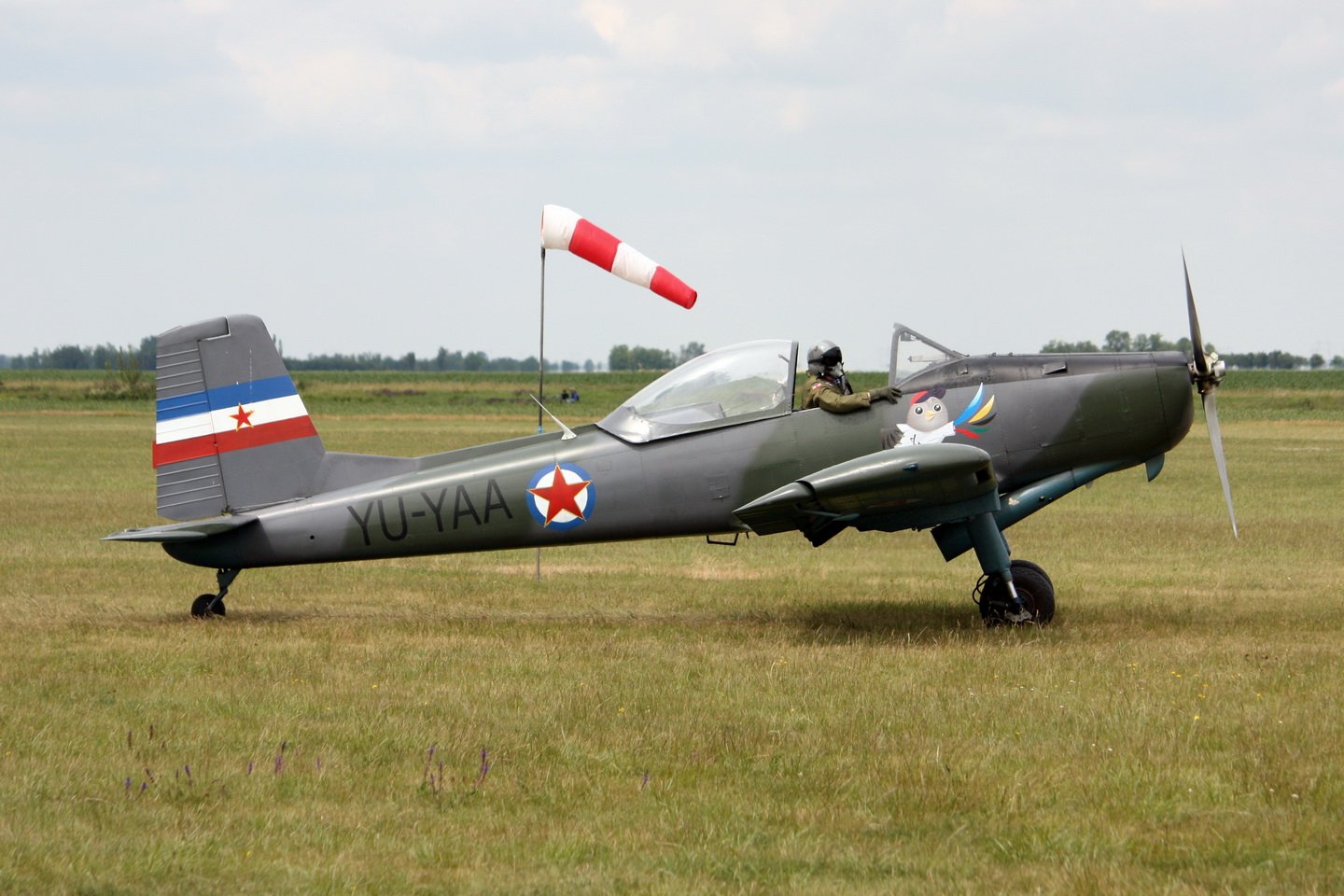
Design Philosophy and Development
The J-20 Kraguj emerged from Yugoslavia's unique military doctrine, heavily influenced by the country's World War II partisan experience. The Yugoslav Aeronautical Research Establishments (VTI) collaborated with SOKO to create an aircraft that could operate independently when conventional military infrastructure was destroyed or unavailable. The design requirements called for extreme short-field performance, simplicity of maintenance, and the ability to operate from improvised strips, even equipped with skis for winter operations.
Captain Rudolf Humar piloted the prototype's maiden flight on November 21, 1962, validating the aircraft's unconventional design approach. The engineering team prioritized ruggedness over sophistication, employing a semi-monocoque metal structure with fixed tailwheel landing gear that could withstand operations on rough terrain.
Technical Innovation
The Kraguj's Textron Lycoming GSO-480-B1J6 engine, producing 340 horsepower, drove a three-blade Hartzell constant-speed propeller measuring 2.44 meters in diameter. This powerplant configuration provided the aircraft with exceptional short-field performance, achieving takeoff runs of just 189 meters to clear a 15-meter obstacle. The engine featured enhanced cooling through ejector systems, crucial for the low-altitude operations that defined the aircraft's mission profile.
With an empty weight of 1,130 kilograms and maximum takeoff weight of 1,624 kilograms, the Kraguj could carry a useful load of 494 kilograms. This capacity allowed for either a 500-kilogram payload in transport configuration or substantial armament loads including two 7.7mm Colt-Browning machine guns with 650 rounds each, plus external stores of bombs, rockets, or specialized munitions.
Military Service and Operations
The Yugoslav Air Force introduced the J-20 into service in 1964, operating the type primarily as a close air support and counterinsurgency platform. The aircraft's designation reflected its intended role - "Kraguj" meaning "sparrowhawk" in Serbian, emphasizing its character as a small but effective predator.
Beyond Yugoslavia's borders, the aircraft found service with successor states following the country's dissolution. The Croatian Air Force and Republika Srpska Air Force both operated the type, while Slovenia's Territorial Defence forces used the aircraft from 1988 for reserve pilot training at Cerklje and Brnik airports. The aircraft's dual role as both combat platform and advanced trainer made it valuable for maintaining pilot proficiency in nations with limited defense budgets.
Manufacturing Legacy
SOKO (Soko Vazduhoplovna Industrija) produced all 43 Kraguj aircraft at its Mostar facility in two small production series following prototype testing. The company, which operated from the post-World War II era through the 1990s, faced severe challenges during the Yugoslav Wars that ultimately ended its independent existence. The limited production run reflected both the specialized nature of the aircraft and the constraints of Yugoslavia's domestic defense market.
The manufacturing process emphasized simplicity and maintainability, with the aircraft designed for field maintenance by minimally trained personnel. This approach aligned with the partisan warfare doctrine that assumed operations would occur with limited logistical support.
Performance and Pilot Perspective
Pilots appreciated the Kraguj's honest flying characteristics and exceptional visibility from its enclosed, heated cockpit. The aircraft achieved a maximum speed of 295 kilometers per hour at 1,500 meters altitude, with a more economical cruise speed of 280 kilometers per hour. Its stall speed of just 88 kilometers per hour with flaps extended contributed to its remarkable short-field capabilities.
The aircraft's 800-kilometer range, reduced to 350 nautical miles when armed, provided sufficient endurance for typical close air support missions. Its climb rate of 8 meters per second enabled rapid escape from ground fire, while the robust landing gear absorbed the punishment of repeated operations from unprepared surfaces.
Current Status and Preservation
Today, no J-20 Kraguj aircraft remain in active military service, though some examples reportedly continue flying as vintage aircraft in Serbia and other former Yugoslav territories. The Aviation Museum in Belgrade displays a preserved example, representing one of the few surviving examples of Yugoslavia's indigenous aircraft industry.
The Kraguj's historical significance extends beyond its modest production numbers, representing a unique approach to military aviation that prioritized operational flexibility over raw performance. Its design philosophy influenced later counterinsurgency aircraft development and demonstrated how smaller nations could develop effective military aviation solutions tailored to their specific strategic requirements.