
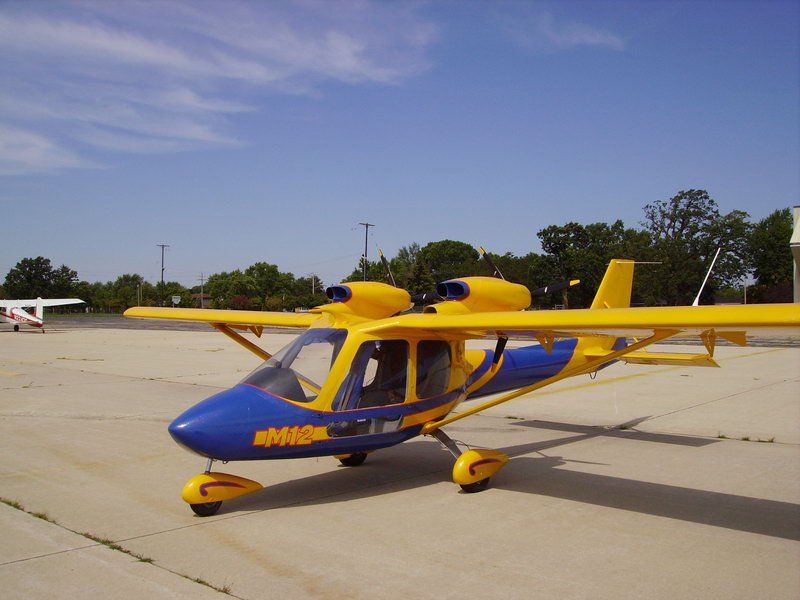
The PHOENIX-AVIACOR M-12 Kasatik is a Russian light aircraft identified by the ICAO type designator KSTK. The aircraft's origins are rooted in the work of the PHOENIX Development Design Office, which created the initial M-12 design that served as the basis for the Kasatik. Documentation regarding the aircraft's creation attributes the design of the first light M-12 to N. Masterov, who worked within the PHOENIX Design Office framework.
In terms of manufacturing and production, the aircraft is linked to the Samara Aircraft Factory, although the specific production years and the total volume of aircraft manufactured remain unverified in available records. The designation PHOENIX-AVIACOR is formally associated with the aircraft's type name in ICAO documentation, reflecting the collaborative or evolutionary nature of its development from the original PHOENIX design bureau's efforts.
Technical specifications for the M-12 Kasatik are primarily defined by ICAO Doc 8643. The aircraft is classified as L2P, with a wake turbulence category of L/G. Its physical dimensions include a wingspan of 10.2 meters and a total length of 6.7 meters. The maximum takeoff weight (MTOW) is recorded as 0.7 tonnes. While these dimensions establish the aircraft as a light-class landplane, other specific performance metrics—such as cruise speed, operational ceiling, and maximum range—are not available in the current verifiable research.
Regarding its propulsion and interior, the specific engine manufacturer, model, and power output have not been confirmed. Similarly, data concerning the seating capacity and interior configuration is absent from the source material. There is no evidence to suggest that the M-12 Kasatik saw military or wartime service, nor is there documented data regarding specific civil operators or established commercial routes. The aircraft's legacy is primarily preserved through its inclusion in international aviation registries and technical documentation, though the number of surviving airframes is currently unknown.