
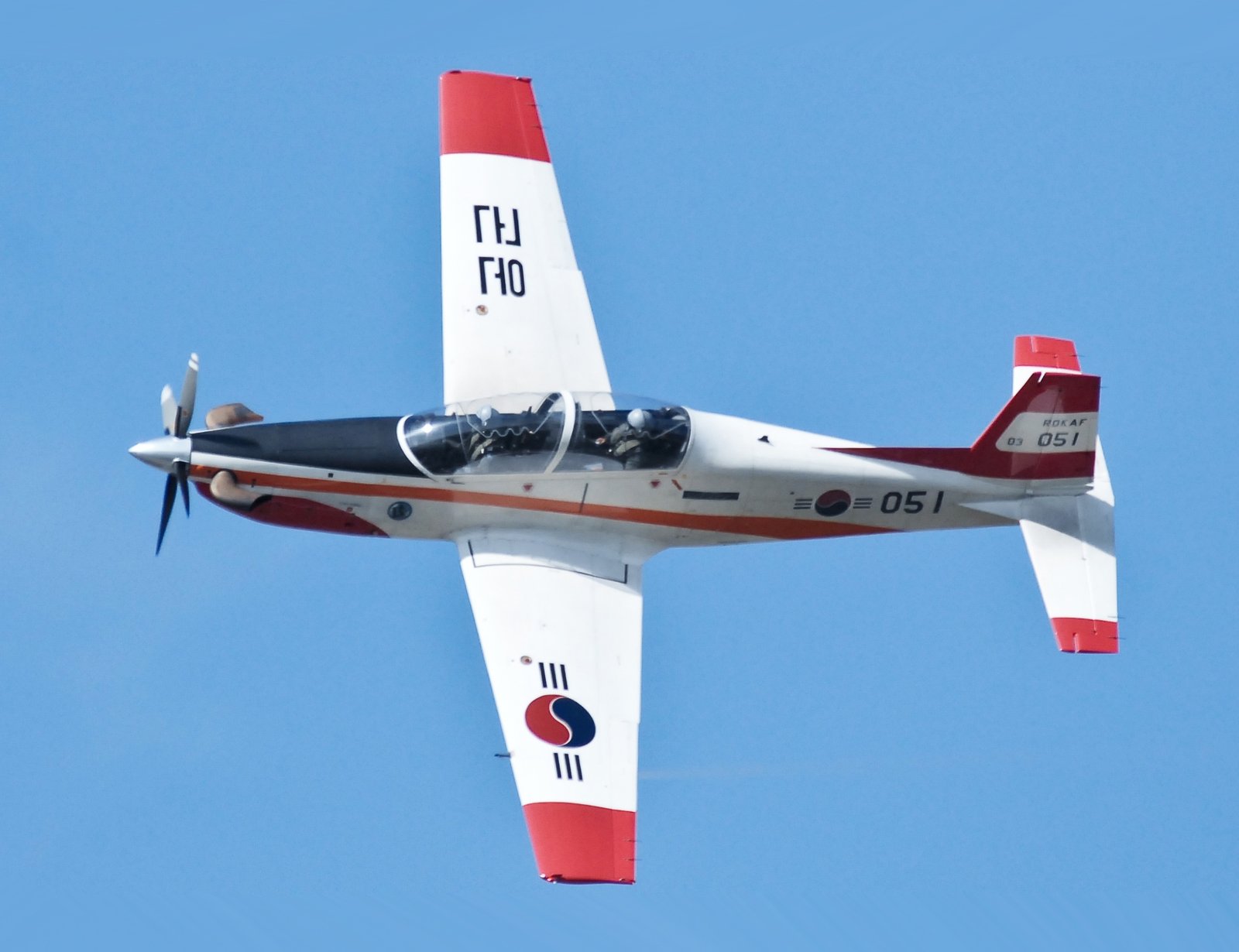
The KT-1 Woong-Bee represents a pivotal achievement for South Korea, serving as the first aircraft designed and developed entirely within the country. The project began in 1988 under the KTX (Korean Trainer eXperimental) program, an initiative launched by the Republic of Korea Air Force (ROKAF) to replace aging piston-powered trainers with a modern turboprop capable of jet-like handling. The aircraft first took flight on December 12, 1991, and officially entered operational service with the ROKAF in 2000.
Originally developed by Daewoo Heavy Industries' aerospace division in collaboration with Samsung Aerospace and Hyundai, the manufacturing landscape shifted around 1999 when the industry was consolidated into Korea Aerospace Industries (KAI). KAI became the primary manufacturer and marketer for the KT-1 and its subsequent derivatives. While a definitive production end date is not documented, approximately 175 to 178 units have been produced since the aircraft's introduction.
Technically, the KT-1 is powered by a single Pratt & Whitney Canada PT6A-62 turboprop engine, delivering approximately 950 shp (708 kW). The aircraft features a tandem two-seat cockpit designed for a student and instructor, with options for either traditional analog instruments or a modern glass cockpit. A defining characteristic of the design is its excellent spin recovery ability and high fuel efficiency. In terms of performance, the baseline trainer reaches a maximum speed of approximately 574 km/h (310 knots) and has a service ceiling of roughly 11,580 meters (38,000 feet). Its operational range varies between 720 and 900 nautical miles depending on the configuration.
Beyond basic training, the airframe was adapted into the KA-1, an armed airborne controller and light-attack variant. The KA-1 incorporates a mission computer, head-up display (HUD), and multi-function displays (MFDs), along with four underwing hardpoints for carrying rockets, bombs, gun pods, and missiles. This versatility has made the KT-1 family attractive for export; the aircraft is operated by the air forces of Turkey (KT-1T), Peru (KT-1P), Indonesia (KT-1B), and Senegal (KA-1S), in addition to the ROKAF. As of recent estimates, approximately 181 aircraft remain in active service globally.