
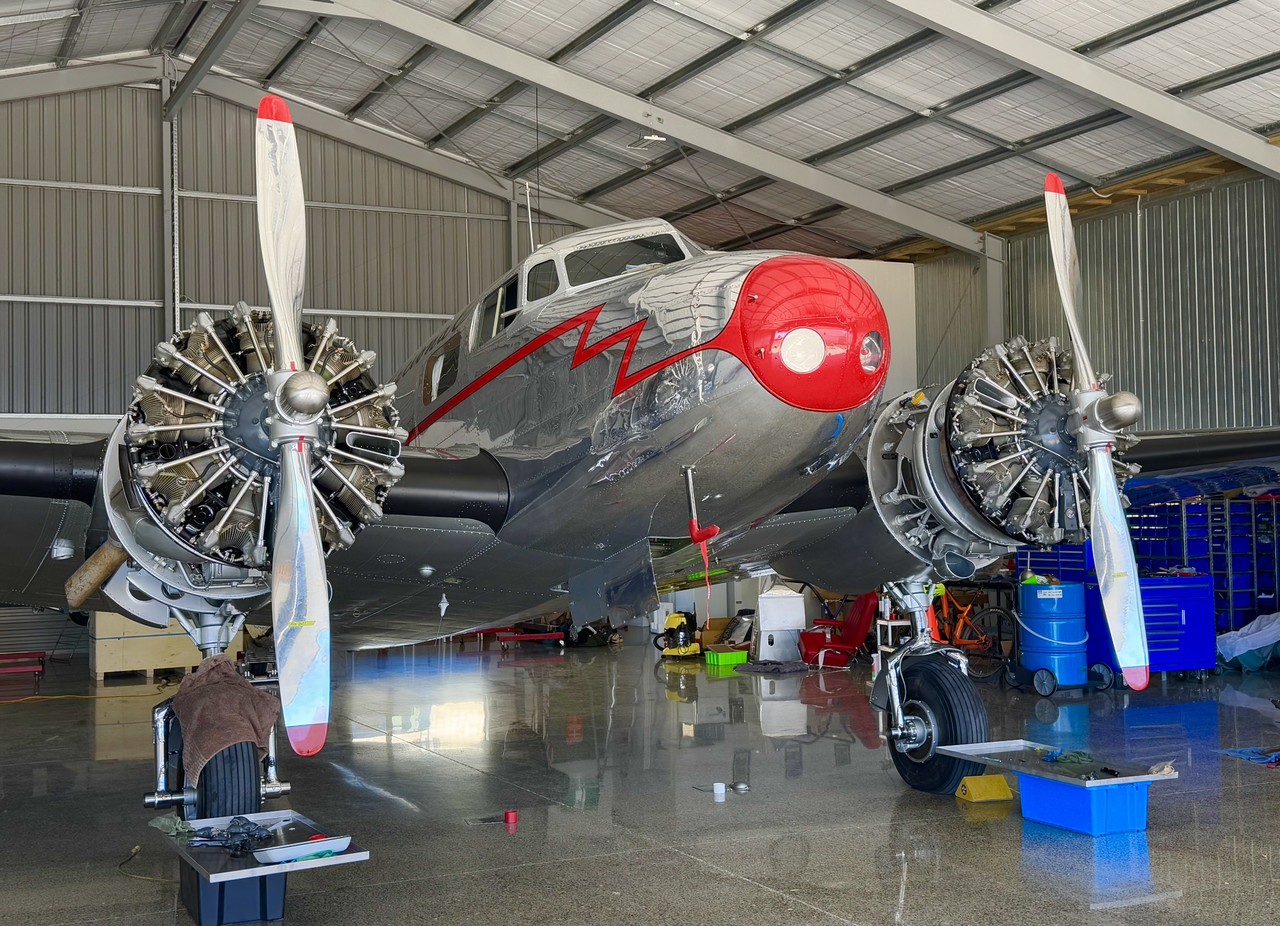
Commercial Aviation Pioneer
The Electra emerged at a crucial moment in aviation history when the U.S. government banned single-engine aircraft for passenger and night flying operations after October 1934. This regulatory change positioned Lockheed perfectly in the market, as their twin-engine design offered airlines compliance with new safety requirements while delivering superior performance compared to earlier transports.
Northwest Airlines became the first carrier to operate the Electra, taking delivery of their aircraft in December 1934. Pan American Airways ordered eight Model 10-C variants, while Cubana de Aviación became the first Latin American airline to operate the type in 1935. The aircraft's 10-passenger capacity and 202-mile-per-hour maximum speed made it highly competitive against the Boeing 247 and Douglas DC-2.
Design Innovation
Hall Hibbard's design represented Lockheed's first all-metal construction, a significant departure from the fabric-and-wood aircraft of the early 1930s. Marshall Headle piloted the prototype on its maiden flight from Lockheed's Burbank, California facility. The aircraft's name honored Electra, a star in the Pleiades constellation, establishing a naming tradition that would continue with later Lockheed designs.
Four main variants emerged during production. The Model 10-A featured Pratt & Whitney R-985 Wasp Junior SB engines producing 450 horsepower each. The 10-B variant utilized Wright R-975-E3 Whirlwind engines rated at 440 horsepower. Both the 10-C and 10-E variants employed the more powerful Pratt & Whitney R-1340 Wasp engines, also producing 450 horsepower per engine.
Military Service
World War II transformed many civilian Electras into military transports. The U.S. Army Air Forces impressed 22 aircraft into service, redesignating them with various C-36 and UC-36 designations. Three Y1C-36 aircraft were purpose-built for the Army Air Corps, while the Navy acquired three R2O-1 variants for the Secretary of the Navy's use.
One notable example, serial number 1011, served as USAAF C-36A with serial 42-56638 from June 8, 1942, to March 21, 1944. The U.S. Coast Guard operated one R3O-1 for the Secretary of the Treasury, while a single C-37 served the Chief of the National Guard Bureau. These aircraft primarily performed transport and utility missions rather than combat roles.
The Amelia Earhart Connection
The Electra achieved lasting fame through Amelia Earhart's 1937 around-the-world flight attempt. Flying a specially modified Model 10-E with navigator Fred Noonan, Earhart disappeared over the Pacific Ocean on July 2, 1937, creating one of aviation's greatest mysteries. This tragic event paradoxically elevated the Electra's profile in popular culture and aviation history.
Manufacturing Legacy
Lockheed Aircraft Corporation, founded in the early 1930s, used the Electra's success to establish itself as a major aircraft manufacturer. The company continued expanding through the decades, eventually merging with Martin Marietta in 1995 to form Lockheed Martin, now one of the world's largest defense contractors.
Production ceased in July 1941 after 149 aircraft rolled off the Burbank assembly line. This relatively modest production run reflected the aircraft's position as a transitional design, bridging the gap between early commercial aviation and the modern airliner era that would soon be dominated by larger, more capable aircraft.
Surviving Aircraft
Today, at least 12 Electras survive from the original 149 built, with only two remaining airworthy. The Pima Air and Space Museum in Tucson, Arizona, displays serial number 1011, the oldest surviving example originally delivered to Northwest Airlines on December 21, 1934. Seattle's Museum of Flight houses a Model 10-A that flew as Northwest Airlines NC14900 before military service as USAAF 42-57213.
In Prague, Czech Republic, serial number 1091 represents international Electra operations. Originally delivered to the Bata Shoe Company as OK-CTB, this aircraft later served the Royal Canadian Air Force as RCAF 7656 beginning September 11, 1940, demonstrating the global reach of Lockheed's design.
The Electra's legacy extends beyond its technical achievements to its cultural significance, forever linked with Earhart's pioneering spirit and the golden age of aviation exploration.