
Service History
The L-1011 entered commercial service with Eastern Air Lines on April 26, 1972, marking Lockheed's return to passenger aircraft manufacturing after an 11-year absence since the L-188 Electra. Despite producing only 250 aircraft over 16 years, the TriStar achieved remarkable operational success with major carriers. Delta Air Lines became the type's largest operator with 70 units across five variants, while Eastern Airlines marketed their fleet as "Whisperliner" aircraft due to the exceptionally quiet cabin environment.
The aircraft dominated long-range routes where passenger comfort and reliability mattered most. TWA praised the L-1011 as one of the world's safest airliners, a reputation supported by its outstanding reliability statistics. British Airways operated the type on prestigious routes including London Heathrow to Abu Dhabi, demonstrating the aircraft's capability on demanding international services.
The Manufacturer
The Lockheed Corporation, founded in 1926, had established itself as a premier military aircraft manufacturer with designs like the P-38 Lightning and C-130 Hercules. The company's decision to re-enter commercial aviation stemmed from disappointing military program results and American Airlines' 1966 requirement for a 250-passenger transcontinental airliner. Lockheed chose an ambitious technological approach, creating advanced systems when existing technology proved inadequate.
This philosophy distinguished Lockheed from Douglas Aircraft, which relied on proven DC-8 technology for their competing DC-10. While Douglas achieved faster market entry, Lockheed's advanced approach ultimately produced a superior aircraft. The company continues today as Lockheed Martin, one of the world's largest aerospace contractors, though the L-1011 marked their final passenger airliner.
Engine & Technical Innovation
The L-1011's heart was three Rolls-Royce RB211 turbofan engines, revolutionary high-bypass powerplants that defined a new generation of fuel-efficient propulsion. Two engines mounted beneath the wings, while the third featured an innovative S-duct inlet system embedded in the tail and upper fuselage. This configuration provided exceptional performance and redundancy while maintaining the aircraft's clean aerodynamic lines.
The later L-1011-500 variant, first flown October 16, 1978, featured upgraded RB211-524 engines delivering increased power and range. This version could fly 6,100 nautical miles, enabling non-stop service on routes like Atlanta to Frankfurt, which Delta inaugurated on June 17, 1979.
Lockheed equipped the TriStar with advanced systems including a unique direct lift control system and sophisticated autopilot capabilities. The aircraft required a crew of three: captain, first officer, and flight engineer, though its automated systems reduced pilot workload compared to earlier generation aircraft.
Pilot Perspective
Pilots consistently praised the L-1011's handling characteristics and advanced automation. One pilot famously described it as "the most intelligent airliner ever to fly," reflecting the aircraft's sophisticated flight management systems and predictable flight characteristics. The TriStar's automated systems provided exceptional stability and reduced crew workload during critical phases of flight.
The aircraft cruised efficiently at high altitudes with remarkable fuel economy for its era. Its advanced wing design and powerful engines delivered smooth performance across a wide range of operating conditions, from short domestic routes to extended overwater flights.
Production Variants & Military Service
Lockheed produced six main variants during the 16-year production run. The original L-1011-1 entered service in 1972, followed by the -100, -200, and -250 with progressive improvements in gross weight and engine power. The -500 variant, introduced in 1979, featured a shortened fuselage for extended range operations, with 50 examples built before production ended in 1983.
The Royal Air Force purchased six TriStar 500s from British Airways in December 1982, operating them initially as passenger transports designated TriStar C.Mk1. These aircraft were later converted to aerial refueling tankers, providing the RAF with strategic airlift and air-to-air refueling capabilities.
Legacy
Despite its technological superiority and exceptional reliability, the L-1011 faced commercial challenges from more economical competitors and Lockheed's late market entry. The program's $20 million unit cost in 1972 dollars reflected its advanced technology but limited sales to price-sensitive airlines.
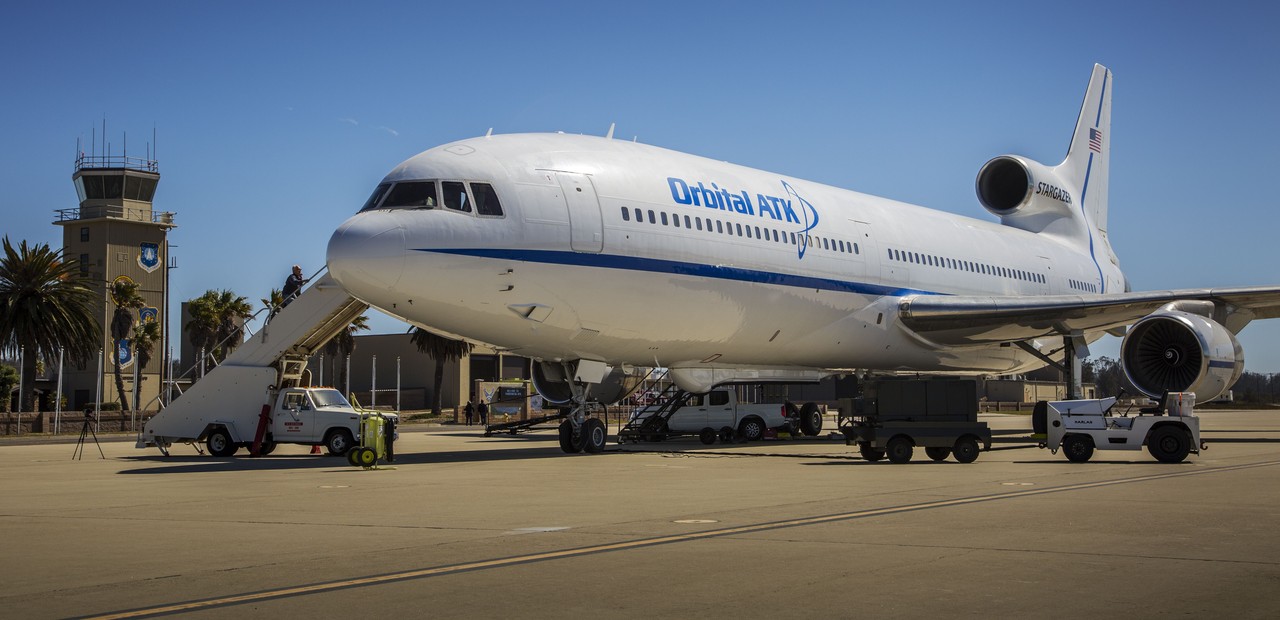
Today, only one L-1011 remains airworthy: Stargazer (N140SC), a 1974-built aircraft modified in 1994 as a launch platform for Northrop Grumman's Pegasus rocket system. This unique conversion allows the venerable TriStar to continue contributing to aerospace advancement, launching small satellites from its modified fuselage.
The L-1011 represents the pinnacle of 1970s airliner technology, combining advanced systems, exceptional reliability, and passenger comfort in ways that influenced subsequent aircraft design. Though commercially overshadowed by the Boeing 747 and DC-10, the TriStar's technical innovations and operational excellence secured its place as one of aviation's most sophisticated passenger aircraft.