
Service History
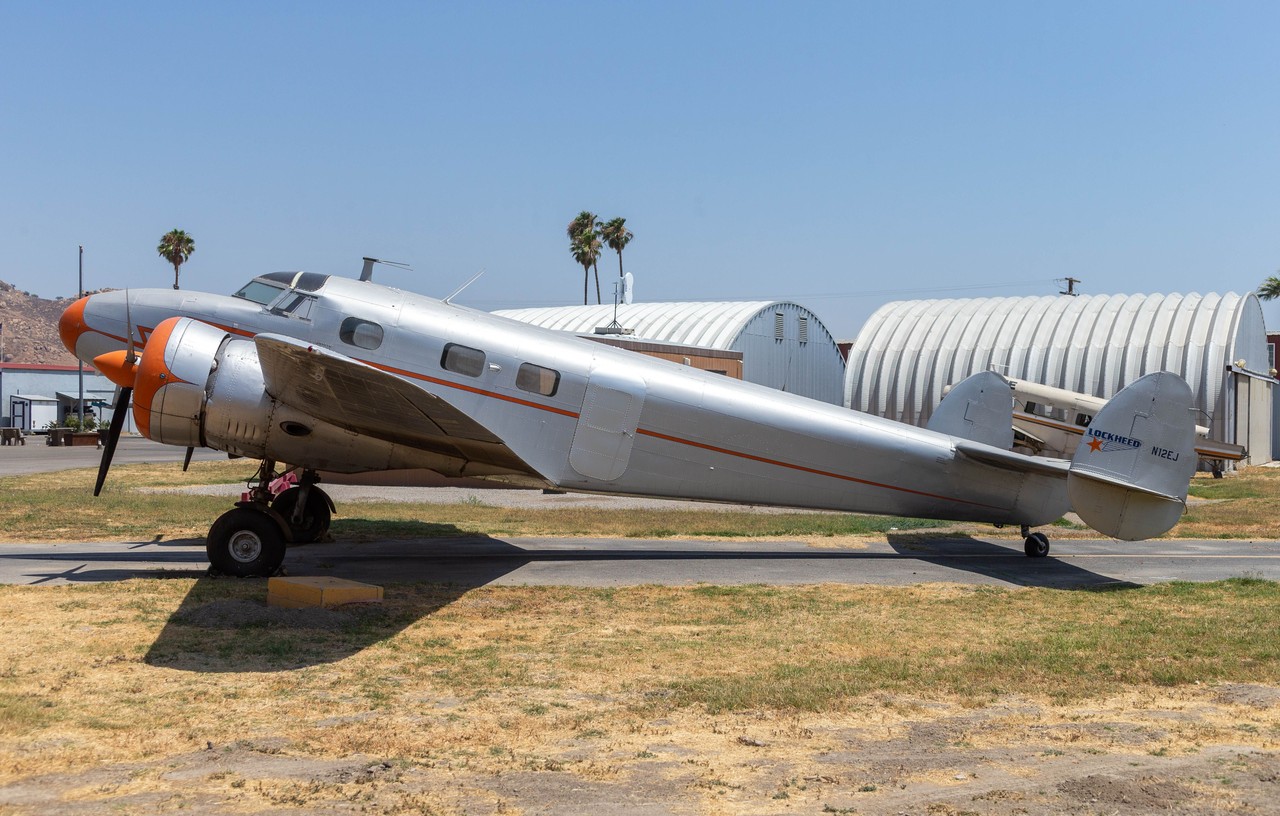
The L-12 Electra Junior carved out a specialized niche as America's premier executive transport and feeder airliner during the late 1930s. Continental Airlines operated NC18137 starting in 1937 for short routes before selling it to Trans World Airlines in 1940. TWA utilized their L-12s from 1940 to 1945 primarily as executive aircraft and flying research laboratories, conducting experiments with static discharge wicks and other aviation technologies.
Corporate operators embraced the aircraft's unique combination of speed and luxury. Phillips Petroleum purchased an L-12 in 1939, which was later requisitioned for military service before returning to civilian use after the war. Texaco also operated the type in the post-war period. The aircraft's ability to operate from unimproved airstrips while maintaining airliner-level performance made it invaluable for oil field operations and remote location access.
Wartime Service
World War II transformed many civilian L-12s into military utility aircraft through requisition rather than new production. The U.S. Army Air Forces operated approximately 30 examples under the designations UC-40 and C-40 for transport and utility missions. UC-40D serial number 42-66386, formerly owned by Phillips Petroleum, exemplified this conversion process. The U.S. Navy designated their examples JO-1, while the Royal Canadian Air Force flew 10 aircraft before selling them as surplus after the war.
Perhaps the most intriguing wartime role involved pre-war intelligence gathering. British pilot Sidney Cotton operated L-12s under the cover of British Airlines, conducting clandestine photographic reconnaissance missions over German and Italian installations. These aircraft carried hidden cameras and provided valuable intelligence in the lead-up to World War II. The Netherlands East Indies operated a specialized variant designated Model 212-A, which featured a dorsal gun turret for defensive purposes.
The Manufacturer
Lockheed Aircraft Corporation traced its origins to 1912 when brothers Allan and Malcolm Loughead founded the Alco Hydro-Aeroplane Company. After bankruptcy in 1932, Robert E. Gross and associates revived the company as Lockheed Aircraft Corporation. The company merged with Vega Aircraft Corporation in 1934, forming Lockheed-Vega before consolidating as Lockheed Corporation. Through subsequent mergers, including the 1995 combination with Martin Marietta, the company evolved into today's Lockheed Martin Corporation.
All 130 L-12 Electra Juniors were manufactured at Lockheed's Burbank, California facility between 1936 and 1941. The aircraft represented Lockheed's expertise in creating scaled variants of successful designs, building upon the larger Model 10 Electra's proven configuration.
Engine & Technical Innovation
Kelly Johnson led the L-12's design team, with Lloyd Stearman contributing the retractable landing gear system. The aircraft was powered by two Pratt & Whitney R-985 Wasp Junior SB radial engines producing 450 horsepower each, though early variants offered 400-horsepower Wasp Juniors or 420-horsepower Wright Whirlwinds as alternatives.
The design incorporated several innovations for its era, including engine fire suppression systems, an emergency exit, fuel dump capability, and distinctively tapered vertical fins. These features, combined with all-metal construction and retractable landing gear, enabled the L-12 to achieve its remarkable 225 mph maximum cruise speed—making it the fastest American commercial twin-engine aircraft of its time.
Performance and Pilot Appeal
Pilots appreciated the L-12's exceptional performance envelope, which included a service ceiling of 22,900 feet and a range of 800 miles. The aircraft's 65 mph stall speed provided reasonable low-speed handling characteristics, while its high cruise speed rivaled single-engine fighters of the period. The combination of speed, luxury appointments including an onboard lavatory, and rough-field capability made it ideal for executive transport missions.
The aircraft won the U.S. Bureau of Air Commerce's 1936 competition by default when competitors including the Beech 18 and Barkley-Grow T8P-1 failed to meet the deadline. This victory validated the design's advanced engineering and performance capabilities.
Production and Legacy
Lockheed produced approximately 130 L-12 Electra Juniors during its five-year production run, with some sources citing figures as high as 135. Despite its technical excellence, the limited production reflected the specialized nature of its market—executive transport and small feeder airline operations.
By 2006, fewer than 12 airframes remained airworthy worldwide. Notable survivors include CF-CCT at the Canada Aviation and Space Museum, which originally served the Department of Transport Canada and completed the first same-day Montreal-Vancouver flight on July 31, 1937, carrying Minister C.D. Howe for airway surveys. Restored example N99K, formerly owned by Phillips Petroleum, was returned to flight status in 1986 by Kent and Sandy Blankenberg.
The L-12's cultural impact extended beyond aviation, serving as the escape aircraft for Victor Laszlo and Ilsa Lund in the 1942 film "Casablanca." This cinematic appearance cemented its image as a symbol of sophisticated air travel during aviation's golden age. The aircraft's influence on subsequent twin-engine designs, particularly the successful Beech 18, demonstrates its importance in bridging pre-war luxury aviation with wartime utility requirements.