
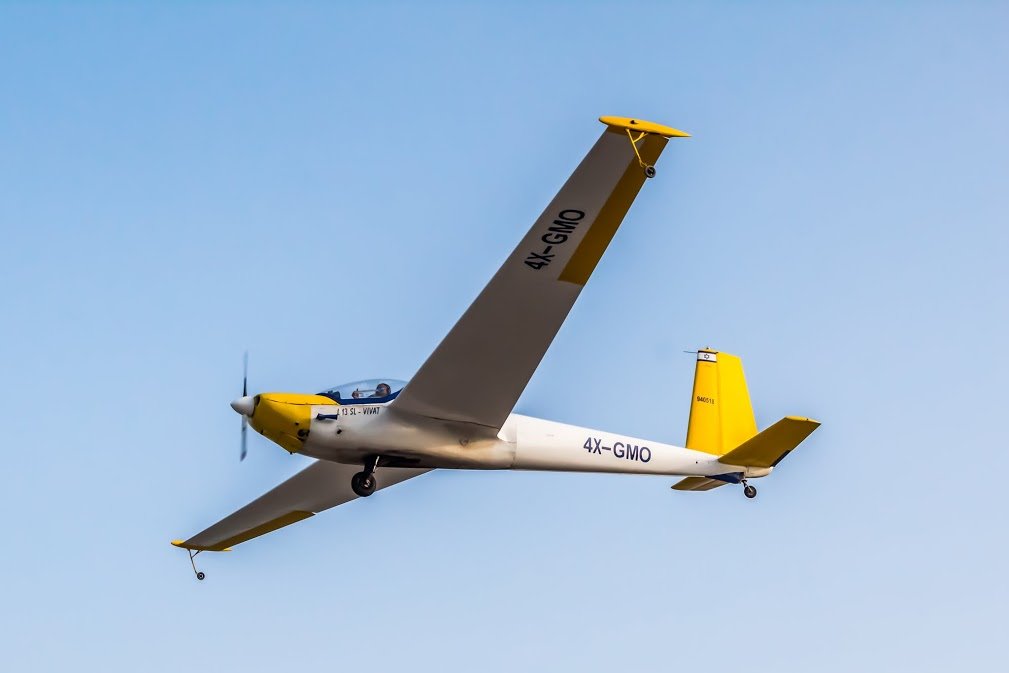
Development and Design Origins
The L-13SL Vivat emerged from a 1970s initiative to create a powered training variant of the successful LET L-13 Blaník sailplane. While the initial L-13W concept originated at LET Kunovice in the early 1970s, actual development began at Aerotechnik during summer 1976. The design team retained the proven wings and tail surfaces of the Blaník but engineered an entirely new fuselage to accommodate side-by-side seating rather than the sailplane's tandem configuration.
Three prototypes entered construction in autumn 1977, with the first aircraft (registration OK-068) completing its maiden flight on May 10, 1978, at Uherské Hradiště. The design incorporated NACA laminar airfoil sections inherited from the Blaník lineage, combined with innovative features including a semi-retractable center-wheel undercarriage and a composite Hoffman propeller with adjustable settings for takeoff, gliding, and cruise flight phases.
Production History and Variants
Serial production commenced in 1983, with first deliveries occurring in early 1984. Manufacturing took place at Aerotechnik facilities in Czechoslovakia (later Czech Republic) after production transfer from LET Kunovice due to capacity constraints. The company developed multiple variants to meet diverse operational requirements.
The initial L-13SW variant utilized a 65-horsepower Aerotechnik Mikron III S engine, with approximately 60 examples completed by 1988. The improved L-13SE followed in 1989, incorporating an electric starter system, automatic radio recharging capability, and redesigned exhaust muffler. The L-13SL variant adopted the German-built Limbach L 2000 EOI engine, producing 67-70 horsepower through its horizontally-opposed, four-cylinder configuration.
Later variants included the L-13SEH with Hoffman propeller optimization and fixed-gear versions designated SDM and SDL. The final SDM examples rolled off the production line in the early 2000s, concluding a manufacturing run that produced approximately 165 aircraft, though some sources indicate totals exceeding 200 delivered examples.
The Manufacturer's Evolution
Aerotechnik established itself as a specialized producer of light aircraft and aviation equipment beyond the Vivat program. The company manufactured the Mikron engine series powering many Vivat variants, overhauled vintage Z 226 and Z 326 Trener aircraft with new Avia M 137 engines, and produced hot-air balloons alongside marketing Pottier P.220S Koala kit aircraft powered by their 75-horsepower Mikron III B engine.
In 1993, Evektor acquired Aerotechnik, fully merging the companies by 1996. This consolidation marked the beginning of the end for Vivat production, as Evektor shifted focus toward their EV-97 Eurostar program. New Vivat manufacturing ceased in 1999, though the parent company continues operations today under the Evektor name, producing modern light sport aircraft.
Engine Technology and Performance
The Vivat's dual-engine approach provided operators flexibility in powerplant selection. The Aerotechnik Mikron III S featured a four-cylinder, four-stroke, inline inverted configuration with air cooling, delivering reliable 65-horsepower output ideal for training operations. Its inverted design lowered the aircraft's center of gravity while maintaining excellent forward visibility.
Alternatively, the Limbach L 2000 EOI offered 67-70 horsepower through a horizontally-opposed, four-cylinder layout produced by Germany's Limbach Flugmotoren. This engine provided slightly superior power-to-weight characteristics and smoother operation due to its balanced configuration. Both powerplants drove two-blade Hoffman composite propellers engineered for optimal efficiency across the Vivat's operational envelope.
Training Capabilities and Pilot Experience
The Vivat's design prioritized advanced training capabilities that distinguished it from typical motor gliders. Its airframe could withstand unlimited spinning maneuvers, stalls at angles up to 60 degrees, and aggressive slip and skid training exercises. The side-by-side seating arrangement facilitated effective instruction, allowing direct communication and shared instrument access between student and instructor.
Pilots appreciated the aircraft's forgiving handling characteristics combined with its ability to simulate emergency scenarios safely. The semi-retractable landing gear system provided training in gear management while maintaining ground clearance for off-airport operations common in gliding activities.
Global Operations and Legacy
Vivat aircraft entered service across multiple continents, with operators in Belgium, Canada, Czech Republic, Finland, Germany, Slovakia, South Africa, Sweden, Switzerland, United Kingdom, United States, and Australia. The type demonstrated remarkable efficiency during a 1993 Victoria-Tasmania flight in Australia, consuming only 35 liters of fuel for the extended overwater journey.
Over 200 examples entered European gliding service following expanded production in the late 1980s. The aircraft served gliding clubs and private owners as both primary trainers and personal transportation. Despite production ending around 1999-2000, many Vivat aircraft remain active today, though accident records indicate at least 13 incidents between 1996-2024, including three fatal accidents.
The Vivat represents a successful evolution of the Blaník lineage, which produced over 2,650 sailplanes since 1958. Notable preserved examples include OM-9105 displayed in Očová, Slovakia, while VH-XQL gained recognition for its Australian demonstration flights and Avalon Airshow appearances.