
Commercial Dominance Cut Short
Despite producing only 170 aircraft between 1957 and 1961, the Electra initially captured significant market share among major airlines. Eastern Air Lines became the launch operator on January 12, 1959, eventually taking delivery of 40 aircraft. American Airlines, the original customer that sparked the design in 1954 with their request for a 75-100 seat domestic airliner, ordered 35 Electras. Other major operators included Northwest Orient with 18 aircraft, National Airlines with 14, and Western Airlines with 12. International carriers embraced the type as well, with KLM operating 12 Electras on European routes and Qantas adding 4 to their fleet for Pacific services.
The aircraft's exceptional short-field performance, achieved through massive Fowler flaps that dramatically increased wing area, made it invaluable for airlines serving challenging airports. This capability, combined with the fuel efficiency of its Allison turboprops, positioned the Electra as the ideal solution for medium-haul routes that pure jets couldn't serve economically.
Structural Crisis and Recovery
The Electra's promising career nearly ended in catastrophe when structural failures claimed two aircraft. In March 1960, N121US disintegrated over Tell City, Indiana, due to harmonic resonance in the wing structure. A second fatal crash occurred in June 1961 when N137US suffered aileron mechanical failure near Chicago. Public confidence evaporated, and several airlines temporarily grounded their fleets.
Lockheed responded with the comprehensive Lockheed Electra Achievement Program (LEAP), spending millions to strengthen engine mounts and wing structures on every aircraft. The 20-day modification process for each Electra included replacing wing skins with thicker material and reinforcing critical structural components. This expensive fix, borne entirely by Lockheed, contributed to the company's estimated $57 million loss on the program, not including an additional $55 million in related costs.
Lockheed Aircraft Corporation
Founded in 1926, Lockheed Aircraft Corporation had established itself as an innovative manufacturer with aircraft like the Vega and the twin-engine Model 10 Electra of the 1930s. The company began L-188 development in 1954 under the leadership of Chief Engineering Test Pilot Herman Salmon, who would pilot the prototype's maiden flight alongside co-pilot Roy Edwin Wimmer on December 6, 1957.
The simultaneous development of the military C-130 Hercules transport around the same Allison 501 turboprop demonstrated Lockheed's confidence in the powerplant. This dual-aircraft strategy ultimately proved more successful with the C-130, which became one of aviation's most enduring designs. Lockheed later merged with Martin Marietta in 1995 to form Lockheed Martin, which continues as a major aerospace contractor today.
Powerplant Innovation
The heart of the Electra was its quartet of Allison 501 turboprops, available in 501D-13, 501D-13A, or 501D-15 variants. These engines offered remarkable fuel efficiency compared to piston powerplants while providing the high power-to-weight ratio that gave the Electra its impressive performance. The combination of short wings and enormous propellers created an aircraft capable of operating from airports that would challenge much larger jets.
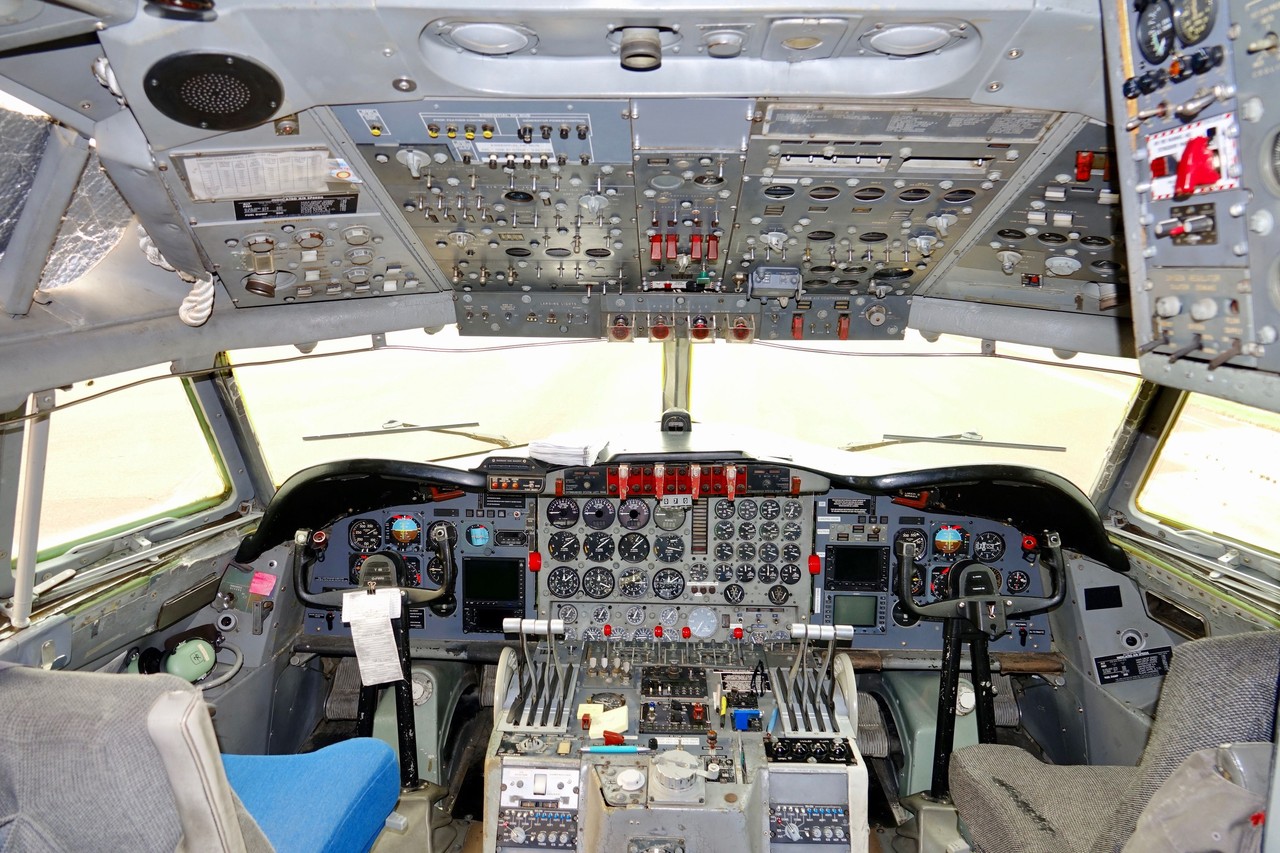
The Electra required a crew of three: pilot, co-pilot, and flight engineer. Its pressurized cabin maintained passenger comfort up to the service ceiling of 28,400 feet, while the 400-mph cruise speed made it competitive with early jets on shorter routes.
Military Legacy Through the P-3 Orion
While the commercial Electra's production ended in 1961, Lockheed adapted the design into the P-3 Orion maritime patrol aircraft, which became one of the most successful military derivatives in aviation history. The P-3 retained the Electra's basic airframe and powerplant but added sophisticated anti-submarine warfare equipment and extended the aircraft's operational life by decades.
Enduring Service
Despite early setbacks, properly modified Electras proved remarkably durable. Northwest Airlines operated their L-188s until 1972, demonstrating the type's long-term reliability once structural issues were resolved. Many aircraft transitioned to cargo and specialized roles, with some remaining active into the 21st century.
Buffalo Airways of Canada became famous for operating two L-188s in cargo service, bringing the vintage airliner to television audiences through reality programming. This visibility helped maintain public awareness of an aircraft that, despite its troubled commercial career, represented a significant step in aviation's evolution from piston power to the turbine age.