
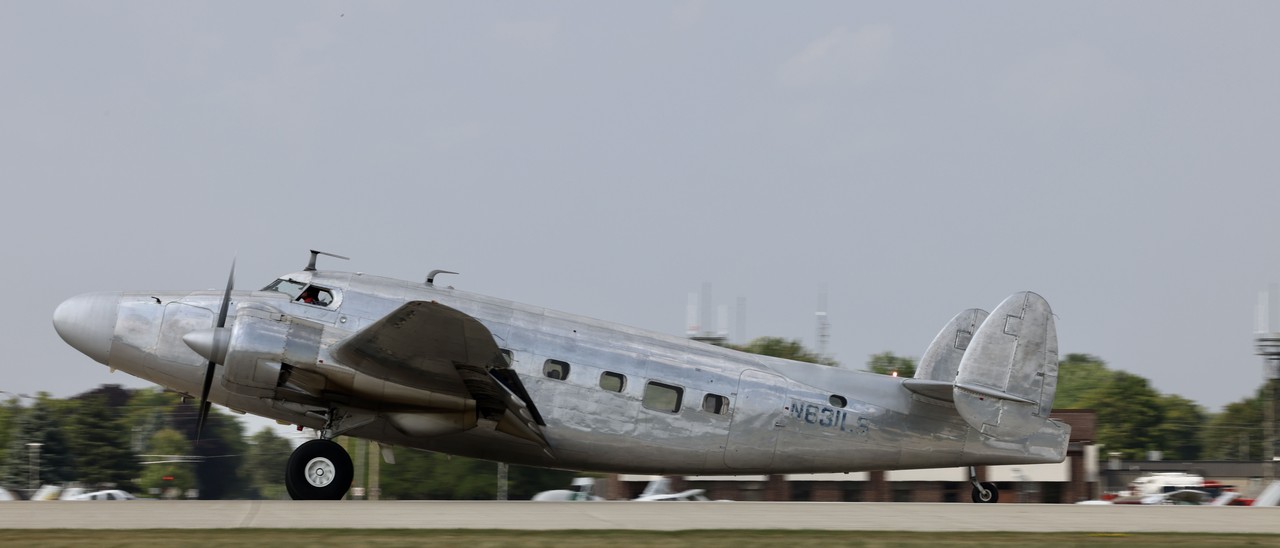
Service History
The Lodestar entered commercial service with Mid-Continent Airlines in March 1940, just one month after receiving type certification. Despite its technical superiority and improved economics over the Douglas DC-3, American carriers ordered only 32 aircraft for domestic routes. The design found greater success internationally, with major operators including South African Airways, New Zealand National Airways Corporation, and Trans-Canada Air Lines, which became the largest civilian operator of the type.
Of the more than 625 Lodestars built, over 470 served military roles during World War II. The U.S. Army Air Forces operated over 380 aircraft across 18 variants, while the U.S. Navy flew more than 90 examples in 7 different configurations. International military operators included the Royal Netherlands East Indies Army Air Force with 29 units, the Royal Air Force, and the Free French Air Force.
Wartime Operations
The most numerous military variant was the C-60A paratrooper transport, with 325 examples built for the U.S. Army beginning in May 1941. These aircraft could carry 28 fully equipped paratroopers or serve as cargo transports. The type also served as the C-56D personnel transport and in various training roles, though it never operated as a combat aircraft.
Military Lodestars operated across multiple theaters, transporting personnel and supplies throughout the Pacific, European, and North African campaigns. Notable losses included aircraft 42-56037, which crashed into RAF barracks at Prestwick, Scotland on September 12, 1943, and Free French aircraft FC-BAD, lost in Algiers on December 30, 1944.
The Manufacturer
Lockheed Aircraft Corporation developed the Lodestar at its Burbank, California facility as a direct response to the Douglas DC-3's market dominance. Founded in 1912 by Allan and Malcolm Loughead, the company had established itself as an innovator with aircraft like the Model 10 Electra. The Lodestar project aimed to create a more economical competitor by stretching the fuselage of the Model 14 Super Electra and adding two additional seat rows.
Lockheed underwent significant corporate changes over the decades, merging to form Lockheed Corporation in 1926, and later becoming part of Lockheed Martin following the 1995 merger with Martin Marietta. Today, Lockheed Martin continues as a major aerospace contractor, though it no longer produces commercial aircraft.
Engine and Technical Innovation
Most Lodestars were powered by twin Pratt & Whitney R-1830 Twin Wasp radial engines, each producing 1,200 horsepower. Some variants, including certain C-60A-5-LO models, utilized Wright R-1820-71 radials of similar power output. The R-1830, produced from the 1930s through the 1950s, became one of the most successful aircraft engines in history with over 170,000 examples manufactured across all variants.
The Lodestar's design addressed several shortcomings of its Model 14 predecessor, particularly the tail flutter issues caused by overpowered engines. The stretched fuselage improved weight distribution and allowed for better passenger economics while maintaining the high cruise speeds that characterized Lockheed designs of the era.
Performance Characteristics
With a maximum speed of 266 mph and cruise speed of 200 mph, the Lodestar was among the fastest transports of its generation. The aircraft had a service ceiling ranging from 23,300 to 30,100 feet depending on variant, and could climb to 10,000 feet in 6.6 minutes. Maximum range reached 2,200 nautical miles, making it suitable for medium to long-haul routes.
The two-pilot crew found the Lodestar responsive and stable, with handling characteristics superior to many contemporaries. Its maximum takeoff weight of 19,200 pounds allowed for substantial payload while maintaining performance margins that impressed both military and civilian operators.
Production and Legacy
Production continued through World War II, with over 150 commercial variants in 7 configurations and more than 470 military examples across 32 different variants. The first production aircraft flew in February 1940 from a prototype converted from an ex-Northwest Airlines Model 14 that had flown in September 1939.
Few Lodestars remain airworthy today, with most scrapped after the war or converted for specialized roles like agricultural work. The Planes of Fame Air Museum in Chino, California is restoring L-18 N1000B, originally USAAF serial 43-16462, to static display condition. This particular aircraft, construction number 18-2622, was built in 1943 as a C-60A-5-LO variant.
While overshadowed by the DC-3's commercial success, the Lodestar proved invaluable during World War II, serving reliably in transport and training roles across multiple air forces. Its 625-aircraft production run represented a significant contribution to Allied logistics capabilities and demonstrated Lockheed's ability to rapidly adapt civilian designs for military service.