
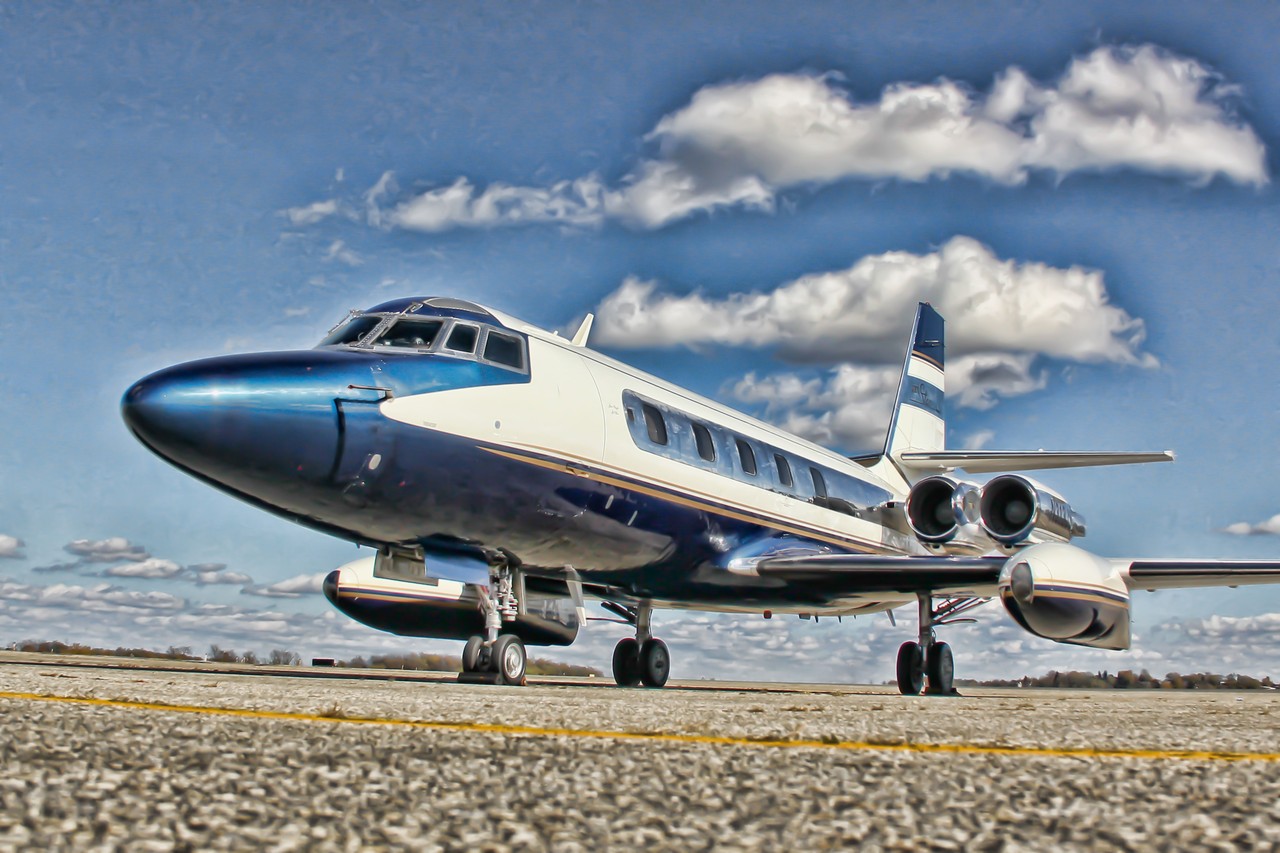
Service History
The JetStar dominated the executive aviation market from its introduction in 1961 through the late 1970s, becoming the standard against which all subsequent business jets were measured. With 204 aircraft delivered over 18 years of production, it captured the majority of the early corporate jet market. The aircraft served dual roles in both civilian and military operations, with the U.S. Air Force operating the type under the designation C-140 from 1960 to 2019.
Military Operations
The JetStar's military service began when the U.S. Air Force adopted variants designated C-140A and VC-140B for executive transport and utility missions. These aircraft provided rapid personnel transport for high-ranking officials and served specialized roles including airway inspection duties. The Canadian Department of Transport operated three JetStars from 1962 to 1986, utilizing them for airway calibration and personnel transport across Canada's vast territory. The type's military career spanned an remarkable 59 years, with the final operational flight occurring on December 30, 2019, when the last known JetStar landed in Kennesaw, Georgia.
The Manufacturer
Lockheed Aircraft Corporation, headquartered in Burbank, California, was one of America's premier aerospace manufacturers throughout the 20th century. Founded in 1912, the company produced legendary aircraft including the P-38 Lightning fighter and the Constellation airliner before venturing into the business jet market. Lockheed's Marietta, Georgia plant, which manufactured the JetStar, would later become famous for producing the C-130 Hercules transport and C-5 Galaxy strategic airlifter. The company merged with Martin Marietta in 1995 to form Lockheed Martin, which continues as one of the world's largest defense contractors.
Engine & Technical Innovation
The original JetStar I utilized four Pratt & Whitney JT12A turbojet engines, initially producing 2,400 pounds of thrust each, later upgraded to JT12-6A variants generating 2,570 pounds of thrust. This four-engine configuration provided exceptional safety margins and performance, allowing operations from shorter runways than competing designs. The revolutionary JetStar II, which first flew on August 18, 1976, featured four Garrett TFE731-3 turbofan engines producing 3,700 pounds of thrust each. These modern turbofans delivered significantly improved fuel efficiency, reduced noise levels, and enhanced environmental performance compared to the original turbojets.
Design Excellence
Clarence "Kelly" Johnson, Lockheed's legendary designer responsible for the F-104 Starfighter and later the SR-71 Blackbird, created the JetStar's elegant configuration. Johnson's team achieved an exceptionally rapid development cycle, progressing from program approval to completed aircraft in merely 241 days. The design featured a distinctive low-wing layout with engines mounted in pairs on the rear fuselage, providing excellent cabin quietness and ground clearance for operations at smaller airports.
Performance Characteristics
Pilots praised the JetStar for its stable handling characteristics and impressive performance envelope. The aircraft achieved cruise speeds of 504-505 miles per hour at altitudes up to 43,000 feet, with a maximum range of 2,995 miles in later variants. The type demonstrated exceptional climb performance at 3,300 feet per minute, allowing rapid transit to efficient cruise altitudes. Maximum takeoff weights ranged from 40,921 pounds for early models to 44,500 pounds for the improved JetStar II.
Production Legacy
Lockheed manufactured 164 JetStar I aircraft from 1961 to 1976, followed by 40 JetStar II models through 1979. The type's success validated the business jet market concept and directly influenced the development of competing designs from Grumman, North American, and later manufacturers. Many JetStar I aircraft received retrofits to "JetStar 731" standard, featuring the efficient TFE731 engines and external fuel tanks for extended range.
Museum Preservation
Several significant JetStar examples are preserved in major aviation museums. The Canada Aviation and Space Museum displays a 1961-manufactured JetStar (Artifact No. 1986.0042) that served with Canada's Department of Transport. The Joe Davies Heritage Airpark at Plant 42 in Palmdale, California, exhibits a NASA-operated C-140A (registration N814NA), while the Pima Air and Space Museum in Tucson, Arizona, houses a VC-140B (USAF serial 61-2489). These preserved examples ensure future generations can appreciate the aircraft that launched the modern business aviation era.