
Development Origins
The L-410 Turbolet emerged from a specific Soviet requirement in the early 1960s when Aeroflot requested a modern twin-engine transport to replace the aging Antonov An-2 biplane on short-range routes. Chief engineer Ladislav Smrček led the design team at the Letov organization in Kunovice, Czechoslovakia, initially conceiving the aircraft as the piston-powered L-400 before upgrading to turboprop propulsion as the L-410.
The prototype, registered OK-YKE, completed its maiden flight on April 16, 1969, marking a significant milestone as the first aircraft manufactured at the Let Kunovice Works. Despite being designed primarily for Soviet operations, the aircraft first entered commercial service with CSA Czechoslovak Airlines in 1971, operating domestic routes from Bratislava.
Production Evolution
Production commenced in 1971 with six initial aircraft that were subsequently converted to L-410A standard. Serial production of the L-410A began in 1972 with a first batch of 30 aircraft. The early production models faced a significant challenge when development delays with the intended Czech Walter M601 engine forced LET to equip initial aircraft with Pratt & Whitney Canada PT6-27 turboprops producing 715 shaft horsepower.
By the mid-1970s, the Walter M601A engine became available, and the L-410M variant adopted this domestically-produced powerplant generating 735 shaft horsepower, paired with Avia V508 three-blade propellers spanning 2.5 meters. This transition represented a crucial step in Eastern Bloc aviation self-sufficiency during the Cold War era.
Global Service Record
The L-410 achieved remarkable commercial success, with exports to more than fifty countries worldwide. The aircraft found favor among regional operators for its robust construction, reliable performance, and ability to operate from short, unprepared airfields. Its 15-passenger capacity in standard configuration, later increased to 19 in the L-410UVP-E variant, proved ideal for regional routes connecting smaller communities.
Military operators adopted the L-410 as a light tactical and utility transport, appreciating its versatility for personnel transport, cargo hauling, and specialized missions. The aircraft's high-wing configuration and twin-engine reliability made it particularly suitable for operations in challenging environments and austere airfields.
Manufacturing Legacy
LET underwent significant ownership changes during the post-Cold War transition, with AYRES Corporation owning the company from 1998 to 2013. Following this period, LET resumed independent operations and continued developing modernized variants. The company's persistence through political and economic upheaval demonstrates the aircraft's enduring market appeal.
Over its production run spanning more than fifty years, LET has manufactured more than 1,200 L-410 aircraft, making it one of the most successful regional transport designs. This production longevity is particularly remarkable for an Eastern European manufacturer competing in the global aviation market.
Modern Variants
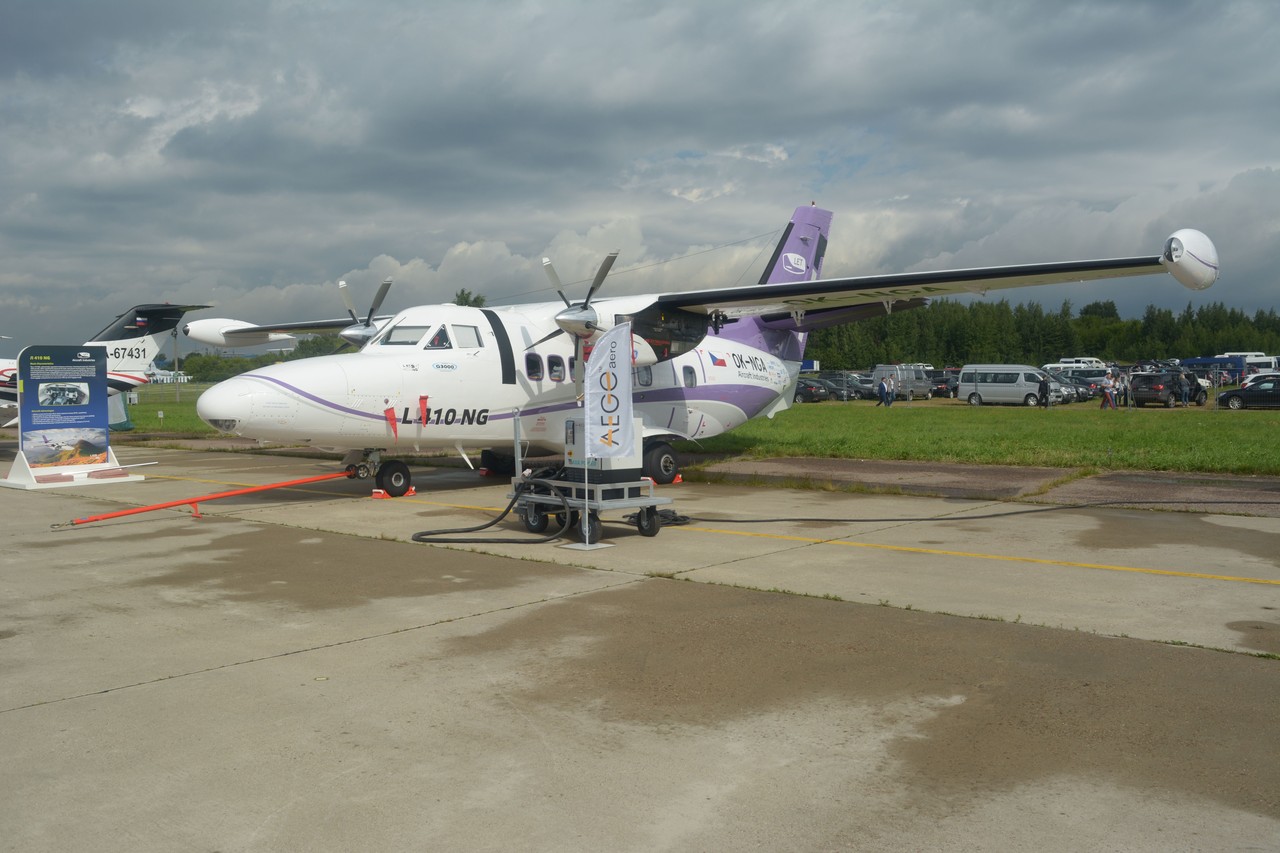
The L-410NG (New Generation) represents the latest evolution of the design, entering serial production in 2018. This variant features General Electric H80 engines producing 850 shaft horsepower with five-blade Avia AV-725 propellers, offering double the range of earlier models while carrying an additional 500 kilograms of payload compared to the L-410 UVP-E.
The L-410NG incorporates integrated fuel tanks in a redesigned wing, expanded luggage compartments, and a modern Garmin glass cockpit. Of the first 16 L-410NG aircraft delivered, eight went to Russian operators, six to Kazakhstan, and two to Poland, demonstrating continued strong demand in traditional markets.
Technical Innovation
The L-410's unpressurized design prioritizes simplicity and maintenance accessibility over high-altitude performance. Its high-wing configuration provides excellent short-field performance and allows easy ground access for cargo loading. The twin-turboprop powerplant arrangement offers redundancy for single-engine operations while maintaining relatively low operating costs.
The aircraft's robust landing gear and structural design enable operations from unpaved airstrips, expanding its utility in developing regions and remote locations. This capability, combined with its reliable Czech engineering, established the L-410 as a workhorse for operators requiring dependable service in challenging conditions.
Current Status
The L-410 continues in production today, testament to its enduring design relevance and market demand. LET currently offers both the L-410 UVP-E20 and L-410NG variants, serving commercial airlines, military forces, and cargo operators worldwide. The aircraft's ability to adapt to modern requirements while maintaining its fundamental design advantages ensures its continued relevance in regional aviation.