
Service History
The L-5 Sentinel dominated U.S. Army liaison operations throughout World War II, serving in virtually every theater from 1942 to 1945. Unlike the more numerous Piper L-4 Cub, which was adapted from a civilian trainer, the Sentinel was designed from the outset as a military aircraft, giving it superior performance in observation, medical evacuation, and communication roles. Production reached 3,590 aircraft over three years, making it the backbone of Army aviation's light aircraft fleet.
Wartime Operations
The Sentinel's versatility made it indispensable across multiple mission types. In the Pacific theater, 697 L-5B ambulance variants evacuated wounded soldiers from forward airstrips, their large cabin accommodating stretcher patients that smaller liaison aircraft could not handle. The 8th and 9th Air Forces in England operated Sentinels for artillery spotting and courier missions, with aircraft like serial number 44-17184 arriving in February 1945 for final operations against Germany.
Specialized variants expanded the aircraft's capabilities significantly. The L-5C and L-5E reconnaissance versions carried K-20 cameras, with 758 units built for photographic missions over enemy territory. Beyond conventional military roles, Sentinels performed covert operations including OSS agent insertions behind enemy lines, leaflet drops for psychological warfare, and even mosquito control missions in tropical regions. The U.S. Marine Corps operated 306 Sentinels, while the British Royal Air Force and U.S. Navy also flew the type in smaller numbers.
The Manufacturer
Stinson Aircraft originated in the 1920s as a pioneering light aircraft manufacturer, building a reputation with reliable designs like the Reliant series. Vultee Aircraft Company acquired Stinson in 1940, operating it as the Stinson Division at the Wayne, Michigan facility. Following the March 1943 merger that created Consolidated-Vultee (later Convair), L-5 production continued under the enlarged corporate structure until war's end in September 1945.
The company's expertise in light aircraft design proved crucial for military adaptation. Stinson's engineering team based the L-5 on their civilian Model 105 Voyager, initially designated V-76, but extensively modified the design for military requirements. After the war, corporate consolidations eventually absorbed Stinson into General Dynamics, ending the brand's independent existence.
Design and Technical Innovation
The L-5's high-wing configuration provided exceptional stability for low-speed observation work, while tricycle landing gear enabled operations from rough forward airstrips that would challenge conventional tailwheel aircraft. This design earned the "Flying Jeep" nickname, reflecting its rugged utility and go-anywhere capability. The spacious cabin, measuring 24 feet 1 inch overall length, accommodated various mission equipment and passenger configurations impossible in smaller liaison types.
Powering the Sentinel was the Lycoming O-435 six-cylinder engine, producing 185 horsepower through a horizontally-opposed air-cooled design. This powerplant provided smooth operation essential for observation missions while delivering sufficient performance for the aircraft's 2,050-pound maximum weight. The engine's reliability proved exceptional, with Tinker Air Force Base overhauling more than 110 O-435 engines between January 1947 and June 1952.
Performance and Pilot Experience
The L-5 offered superior range and payload compared to contemporary liaison aircraft, with a maximum range of 375 statute miles and empty weight of 1,500 pounds. This performance advantage made it ideal for long-range courier missions and medical evacuations from remote locations. The aircraft's docile handling characteristics and forgiving flight envelope made it suitable for pilots with minimal training time, crucial during wartime expansion of Army aviation.
Operating from a crew of one or two, the Sentinel could adapt to mission requirements by carrying an observer for reconnaissance, a patient for medical evacuation, or cargo for supply missions. Its short-field performance capabilities enabled operations from hastily prepared airstrips near front lines, bringing essential services directly to combat units.
Production Legacy
Manufacturing ceased in August 1945 with war's end, but the L-5's impact continued into the post-war era. Some Sentinels remained in military service into the late 1960s, while others found civilian roles with the Civil Air Patrol for search and rescue operations. The design influenced subsequent liaison aircraft development, proving that purpose-built military light aircraft could outperform civilian adaptations.
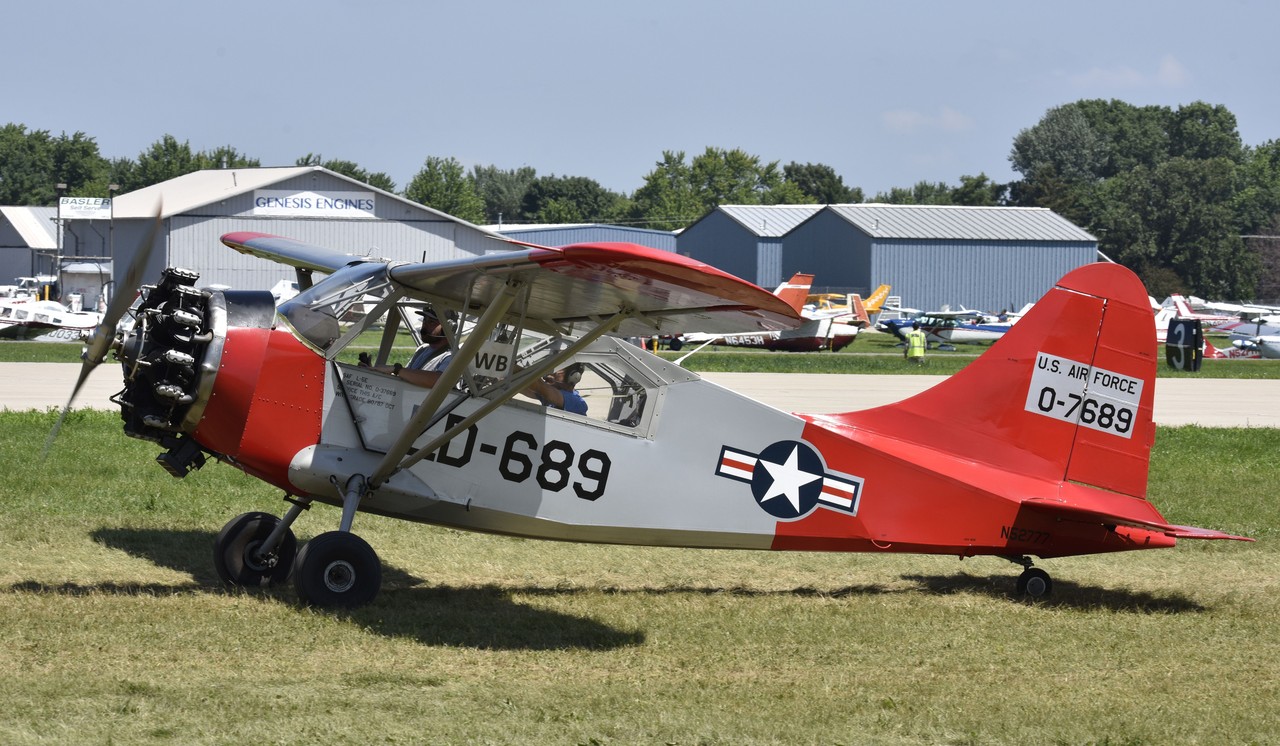
Today, several L-5s remain airworthy in private hands and museum collections. Notable preserved examples include aircraft at the EAA Aviation Museum in Wisconsin (1944 L-5E-1VW), March Field Air Museum in California, and the Military Aviation Museum in Virginia. The Fagen Fighters WWII Museum in Minnesota maintains serial number 44-17184, the same aircraft that served with the 9th Air Force in Europe. These surviving Sentinels preserve the legacy of an aircraft that revolutionized military liaison operations and earned its place as one of World War II's most versatile aircraft types.