
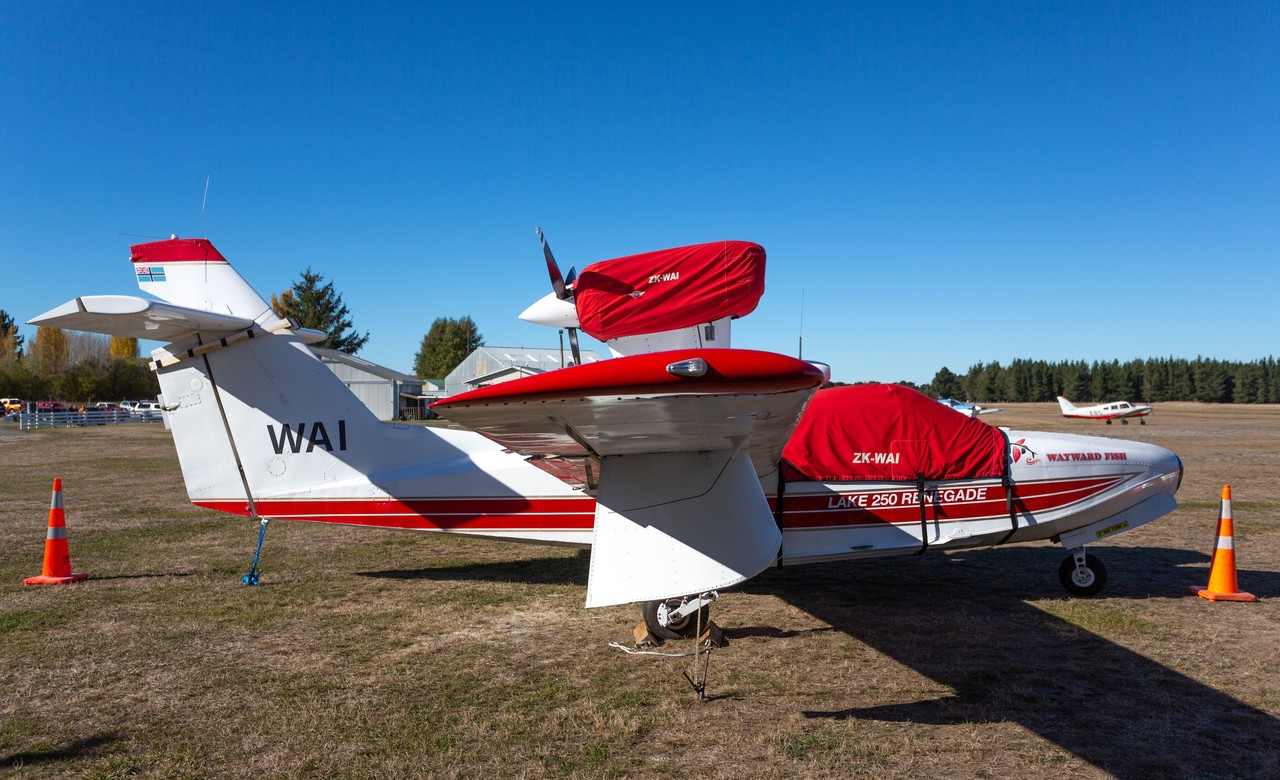
Development and Design
The LA-250 Renegade emerged from a deliberate effort to create a more capable amphibian aircraft building upon the proven LA-4-200 Buccaneer design. The development team, including engineers Herb Lindblad, Rivard, and Paul Furnee, stretched the original fuselage by 3 feet 5 inches, adding 38 inches specifically to the cabin area. This extension transformed the four-seat Buccaneer into a true six-seat utility aircraft, though the rear two seats carried a 200-pound weight limitation.
The prototype, designated serial number 1 with registration N250L, was created by converting an existing LA-4-200 airframe. Beyond the fuselage stretch, designers incorporated a deeper V-hull for improved rough-water handling, additional strakes for stability, and redesigned the tail, pylon, and engine cowling. The aircraft retained the proven 38-foot wingspan and 170-square-foot wing area of its predecessor while achieving a superior power loading of 12.2 pounds per horsepower compared to the LA-4-200EP's 13 pounds per horsepower.
Powerplant and Performance
The standard Renegade utilized the Textron Lycoming IO-540-C4B5 engine, a six-cylinder inline piston powerplant producing 250 horsepower. This engine enabled a best cruise speed of 139 knots indicated airspeed, with a maximum range of 804 nautical miles when carrying 88 gallons of usable fuel across five tanks. The aircraft demonstrated a service ceiling of 12,500 feet, initial climb rate of 900 feet per minute, and stall speed of 53 knots.
A turbocharged variant, the Turbo 270 Renegade, employed the Lycoming TIO-540-AA1AD engine producing 270 horsepower. This version achieved remarkable altitude capabilities, setting world altitude records for single-engine amphibians. On August 31, 1988, pilots Peter L. Foster and Robert Mann reached 24,500 feet sustained altitude and 24,600 feet maximum altitude in the FAI C-3C-08 class, surpassing an earlier record of 24,500 feet set in August 1983.
Manufacturing and Production
Lake Aircraft Corporation received FAA certification for the Renegade in August 1983, with production beginning immediately at their Sanford, Maine facility. By early 1986, 31 aircraft had been delivered with serial numbers extending to 38 in final assembly stages. Production peaked in 1989 with approximately 23 Renegades delivered that single year. Manufacturing continued through at least 1997, with total production reaching 137 aircraft by around 2005.
The company's complex ownership history reflected broader challenges in general aviation manufacturing. Originally formed in 1959 when John F. Strayer purchased rights from Colonial Aircraft Corporation, Lake Aircraft evolved through multiple ownership changes, including periods under Consolidated Aeronautics and manufacturing contracts with Aerofab, Inc. in Elkhart, Indiana, before settling in Maine for Renegade production.
Specialized Variants
Lake developed several specialized versions to expand the Renegade's market appeal. The Special Edition Seafury, introduced in summer 1990, featured stainless steel brakes and survival equipment specifically for saltwater operations. The LA-250 Seawolf represented a militarized variant equipped with hardpoints and provisions for radar equipment, though no operational military service materialized.
These variants reflected the aircraft's versatility in roles ranging from personal transportation to potential commercial operations. The additional seating capacity and improved rough-water handling made the Renegade suitable for operations in challenging environments where conventional aircraft could not operate.
Legacy and Current Status
The Renegade represented the culmination of amphibian aircraft development that began with the 1948 Colonial C-1 Skimmer. While production numbers remained modest compared to land-based aircraft, the 137 Renegades built contributed significantly to the total Colonial-Lake fleet of approximately 1,100 aircraft spanning all variants from 1948 through the early 2000s.
Many Renegades continue flying today, serving private owners who value the unique capability of accessing both conventional airports and water landing sites. The aircraft's role in setting multiple world altitude records for amphibians demonstrated the technical achievements possible in this specialized category. The Renegade stands as a testament to American innovation in amphibian aircraft design, representing four decades of continuous refinement in this challenging aviation niche.