
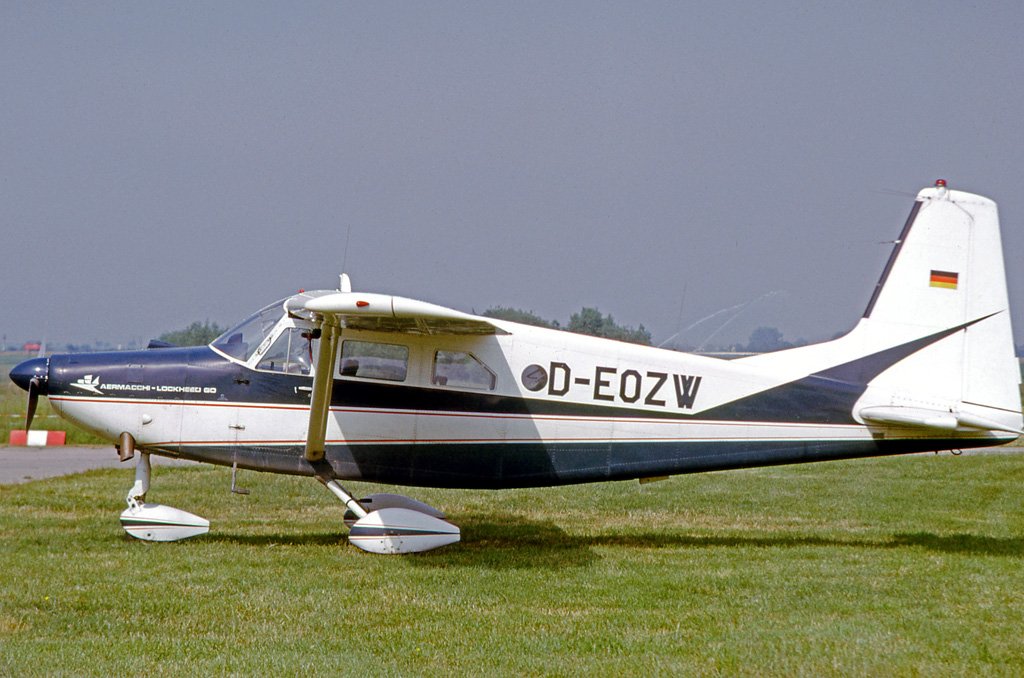
Origins and Design Philosophy
The AL-60 B-2 Santa Maria emerged from an ambitious international collaboration that began with Lockheed Aircraft Corporation's Georgia Division in the late 1950s. Designer Al Mooney, famous for his efficient light aircraft designs including the Mooney M20 series, conceived the original L-402/CL-402 prototype specifically for South American backcountry operations. Lockheed recognized that weak domestic demand in the United States made overseas production more viable, leading to an unprecedented multi-national licensing arrangement.
The prototype CL-402 first took flight on September 15, 1959, at Marietta, Georgia, powered by a 250-horsepower Continental IO-470-G engine. A second prototype equipped with the turbocharged TSIO-470-B engine followed shortly after, earning FAA type certification on April 5, 1960, with revisions completed on December 14, 1960, for the turbocharged variant.
International Production Network
Production commenced simultaneously across four countries between 1960 and 1974, creating one of the most geographically dispersed manufacturing programs in general aviation history. Mexican production by Lockheed-Azcarate SA (LASA) in San Luis Potosí ran from 1960 until April 1962, yielding 41 aircraft designated as LASA-60s. Of these, 18 were delivered to the Mexican Air Force for training and utility missions.
Argentine assembly by Aviones Lockheed-Kaiser Argentina began in 1961 at their Santa Isabel facility in Córdoba but proved less successful, completing only 11 of a planned 16 aircraft before production ceased. The Italian operation, however, became the most productive variant of the international program.
Aermacchi's Italian Production
Aeronautica Macchi S.p.A., founded in 1912 and known for transitioning from seaplanes to successful trainers like the MB-326, acquired AL-60 production rights as part of their strategy to expand beyond military aircraft into the utility market. The first Italian-built AL-60 took flight on April 19, 1961, from their Varese facility.
Aermacchi developed two primary variants: the AL-60B-1 with a 250-horsepower Continental IO-470-R engine, of which only four were built, and the AL-60B-2 Santa Maria featuring the turbocharged 260-horsepower Continental TSIO-470-B powerplant. Production of the B-2 variant totaled between 81 and 85 aircraft, with sources varying slightly on the exact count. Overall Aermacchi output reached approximately 85 AL-60B units before Italian production ended in 1972.
Engine and Performance Characteristics
The AL-60 B-2's Continental TSIO-470-B engine represented the most advanced powerplant option in the AL-60 family. This turbocharged inline piston engine delivered 260 horsepower, providing only a modest 10-horsepower increase over the non-turbocharged IO-470 variants but offering crucial performance advantages at high altitude and temperature conditions. The engine proved reliable in utility operations, though the power gains were less dramatic than initially anticipated.
Continental's IO-470 and TSIO-470 series engines, produced by Teledyne Continental Motors throughout the 1950s and 1970s, powered thousands of general aviation aircraft including the popular Cessna 182. The AL-60's tricycle landing gear configuration and robust construction made it well-suited for unprepared airstrips and challenging operating conditions.
Military and Government Service
While designed primarily as a civil utility aircraft, the AL-60 family found modest military applications. The Mexican Air Force's 18 LASA-60 aircraft served in training and utility roles throughout the 1960s. The most significant military variant emerged in South Africa, where Atlas Aircraft Corporation produced 40 C4M Kudu aircraft between 1973 and 1974 for the South African Air Force.
The Kudu program involved eight aircraft fully manufactured in Italy with 32 assembled in South Africa. These aircraft served with two SAAF squadrons in reconnaissance and liaison roles until 1992, representing the longest military service life of any AL-60 variant. Notably, Aermacchi lost a potential Italian Army contract to the SIAI Marchetti SM-1019 despite completing prototype demonstrations.
Commercial Challenges and Legacy
Despite its international production network and technical capabilities, the AL-60 struggled against established competitors, particularly the Cessna 182, 185, and 206 series. Limited support networks and parts availability hindered market acceptance, and the aircraft never achieved the commercial success its designers envisioned. Total production across all variants and locations exceeded 170 aircraft, though exact figures vary due to overlapping licensing arrangements.
The AL-60's significance lies not in commercial triumph but in its demonstration of international collaboration in aircraft manufacturing during the 1960s. It represented Lockheed's only venture into light general aviation and showcased how American designs could be adapted and produced globally to serve niche markets.
Current Status and Preservation
Few AL-60 aircraft remain airworthy today, making surviving examples increasingly rare and valuable to aviation enthusiasts. The Volandia Park museum in Varese, Italy, displays an AL-60B donated by the Bertolina Family in 2012, serving as a testament to the local manufacturing heritage. Other examples survive in private collections, including the notable YU-BCZ, which has been documented by aviation historians as an exceptionally rare survivor.
The AL-60 B-2 Santa Maria stands as a fascinating footnote in aviation history, representing the complex international partnerships that characterized aircraft development during the jet age's early years and the challenges faced by specialized utility aircraft in an increasingly competitive market.