
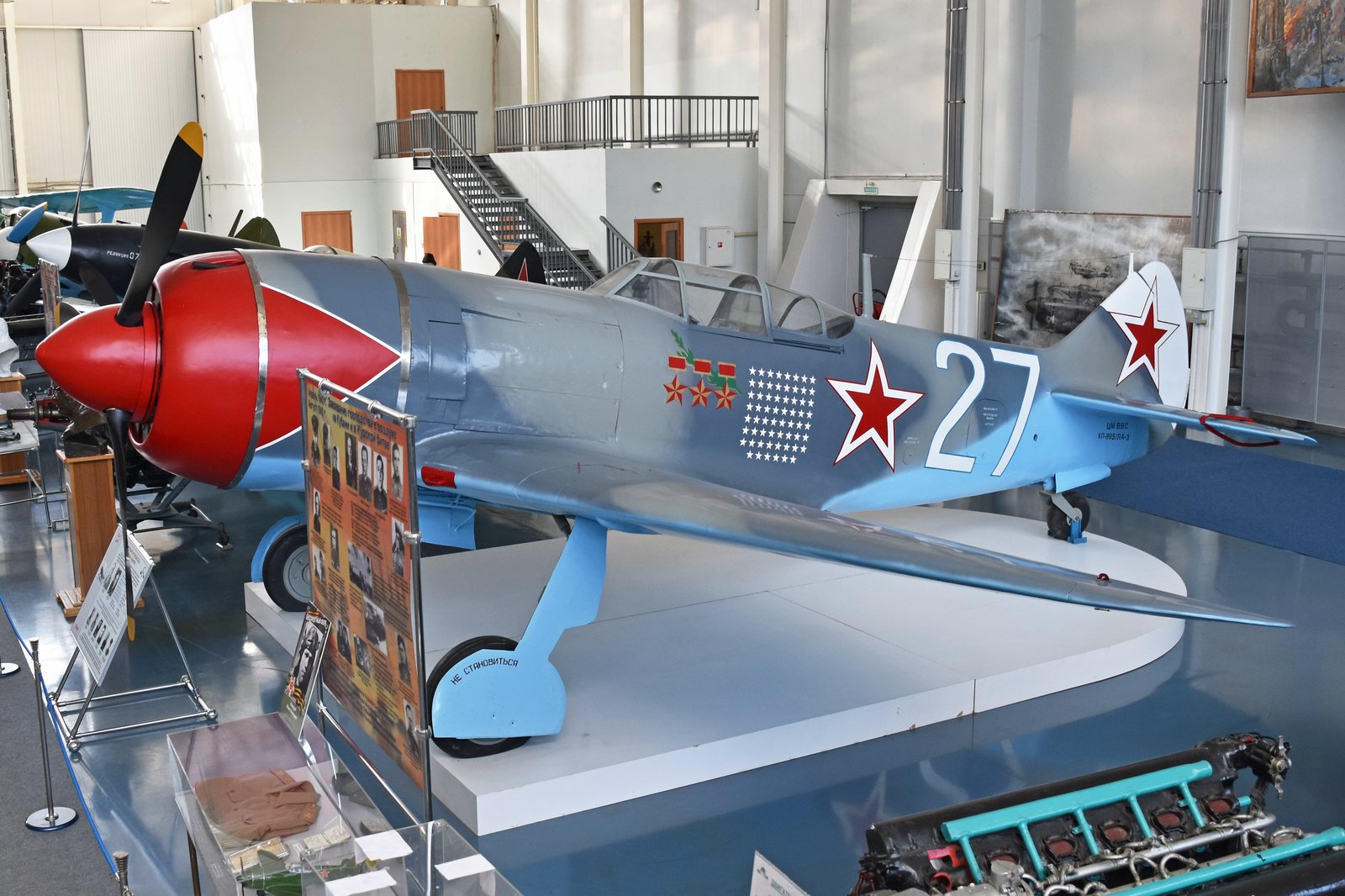
The Lavochkin La-7 was developed by the S. A. Lavochkin Design Bureau under the leadership of Semyon Alekseyevich Lavochkin. Emerging as a heavily modified version of the La-5, the prototype first flew on February 1, 1944. The design focused on extensive aerodynamic cleanup to reduce drag, featuring a reshaped cowling, an improved canopy, and refined wing-fuselage fairings. To enhance durability and strength, the designers increased the use of metal in the airframe, specifically implementing metal wing spars.
Production of the La-7 took place between May 1944 and August 1946 across three primary state factories: Plant No. 21 in Gorky (now Sokol), Plant No. 381 in Moscow, and Plant No. 99 in Ulan-Ude. A total of 5,753 single-seat fighters were manufactured, alongside 584 La-7UTI two-seat trainers. The aircraft was powered by a Shvetsov ASh-82FN 14-cylinder air-cooled radial engine, which produced approximately 1,850 hp. This powerplant enabled a maximum speed of 661 km/h (411 mph) at an altitude of 6,000 meters, making it competitive with German Bf 109G and Fw 190A fighters.
Operational service began in June 1944 with the Soviet Air Forces (VVS), debuting during Operation Bagration. Primarily utilized as a day fighter for air superiority, the La-7 also performed bomber escort, fighter sweeps, and ground-attack missions, with some configurations capable of carrying 200 kg of bombs or underwing rockets. The aircraft is famously associated with Ivan N. Kozhedub, the top Allied ace of the war, who used the La-7 to score 17 of his 62 victories, including a Messerschmitt Me 262 jet on February 19, 1945.
Beyond the Soviet Union, the Czechoslovak Air Force operated a small batch of La-7s until 1950, and the North Korean Air Force employed them during the opening stages of the Korean War in June and July 1950. While the VVS phased out the type by 1947 in favor of jet aircraft, the La-7 remains historically significant as the culmination of Soviet piston-fighter development. Today, several examples are preserved in museums across Russia and former Eastern Bloc nations.