
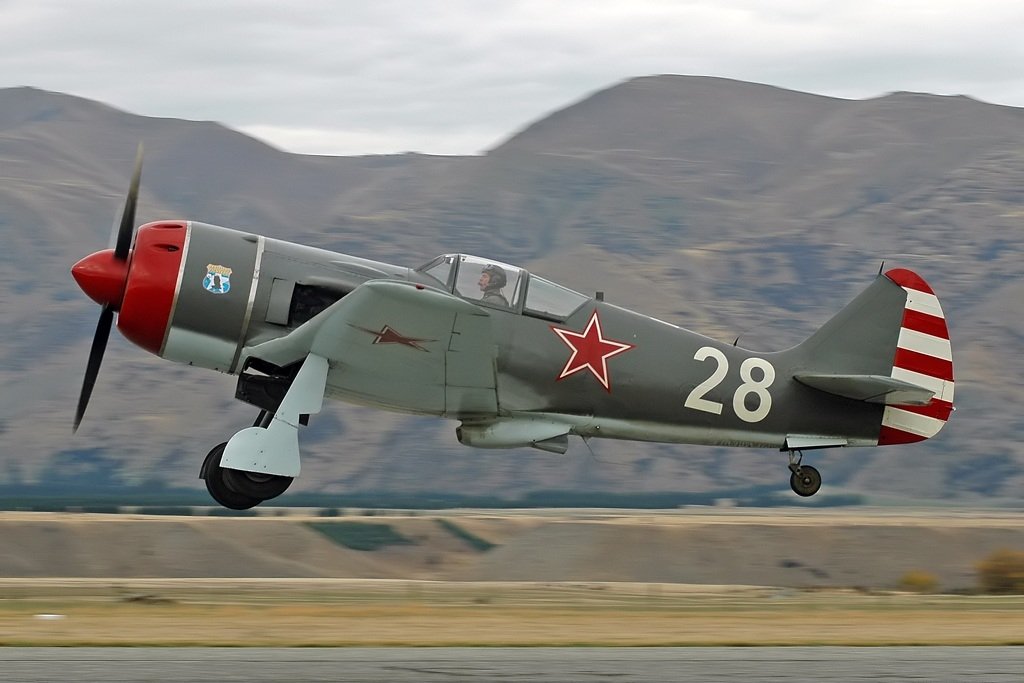
The Lavochkin La-9, designated by NATO as the “Fritz,” was a late-1940s Soviet single-seat fighter that represented the peak of piston-engine development by the Lavochkin design bureau. Led by Semyon Alekseevich Lavochkin, the design evolved from the La-126 prototype, with the first all-metal prototype, the La-130, completed in 1946. While it shared a superficial resemblance to the earlier La-7, the La-9 was a significant structural departure, utilizing an all-metal construction and a laminar-flow wing to reduce drag and enhance high-speed performance. This modernization allowed for increased fuel capacity and a heavier armament of four 23 mm Nudelman-Suranov NS-23 cannons, each with 75 rounds.
Production began in August 1946 and continued through 1948, with a total of 1,559 aircraft manufactured in the Soviet Union. The aircraft was powered by a Shvetsov ASh-82FN (or ASh-82FHV) 14-cylinder, two-row, air-cooled radial engine, producing between 1,380 kW (1,850 hp) and 1,395 kW (1,870 hp). These specifications enabled a maximum sea-level speed of 689 km/h (428 mph) and a service ceiling of 11,235 meters. Despite its speed, the La-130 prototype was found to be inferior to the Yakovlev Yak-3 in horizontal maneuvers during mock combat.
Though it entered service too late for World War II, the La-9 saw operational use during the early Cold War. It served primarily as an interceptor for the Soviet Air Force (VVS) and Soviet Air Defense Forces (PVO), targeting bombers and transports. Other operators included the People's Liberation Army Air Force (PLAAF) of China, which imported 129 aircraft in 1950, as well as air forces in North Korea and Romania, and the East German Volkspolizei. The aircraft saw action during the Korean War, where the majority of its engagements occurred.
Experimental variants explored hybrid propulsion; the La-130R project utilized a liquid-fuel rocket engine but was cancelled in 1946. The La-9RD, tested between 1947 and 1948, featured two RD-13 pulsejets under the wings, which increased top speed by 70 km/h but were abandoned due to extreme noise and vibration. The La-9 remained in Soviet and Chinese service until 1959. Today, only one airworthy example exists, restored by Pioneer Aero Restorations and held by the Military Aviation Museum in Virginia Beach, USA, while a La-9UTI trainer is preserved at the PLAAF Museum in China.