
Service Dominance
By April 1945, more than 1,000 Lancasters operated in frontline service with RAF Bomber Command, vastly outnumbering the Halifax and Mosquito bombers combined. The Lancaster's war record was extraordinary: 156,000 combat sorties delivered 608,612 long tons of bombs between 1942 and 1945. However, this success came at tremendous cost, with 3,249 aircraft lost in combat operations and another 487 destroyed in ground accidents—representing 51 percent of all Lancasters built.
Famous Operations
The Lancaster achieved legendary status through Operation Chastise in May 1943, when specially modified aircraft from 617 Squadron carried Barnes Wallis's revolutionary "Upkeep" bouncing bombs against German dams in the Ruhr valley. The precision attack on the Möhne, Eder, and Sorpe dams demonstrated the aircraft's adaptability for specialized missions beyond conventional bombing. Throughout the war, Lancasters targeted critical industrial facilities including the Auguste Viktoria benzol factory and oil installations, systematically degrading German fuel production capacity.
Manufacturing Achievement
A.V. Roe and Company designed the Lancaster at their Chadderton facility near Manchester, with prototype BT308 assembled at Ringway Airport using a modified Manchester airframe fitted with a new four-engine wing. Test pilot H.A. "Sam" Brown conducted the maiden flight on January 9, 1941. Wartime demand necessitated forming the Lancaster Aircraft Group, distributing production across multiple companies: A.V. Roe built 3,973 aircraft at Woodford, Chadderton, and Yeadon; Armstrong Whitworth contributed 1,329 from Whitley; Metropolitan-Vickers added 1,080 from Trafford Park; and Victory Aircraft produced 430 in Canada.
Technical Excellence
The Lancaster evolved from the problematic twin-engine Manchester, which suffered from unreliable Rolls-Royce Vulture engines and was withdrawn after only 200 examples. Originally designated Type 683 Manchester III, the four-engine configuration transformed the design's potential. Early Lancaster B.I variants used Merlin 20 or 22 engines, while later aircraft received Merlin 28 or 38 powerplants. The B.III variant employed American-built Packard Merlins, and Canadian aircraft used Merlin 224 engines. This inline V-12 liquid-cooled engine became one of World War II's most successful powerplants.
Operational Characteristics
The Lancaster's mid-wing configuration and spacious bomb bay accommodated various ordnance loads, from conventional high-explosive bombs to specialized weapons like the massive "Grand Slam" earthquake bombs. Crews typically consisted of seven men: pilot, flight engineer, navigator, bomb aimer, wireless operator, and two gunners. The aircraft's reliability and handling characteristics earned pilot confidence, though combat losses were severe—only 35 Lancasters completed more than 100 successful operations, with the most successful survivor achieving 139 missions before retirement in 1947.
Industrial Scale
Production complexity was staggering: over 920 companies across Britain and Canada contributed components, employing more than 1.1 million workers at peak manufacturing periods. Total production reached 7,377 aircraft between 1941 and 1946, with the final example rolling off A.V. Roe's production line on February 2, 1946. This represented one of the largest coordinated manufacturing efforts in aviation history.
Legacy and Survivors
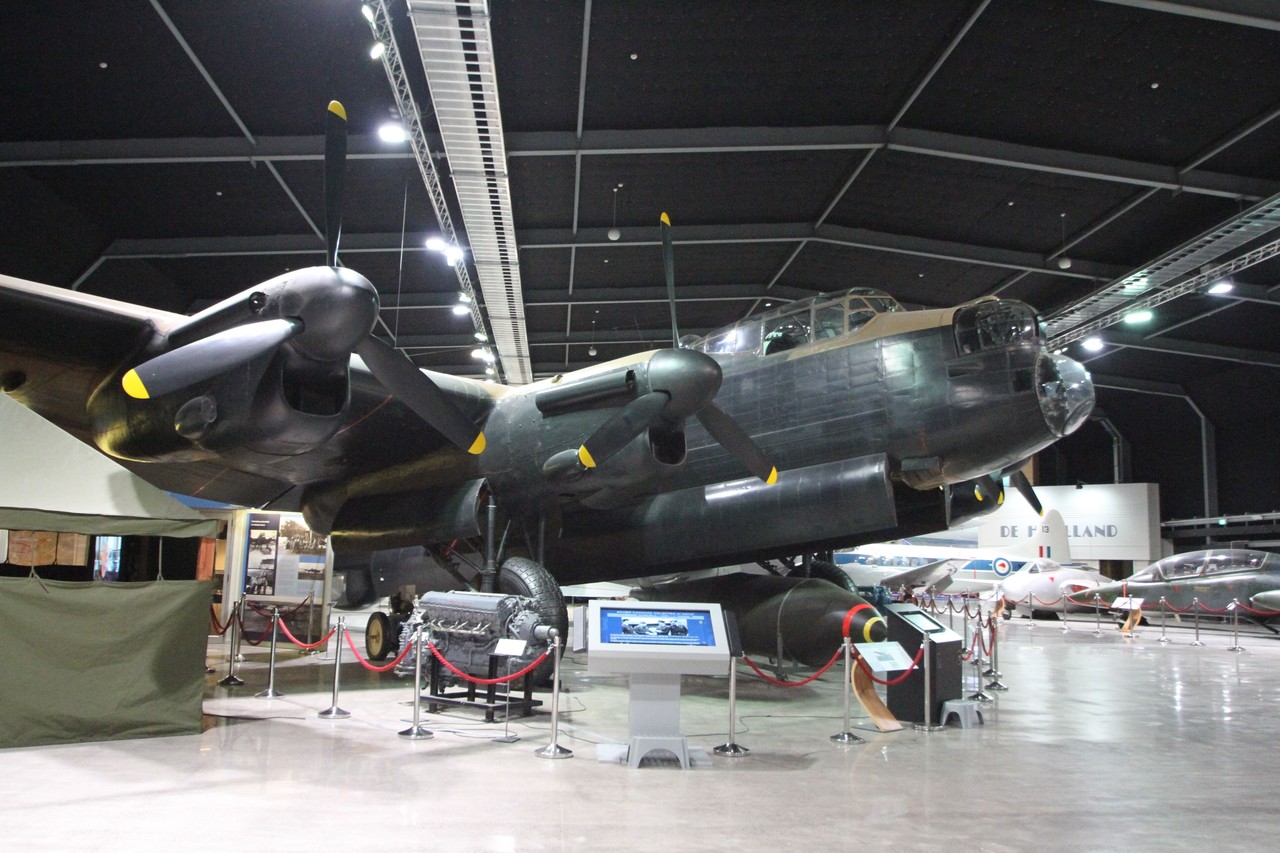
Of 7,377 Lancasters built, only 17 complete aircraft survive today. Two remain airworthy, with two others in taxiable condition with operational engines. The Lancaster's impact extended beyond pure military statistics—it represented the pinnacle of British heavy bomber design and demonstrated the industrial mobilization possible during wartime. More service personnel were involved in flying and maintaining Lancasters than any other British aircraft in history, cementing its position as the most significant RAF bomber of World War II.