
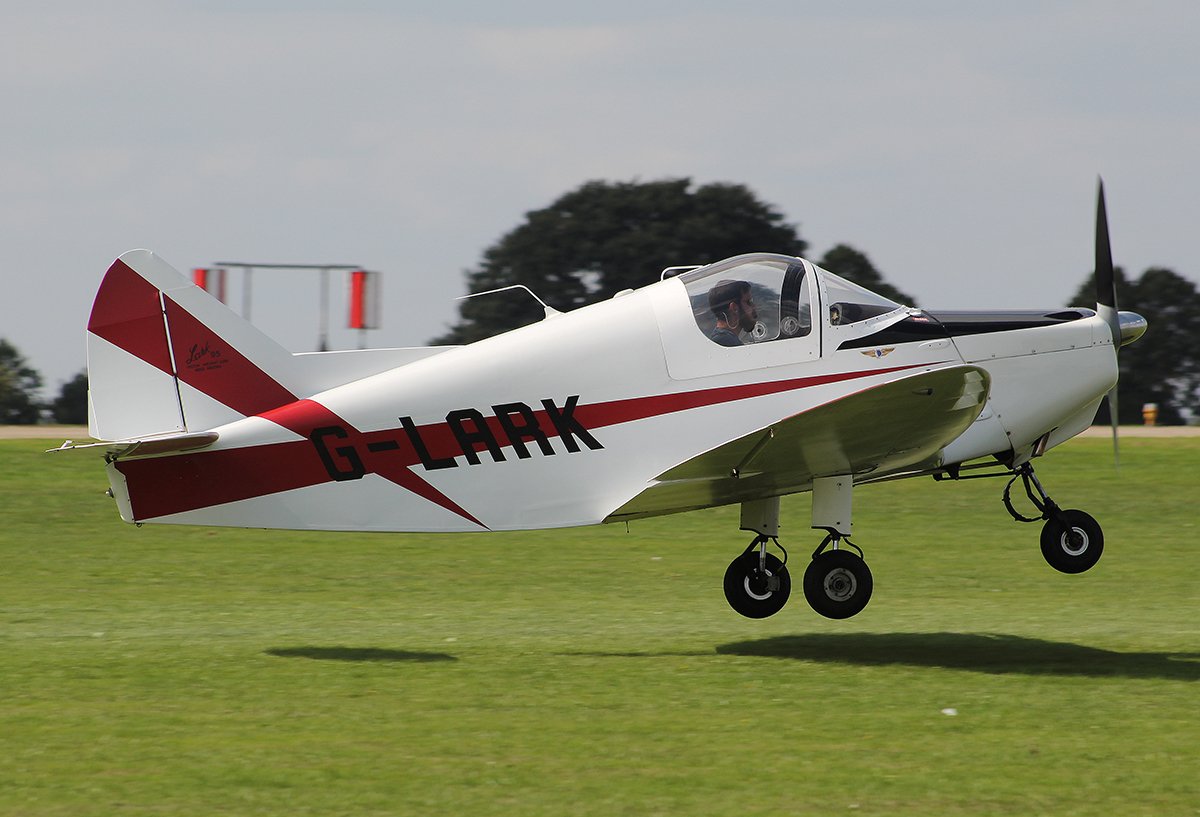
A Drone's Second Life
Few aircraft can claim a more circuitous path from military service to civilian flying than the Helton Lark 95. Born from the ashes of World War II target drone programs, this rare general aviation aircraft represented an unusual attempt to resurrect 1940s military technology for the booming civilian market of the 1960s.
Service History
The Lark 95's story begins not with civilian aviation, but with the urgent wartime need for realistic aerial targets. During World War II, the original Culver Cadet design served extensively as radio-controlled target drones. The U.S. Army Air Forces operated 200 PQ-8 variants powered by Franklin engines, followed by 200 PQ-8A models equipped with 125-horsepower Lycoming O-290 engines. The Navy simultaneously operated 200 TDC-2 variants based on the Army's PQ-8A configuration, with orders placed in late 1941 as America entered the war.
The Manufacturer
Helton Aircraft Corporation of Mesa, Arizona acquired the rights to develop the Culver Cadet design after the original Lark Aircraft Company folded without completing any airframes. Operating from 1966 until ceasing business around 1971, Helton represented the final chapter in the Cadet's evolution. The company's brief five-year existence focused solely on transforming military surplus designs for civilian use, making it a specialized player in post-war aviation development.
Design Origins
The aircraft's technical foundation traced back to Al Mooney, the legendary designer who led engineering at Culver Aircraft Company before founding his own aircraft manufacturing empire. Mooney's original Culver Cadet prototype first flew on December 2, 1939, featuring revolutionary semi-monocoque fuselage construction that replaced traditional welded steel tube frameworks. This innovation provided superior strength-to-weight ratios while accommodating the aircraft's distinctive elliptical wing planform.
Engine and Technical Details
The Lark 95 was powered by a Continental C90-16F engine, a four-cylinder horizontally opposed powerplant producing 90 horsepower. Continental Motors, now Continental Aerospace Technologies, designed this air-cooled engine as part of their reliable C90 series that became a cornerstone of post-war general aviation. The aircraft retained the Cadet's fixed tricycle landing gear configuration, a progressive feature that simplified ground handling compared to conventional tailwheel designs of the era.
The two-seat configuration accommodated a pilot and passenger in side-by-side seating, with the aircraft's low-wing design providing excellent visibility and stable flight characteristics. One documented example accumulated 900 hours total time on both airframe and engine, demonstrating the design's durability despite its limited production numbers.
Production and Variants
Helton achieved FAA type approval in September 1966 and delivered all 15 Lark 95 aircraft that same year, making it one of the shortest production runs in aviation history. The company also developed a Lark 95A variant featuring a fuselage extended by two feet and revised tail surfaces, though production numbers for this variant remain undocumented.
Serial number 9506, a 1966 production aircraft, became notable for its involvement in an NTSB-investigated accident, providing rare documentation of the type's operational history. Some examples received Permit to Fly certification rather than standard airworthiness certificates, reflecting their specialized nature as converted military designs.
Performance Characteristics
While specific performance data for the Lark 95 remains limited, the aircraft inherited the Cadet's capability for approximately 135 miles per hour cruise speed. The elliptical wing design, similar to that famously employed on the Supermarine Spitfire, provided efficient lift distribution and contributed to the aircraft's distinctive appearance. Maximum speed approached 124 miles per hour, with the Continental powerplant providing adequate performance for training and recreational flying.
Legacy and Preservation
Despite extremely limited production, several Lark 95 examples survive in airworthy condition as of the 2020s. The aircraft appears occasionally at airshows, particularly in California venues like Santa Paula and Camarillo, where enthusiasts appreciate its unique historical significance. Related Culver Cadet examples are preserved at the Historical Aircraft Squadron Museum in Carroll, Ohio, the Chico Air Museum in California, and the Western Antique Aeroplane & Automobile Museum in Oregon.
The Lark 95's importance extends beyond its modest production numbers. It represents a fascinating bridge between wartime necessity and peacetime recreation, demonstrating how military innovations could find new life in civilian aviation. With only 15 examples built, each surviving aircraft serves as a tangible link to both World War II's technological demands and the optimistic general aviation boom of the 1960s.