
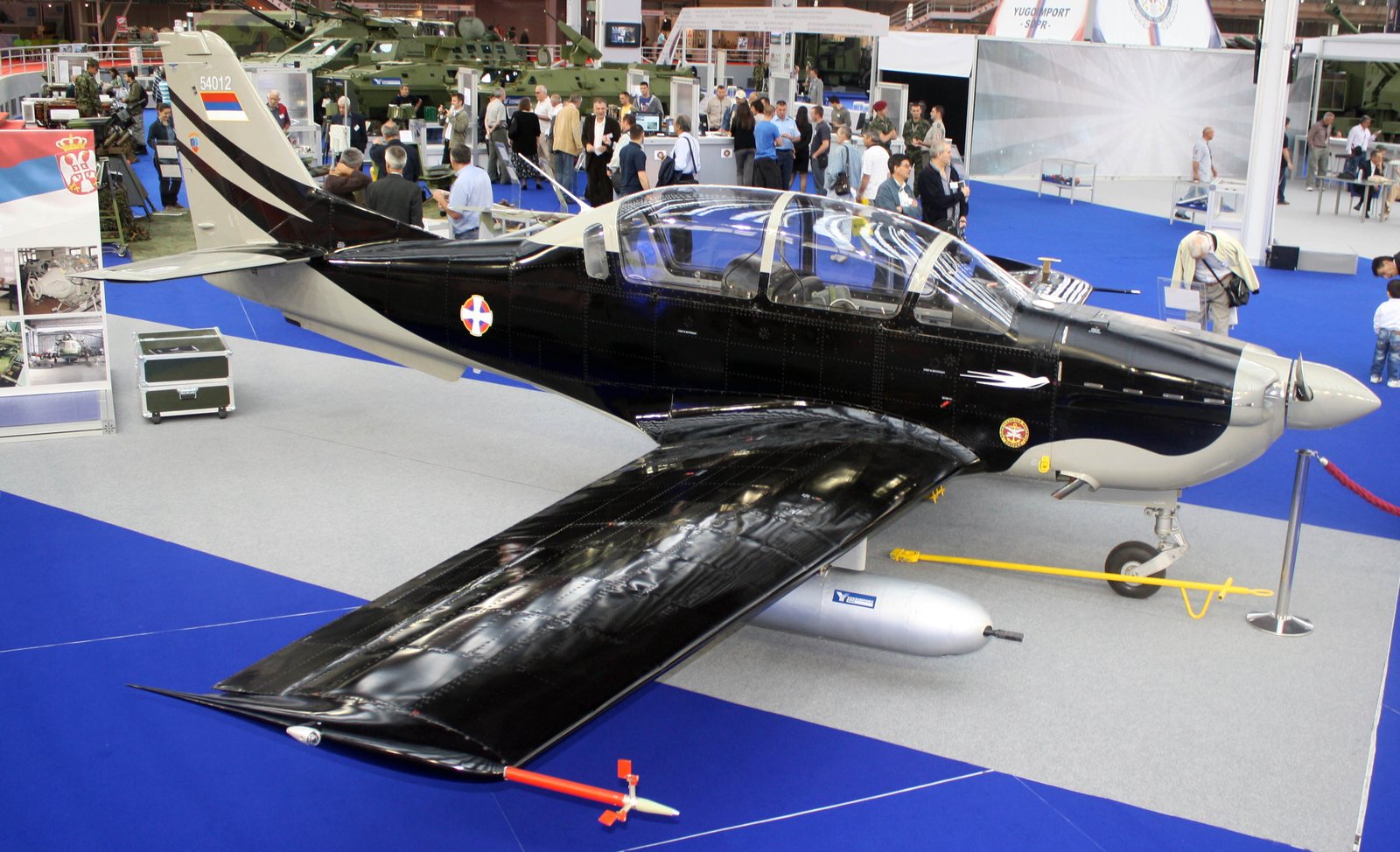
The UTVA N-63 Lasta, also known as the Lasta 95, is a modern Serbian military basic trainer and light attack aircraft. Developed to replace the Utva 75 within the Yugoslav and Serbian Air Forces, the aircraft was designed by the Technical Military Institute (Vojnotehnički Institut) in Belgrade and manufactured by UTVA Aircraft Industry in Pančevo, Serbia. The aircraft's development spanned several decades; the original Lasta 1 prototype first flew on September 2, 1985, while the prototype for the current production-standard Lasta 3 / Lasta 95 flew on February 26, 2009.
Designed as a full-aerobatic trainer, the Lasta is intended to streamline pilot training by covering basic flight, instrument and night flying, and initial weapons training in a single platform. The airframe is an all-metal, low-wing monoplane with a tandem two-seat cockpit. To ensure versatility, it is certified under EASA CS-23 standards in both aerobatic and utility categories. The aircraft is powered by a single Lycoming AEIO-580-B1A six-cylinder, horizontally-opposed, air-cooled piston engine producing 232 kW (315 hp), paired with a two-bladed metal Hartzell HC-C2YR-4CF/FC 8475-6 propeller.
In military service, the Lasta has been adopted by two primary operators. The Iraqi Air Force ordered 20 Lasta 95N aircraft in 2007, with deliveries completed between 2010 and 2012. These aircraft were utilized for basic and advanced training, as well as light attack and counter-insurgency (COIN) roles, including operations against ISIL. The Serbian Air Force and Air Defence operates the Lasta 95V-54 variant, with 14 aircraft in service as of 2017. For combat or utility missions, the aircraft can be equipped with two hardpoints capable of carrying 100 kg bombs, 57 mm rocket pods (seven rockets per pod), or machine-gun pods chambered in 7.62×54 mmR or 12.7×108 mm.
Performance varies by configuration. The Lasta 95 can reach a maximum horizontal speed of 320 km/h at sea level, with some variants reaching 345 km/h at 3,000 meters. It has a never-exceed speed (Vne) of 425 km/h and a service ceiling of 6,300 meters. Depending on the source, its range is cited between 963 km and 1,160 km, with an endurance of 3.5 hours. The aircraft is designed for rough-field operations, utilizing retractable tricycle landing gear.