
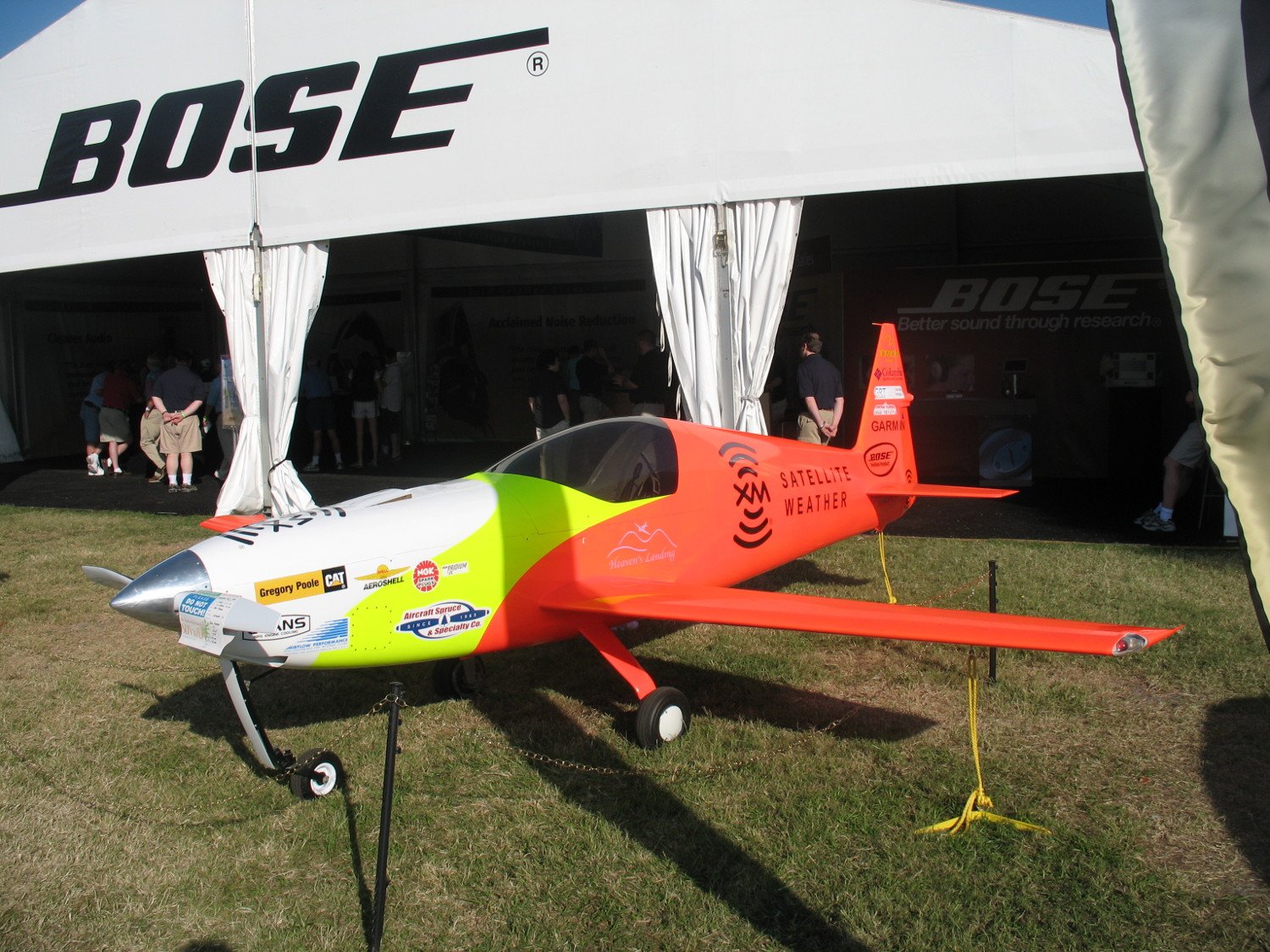
The REFLEX Lightning Bug, also known as the Jones Lightning Bug, is a modern American single-seat aerobatic monoplane designed by Nick Jones. Developed as a follow-up to Jones's larger four-seat White Lightning, the Lightning Bug was a departure in purpose, focusing on high-performance aerobatics and sport flying rather than family cruising. The aircraft was marketed in kit form by Reflex Fiberglass Works, based in Walterboro, South Carolina, starting in the mid-1990s.
Technically, the aircraft is characterized by a clean, low-drag fiberglass composite airframe with a cantilever low-wing and an enclosed cockpit protected by a bubble canopy. To further reduce drag, the design incorporates retractable conventional (tailwheel) landing gear. The aircraft is powered by a single AMT 808 three-cylinder, in-line, air-cooled, two-stroke piston engine with dual ignition. Two specific variants of this engine were utilized: the L-95, producing 71 kW (95 hp) at 7,000 rpm, and the L-100, producing 75 kW (100 hp) at 7,000 rpm. Both engine versions weigh approximately 59 kg (130 lb).
Performance figures highlight the efficiency of the composite design. The Lightning Bug is capable of reaching estimated maximum level speeds between 400 km/h (250 mph) and 445 km/h (276 mph), with a maximum cruising speed of 362 km/h (225 mph). It possesses a rate of climb of 366 m/min (1,200 ft/min) and a service ceiling of 6,096 m (20,000 ft). Its stall speed is 137 km/h (85 mph) in a clean configuration and drops to 100 km/h (62 mph) during landing. The aircraft's wing area is small, measuring approximately 3.71 m² (40 sq ft).
Production was limited, with at least nine aircraft documented on the FAA register. By February 2014, two of these remained on the U.S. registry. The aircraft's reach extended beyond the United States, as evidenced by VH-EMK4 (c/n 6), an example built in South Australia by Milton King and registered in November 2017. The business associated with the Lightning Bug was acquired in 2008 by the owner of Rapture Aviation, who subsequently developed the Rapture Bug, a derivative design intended to simplify manufacturing and improve performance. While the original Reflex Fiberglass Works is no longer the active marketer of the design, the Lightning Bug remains a significant example of 1990s experimental composite aviation.