
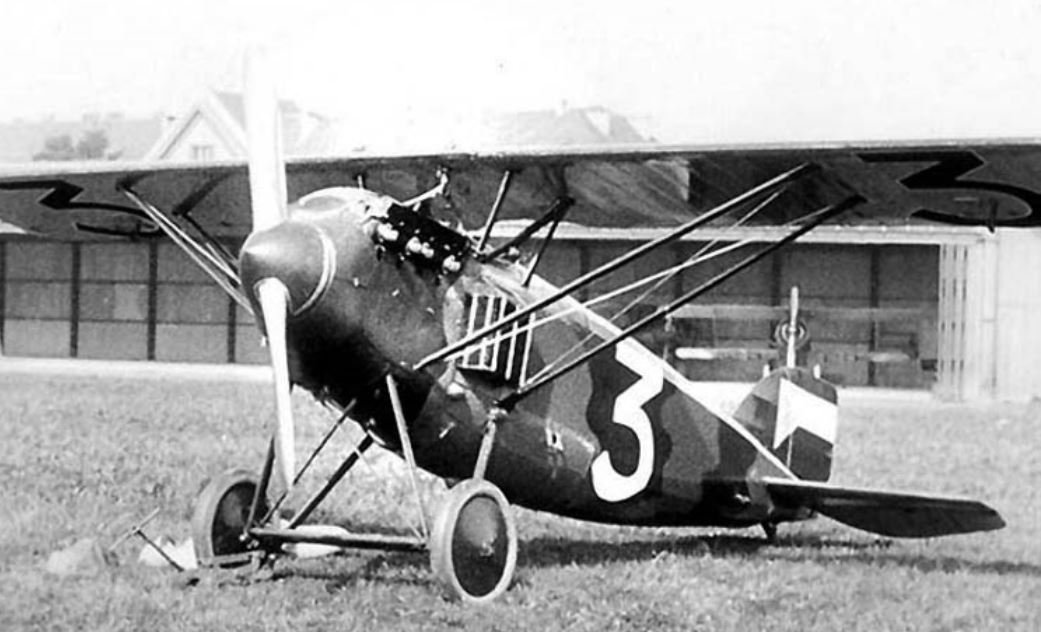
The Letov Š-14 was a single-seat, single-engine prototype fighter developed in Czechoslovakia during the early 1920s. Designed by Alois Šmolík, who served as the chief designer and technical director at the Vojenská továrna na letadla Letov (Military Aircraft Factory Letov), the aircraft was part of an early effort to establish indigenous fighter capabilities for the newly independent Czechoslovak state. The factory, located in the Kbely/Letňany area of Prague, had been founded in 1918 by the Ministry of Defense and would later become a primary supplier of military aircraft, producing successful series such as the Š-20 and Š-328.
Originally constructed in 1924 as a single-bay biplane, the Š-14 featured mixed construction consisting of a metal-framed fuselage with rounded decking and wooden wings of constant chord with no stagger. The aircraft was powered by a 300 hp Hispano-Suiza 8Fb water-cooled V-8 piston engine, produced under license in Czechoslovakia by the Škoda Works as the Škoda HS.8Fb. This engine drove a two-blade wooden propeller equipped with a spinner, and the cooling system utilized side radiators. The airframe featured an open cockpit and a fixed conventional tailskid undercarriage.
Although intended as a fighter with a planned armament of two fixed 7.7 mm machine guns (identified as either Vickers vz. 09 or Lewis guns), the Š-14 never entered production or operational military service. Its most significant contribution occurred when it was rebuilt as a cantilever high-wing parasol monoplane for the Third Speed Contest of 1924. In this configuration, the aircraft achieved a recorded speed of 246.44 km/h (153.13 mph), surpassing its biplane maximum speed of 238 km/h (148 mph). Other performance metrics for the prototype included a range of 495 km and a time to altitude of 18.5 minutes to reach 5,000 meters.
Only one example of the Š-14 was ever built. While records indicate that pilot František Peřina may have used the aircraft for training or familiarization between 1929 and 1931, it never saw combat or squadron use. No examples of the aircraft survive today, though historical photographs of the prototype at Kbely airfield remain. The Š-14 remains a significant example of the rapid design evolution led by Šmolík, contributing to the technical experience that enabled Letov's later production successes.