
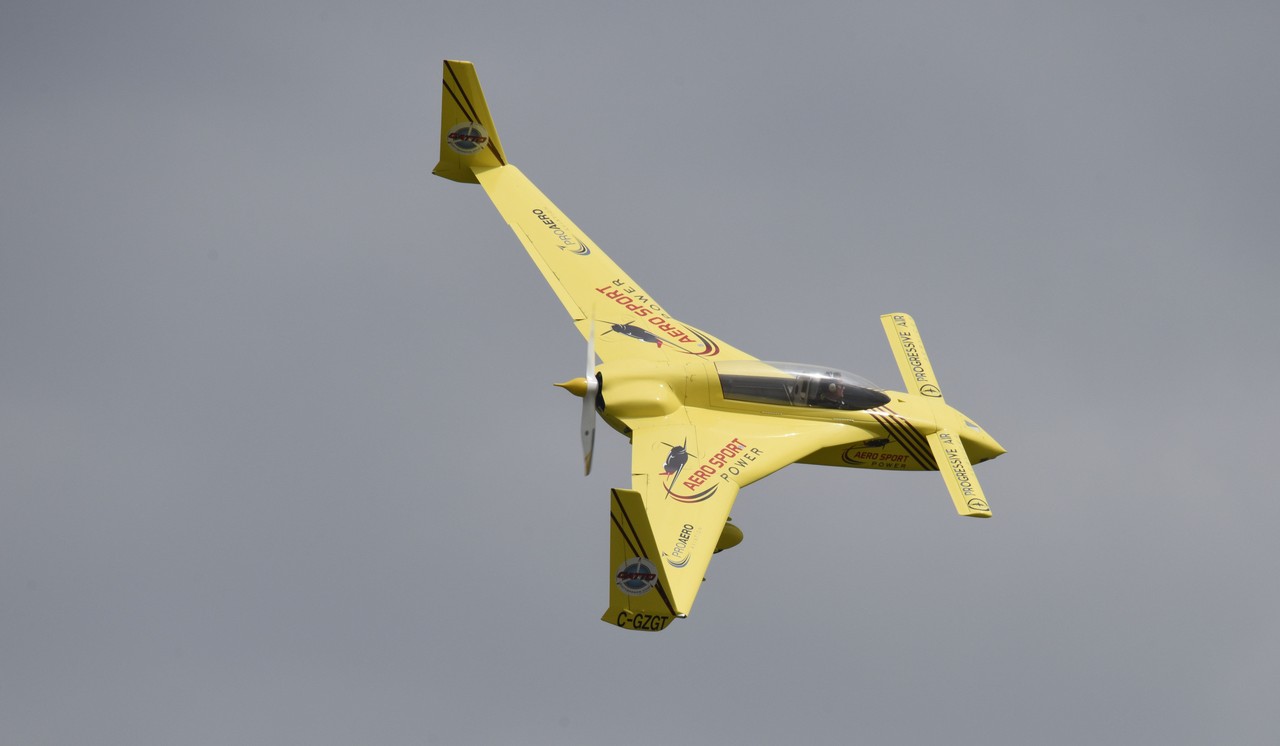
Design Revolution
Burt Rutan conceived the Long-EZ as a scaled-up evolution of his earlier VariEze design, addressing the fundamental challenge of creating an ultra-efficient personal aircraft using readily available engines. The prototype's maiden flight on June 12, 1979, validated Rutan's radical approach to general aviation design. Unlike conventional aircraft, the Long-EZ employed a canard layout with the primary wing positioned behind a smaller forward lifting surface, coupled with a pusher propeller configuration that eliminated the need for a traditional tail.
Record-Breaking Performance
The Long-EZ immediately distinguished itself through extraordinary efficiency achievements. In December 1979, just months after first flight, a Long-EZ equipped with auxiliary fuel tanks established a distance record by flying 4,800 miles nonstop, a record that remains unbroken for aircraft weighing less than 1,000 kilograms. Dick Rutan's modified Long-EZ-B, powered by a 180-horsepower Lycoming IO-360, extended this legacy in July 1981 by setting a World Class distance record of 4,563.35 miles, flying the great circle route from Anchorage, Alaska to Grand Turk Island.
Homebuilt Success Story
Rutan Aircraft Factory offered Long-EZ plans from 1980 to 1985, requiring builders to invest 600 to 1,000 hours of construction time and approximately $5,000 to $9,000 in materials. This plans-only approach democratized access to high-performance aviation, enabling skilled amateurs to construct aircraft rivaling factory-built designs. By late 2005, approximately 700 Long-EZs carried FAA registration, growing to 833 aircraft by 2021, making it among the most successful homebuilt designs in aviation history.
Technical Innovation
The Long-EZ incorporated several groundbreaking features that set new standards for amateur-built aircraft. Its fiberglass construction utilized a 33 percent larger main wing compared to the VariEze, featuring a modified Eppler 1230 airfoil with reduced sweep angle. The enlarged wing strakes provided additional fuel capacity and baggage storage while contributing to the aircraft's distinctive appearance. Wingtip-mounted rudders eliminated the need for a conventional vertical stabilizer, reducing drag and weight.
Engine and Performance Specifications
Most Long-EZ aircraft employed the reliable Lycoming O-235 air-cooled flat-four engine, producing 115 horsepower and driving the rear-mounted propeller through a belt reduction system. This powerplant enabled cruise speeds approaching 180 miles per hour while consuming fuel at remarkably low rates. The standard fuel capacity of 52 gallons provided over 10 hours of endurance, translating to ranges exceeding 1,600 miles under optimal conditions. The aircraft's empty weight of 710 pounds and maximum takeoff weight of 1,325 pounds demonstrated exceptional structural efficiency.
Global Adventures and Demonstrations
The Long-EZ's capability received ultimate validation through Dick Rutan and Mike Melvill's around-the-world flight in 1997. Flying two Long-EZ aircraft they had personally constructed, the pair completed their circumnavigation in slightly over 80 days, accumulating 240 flight hours while covering more than 61,000 kilometers. This achievement earned Dick Rutan the Louis Bleriot Medal from the Federation Aeronautique Internationale, recognizing his contributions to aviation achievement.
Modern Adaptations and Legacy
The Long-EZ platform has served as a testbed for advanced propulsion concepts, most notably XCOR Aerospace's EZ-Rocket, which replaced the conventional engine with twin liquid-fueled rocket motors. In 2012, pilot Chip Yates achieved 202.6 miles per hour in level flight using a Long-EZ modified with a 258-horsepower electric motor, establishing it as the fastest manned electric aircraft at that time. These adaptations underscore the design's fundamental soundness and adaptability to emerging technologies.
Museum Preservation and Continuing Influence
Several Long-EZ aircraft have found homes in aviation museums, including the example displayed at Pima Air & Space Museum. Built by John R. Stitt between 1981 and 1983, this particular aircraft (registration N82ST) accumulated over 200 flight hours before Stitt's death in 1986, when his family donated it to preserve the design's historical significance.
The Long-EZ's influence extends far beyond its production numbers, inspiring subsequent generations of efficient aircraft designs and proving that amateur builders could achieve performance levels previously reserved for professional manufacturers. With over 800 examples still registered in the United States alone, the Long-EZ continues to demonstrate Burt Rutan's vision of accessible, efficient personal aviation three decades after production ended.