
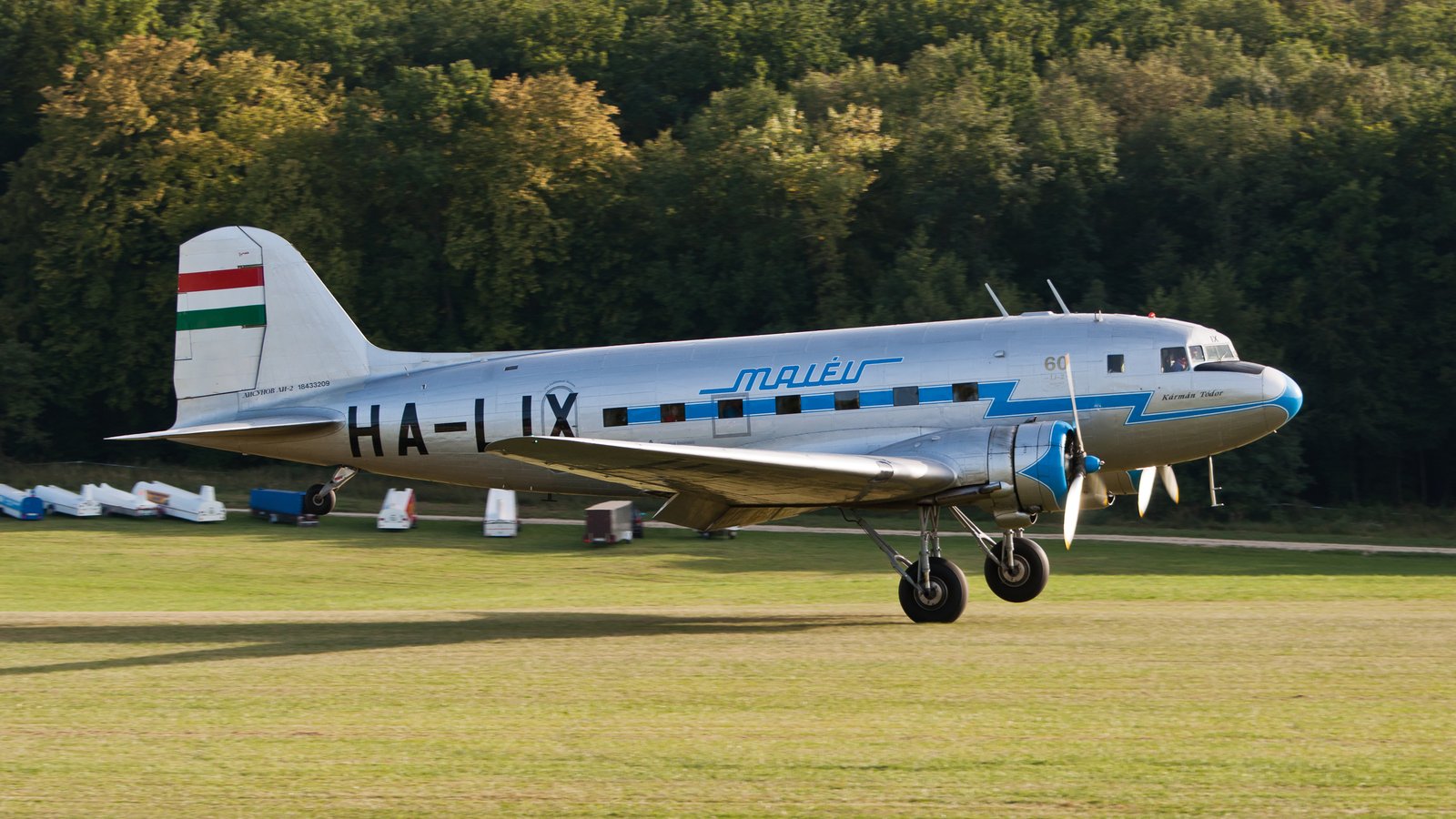
The Lisunov Li-2 was a Soviet adaptation of the Douglas DC-3, developed to meet the specific operational requirements of the USSR. The project was led by Boris Pavlovich Lisunov at Plant No. 84 near Moscow, where Lisunov applied production methods he had studied at Douglas in the United States. Initially designated as the PS-84 (Passenger Aircraft, Plant 84), the aircraft was renamed the Li-2 in September 1942 to honor its lead designer. The first prototype flew in September 1938.
To ensure the aircraft could operate in harsh Soviet environments, the design underwent significant re-engineering. The original US Wright Cyclone engines were replaced with Soviet Shvetsov M-62 or M-63 radial piston engines, which utilized Soviet materials and metric fasteners. The M-62 provided approximately 1,000 hp (746 kW), while the uprated M-63 delivered about 1,100 hp (820 kW). Additionally, the airframe was strengthened for use on unprepared or rough airfields, and the heating and insulation systems were modified for extreme cold. Instrumentation was also updated to Soviet metric standards.
Mass production occurred between 1939 and 1953 across several state factories, including the Tashkent Aviation Plant (now JSC Tashkent Mechanical Plant), the Kazan Aircraft Plant (now Kazan Aircraft Production Association), and the Komsomolsk-on-Amur Aircraft Plant (now KnAAPO). While exact per-plant totals are unknown, the best-documented production total is 4,937 aircraft, with some estimates rounding to 5,000.
During the Great Patriotic War (1941–1945), the Li-2 served the Soviet Air Force (VVS) in diverse roles. Beyond standard troop and cargo transport and paratroop drops, the Li-2 was uniquely adapted as a front-line bomber. Some variants were equipped with under-wing bomb racks capable of carrying roughly 2,000 kg of bombs, as well as dorsal and ventral defensive gun positions with 7.62 or 12.7 mm machine guns. In civil service, Aeroflot was the primary operator, utilizing the aircraft to carry between 21 and 28 passengers on routes across Siberia, Central Asia, and European Russia. Post-war, the type was also operated by the Polish and Czechoslovak Air Forces, as well as LOT Polish Airlines and CSA Czechoslovak Airlines.
Technically, the Li-2 featured a wingspan of 28.81 m and a length of 19.66 m. It reached a maximum speed of approximately 290–300 km/h and had a range of 2,500–2,700 km. Today, a small number of Li-2s survive in museums across Russia, Hungary, Poland, and the Czech Republic, with only a few remaining airworthy in Eastern Europe and Russia.