
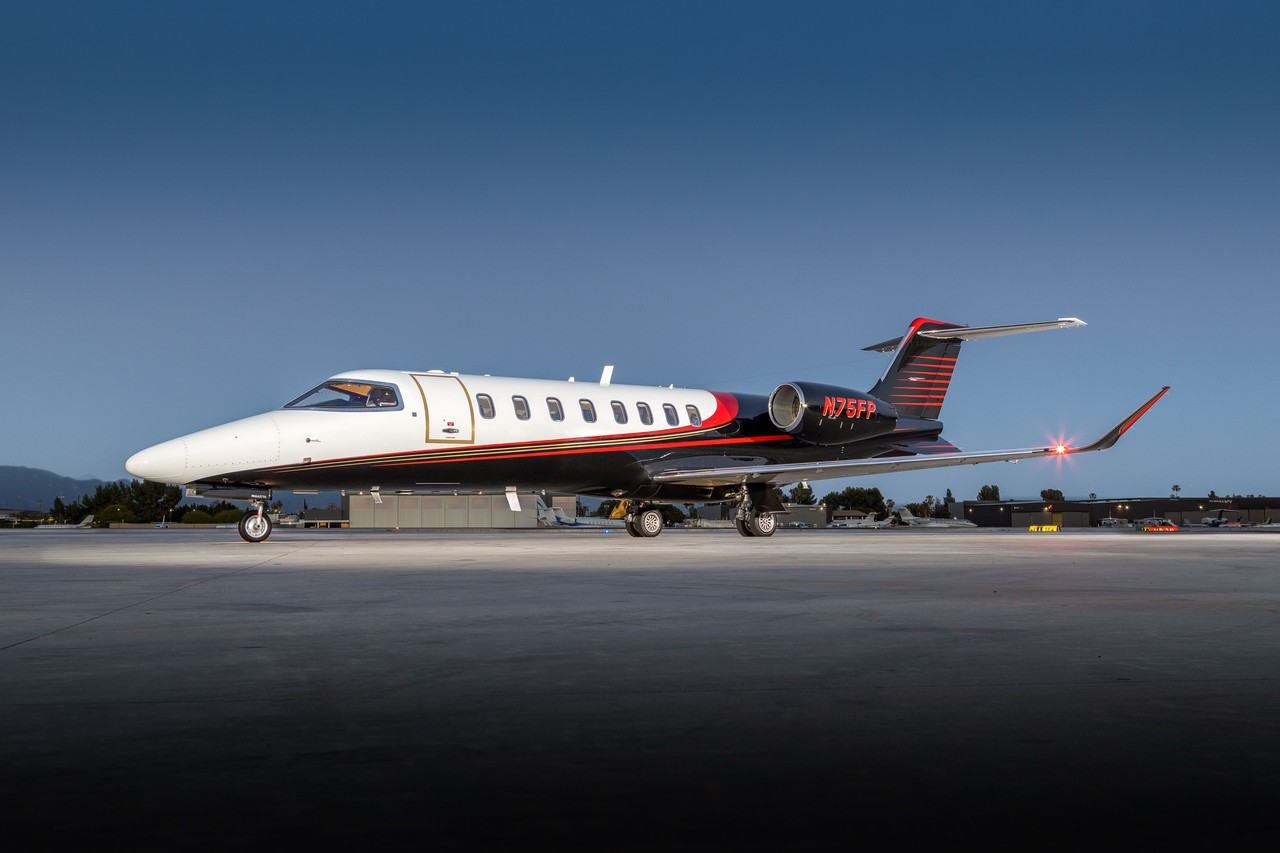
Service History
The Learjet 75 carved out a significant niche in the competitive mid-size business jet market during its nine-year production run. Operating primarily in corporate and charter service, the aircraft attracted owners seeking the prestige of the Learjet brand combined with modern avionics and improved fuel efficiency. By 2022, market analysis revealed that 68 percent of Learjet 75s remained with their original purchasers, while 32 percent had entered the pre-owned market with values ranging from $4.5 million to over $8.9 million.
The aircraft found particular favor among charter operators and corporate flight departments requiring reliable point-to-point transportation. Its enhanced takeoff performance, requiring 12 percent less runway than its predecessor the Learjet 45XR, made it suitable for operations at smaller airports often inaccessible to larger business jets.
The Manufacturer
The Learjet 75's manufacturer traces its origins to aviation pioneer William P. Lear, who established the Swiss American Aircraft Corporation in Switzerland in 1960. Frustrated by slow European progress on his SAAC-23 Execujet project, Lear relocated operations to Wichita, Kansas, in 1962 and renamed the company Lear Jet Corporation. The first Learjet 23 flew in 1963, establishing a dynasty that would define high-performance business aviation for decades.
Bombardier Aerospace acquired the Learjet brand in 1990, integrating it into their expanding business aviation portfolio alongside the Challenger and Global aircraft families. Under Canadian ownership, Learjet production continued for over three decades, with the company modernizing designs while maintaining the brand's reputation for speed and performance. However, facing market pressures favoring larger, more profitable aircraft, Bombardier announced in February 2021 that Learjet production would cease by year's end.
Engine & Technical Details
Powering the Learjet 75 were two Honeywell TFE731-40BR turbofan engines, each producing 3,850 pounds of thrust. These engines, representing an evolution of the proven TFE731 family that had powered business jets since the 1970s, consumed a combined 176 to 214 gallons per hour depending on flight profile. The powerplants enabled the aircraft to reach altitudes exceeding 41,000 feet, placing it above most airline traffic and weather.
The aircraft incorporated significant technological advances over earlier Learjets, including a modern glass cockpit and redesigned winglets that improved fuel efficiency. The cabin, measuring 415 cubic feet, featured eight passenger seats in typical configuration, with options for club seating arrangements. The Learjet 75 Liberty variant, introduced in October 2020, modified the forward cabin with fold-down ottomans and fold-out tables, creating an executive suite configuration.
Performance Characteristics
Pilots appreciated the Learjet 75's combination of traditional Learjet responsiveness with modern systems reliability. The aircraft achieved a maximum cruise speed of 465 knots while offering a long-range cruise speed of 437 knots for extended missions. With four passengers aboard and following NBAA IFR reserves, the Learjet 75 could fly 2,058 nautical miles nonstop, connecting city pairs such as New York to Denver or Los Angeles to Chicago.
The aircraft's performance envelope reflected decades of Learjet design evolution. Crews required type rating certification, with training typically conducted at FlightSafety International or CAE facilities. The aircraft's handling characteristics maintained the crisp, responsive feel that had made Learjets popular among pilots, while modern avionics reduced workload during complex approaches and adverse weather conditions.
Production & Legacy
Learjet 75 production reached significant milestones throughout its manufacturing life. The aircraft received Federal Aviation Administration certification on November 14, 2013, followed by European Aviation Safety Agency approval in September 2014. Production accelerated steadily, with the 100th aircraft delivered in June 2017. The final Learjet 75 rolled off the assembly line in January 2022 and was delivered to Northern Jet Management on March 28, 2022.
The Learjet 75's discontinuation marked the end of an era that had seen more than 3,043 aircraft built across six different Learjet model classes since 1964. The brand had achieved iconic status in business aviation, with "Learjet" becoming synonymous with private jet travel in popular culture. While Bombardier continues manufacturing larger Challenger and Global aircraft, the Learjet name now belongs to aviation history, with the Model 75 serving as the final chapter in a story that began with Bill Lear's vision of democratizing jet travel for business users.
Today, Learjet 75 aircraft continue serving operators worldwide, their modern systems ensuring relevance for years to come despite production ending. The aircraft stands as testament to the evolution of business aviation technology while maintaining the performance characteristics that made the Learjet name legendary among pilots and passengers alike.