
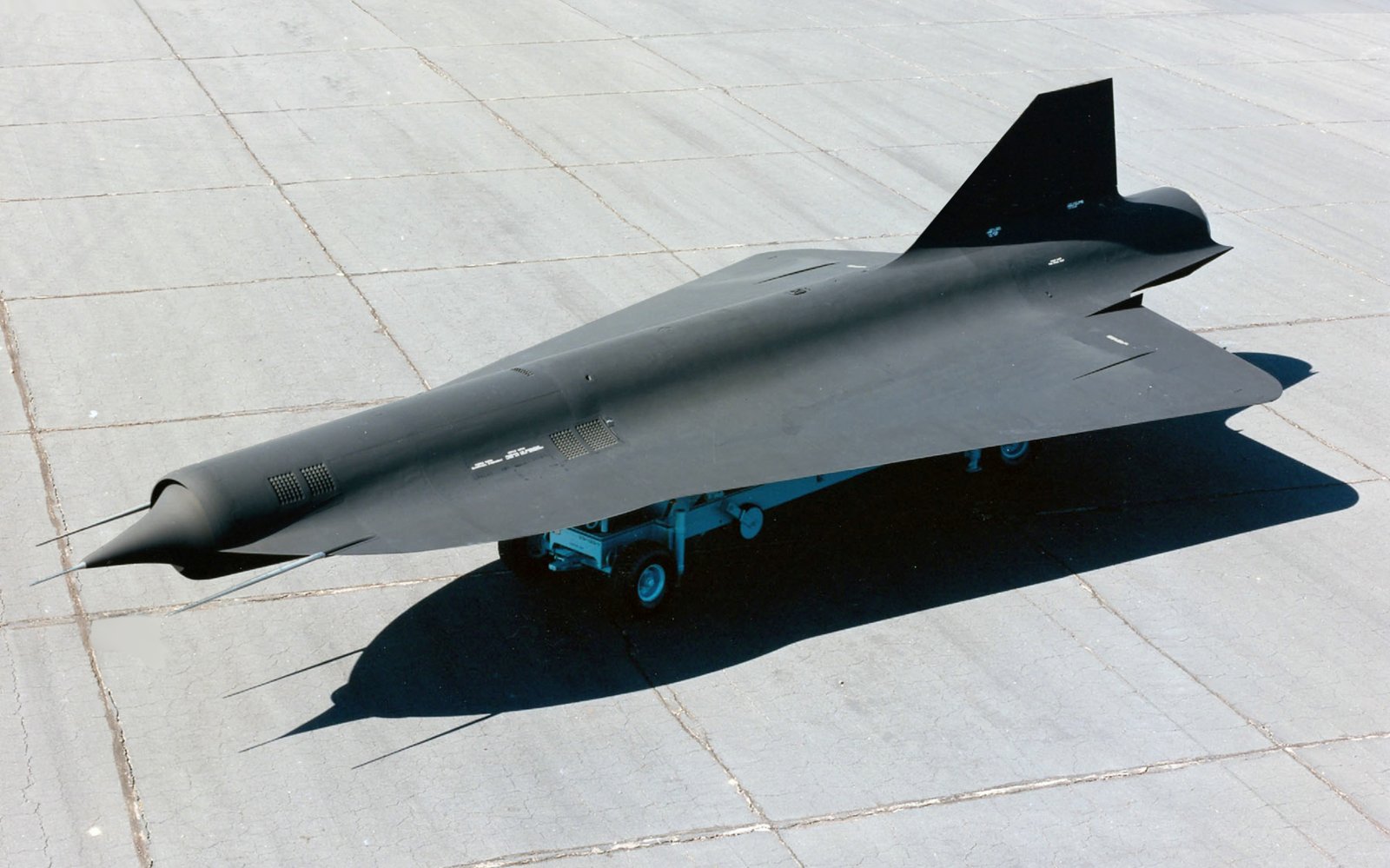
Developed by Lockheed’s Skunk Works team under the leadership of Kelly Johnson, the D-21 was designed as a high-speed, autonomous reconnaissance platform to conduct strategic intelligence missions over denied territories. Johnson specifically established the drone's camera requirements and operational range to ensure it could perform its role without a pilot. The aircraft was characterized by its advanced design for the era, featuring a single high-resolution camera and a system for recovering data packages or self-destructing.
Technical specifications highlight the D-21's extreme performance capabilities. The drone measured 42 feet 10 inches in length and had a loaded weight of approximately 11,000 lb. It was powered by a Marquardt ramjet engine—specifically the RJ43-MA-11 or RJ43-MA-20S4 variants—which produced roughly 1,500 lbf of thrust using JP-7 fuel. These engines enabled the D-21 to reach speeds of approximately Mach 3.35 and operate at service ceilings between 90,000 and 95,000 feet, with a total range of roughly 3,000 to 3,500 miles.
Operational history began with the M-21, a modified A-12 carrier aircraft. The first M-21/D-21 combination flight occurred on December 22, 1964, and the first free launch from an M-21 took place on March 5, 1966. However, the M-21 launch method proved hazardous; during the fourth launch, the D-21 struck the carrier's tail upon separation. While pilot Bill Park survived the incident, LCO Ray Torrick drowned. Consequently, the program shifted to launching the D-21B variant from a B-52 Stratofortress using a rocket booster.
Associated with the CIA and the U.S. Air Force, the drone was utilized in the Tagboard and Senior Bowl programs. Between 1969 and 1971, four operational missions were flown over China, though none resulted in a fully successful recovery of data. The program was officially cancelled in 1971. Today, the D-21's legacy is preserved in museums; a D-21B (serial 533) is displayed at the Pima Air & Space Museum, and another D-21B (Drone 80A-1) is held by the Museum of Flight on loan from the National Museum of the United States Air Force.