
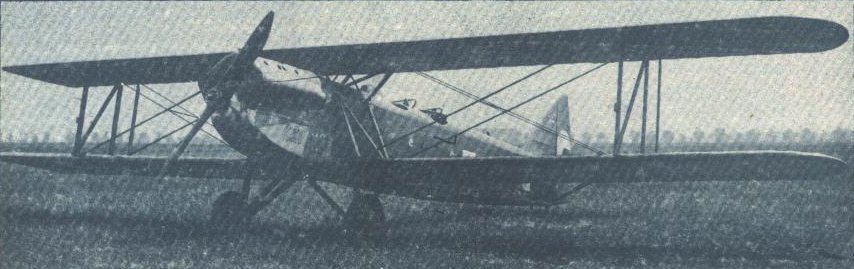
Designed by Alois Šmolík at the Letov Kbely factory near Prague, the Letov Š-16 was a cornerstone of early Czechoslovak military aviation. First flying in 1926, the aircraft was developed as a two-seat biplane intended for aerial observation and bombing roles. The design was characterized by its versatility; while bomber and observation versions existed, they primarily differed in equipment fitout rather than fundamental construction. Approximately 89 aircraft were produced across the family, though some records indicate the Czechoslovak Air Force operated up to 115 aircraft, suggesting a discrepancy in production totals or the inclusion of closely related types.
The Š-16 family is particularly notable for its extensive range of engine configurations. The baseline model utilized a French-made Lorraine-Dietrich 12Cc liquid-cooled W-12 piston engine producing 330 kW (440 hp), driving a two-bladed wooden fixed-pitch propeller. However, Letov developed numerous variants to suit different roles and export requirements. These included the Š-116 with a 500 hp Škoda L engine for long-range reconnaissance, the Š-216 featuring a Walter-built Bristol Jupiter radial engine, and others utilizing powerplants from Hispano-Suiza, Isotta-Fraschini, Praga, and Breitfeld-Daněk. A third prototype, the Š-17, was also fitted with a 500 hp Breitfeld-Daněk (Praga) engine.
In operational service, the Š-16 became a standard asset for the Czechoslovak Air Force. Beyond domestic use, the aircraft served as a tool for international diplomacy and trade. Latvia acquired 21 aircraft (the Š-16L variant) following negotiations in September 1930, while Turkey operated 16 aircraft (the Š-16T variant). Additionally, the Yugoslav Royal Navy operated a single Š-16J seaplane version. The standard bomber configuration featured a fixed 7.7 mm ZB vz. 09 machine gun in the forward fuselage and two 7.7 mm Lewis guns on a flexible mount in the rear, with a bomb load consisting of three 200 kg bombs under the fuselage and twelve 20 kg bombs under the wings.
Technically, the Š-16 achieved a maximum speed of 230 km/h at ground level and a service ceiling of 6,500 m. While the manufacturer, Letov, later served as a repair facility for German aircraft and produced the Junkers Ju 290 during World War II, the Š-16 itself remains a symbol of the inter-war period. No complete airframes are known to survive today in museum or airworthy condition.