
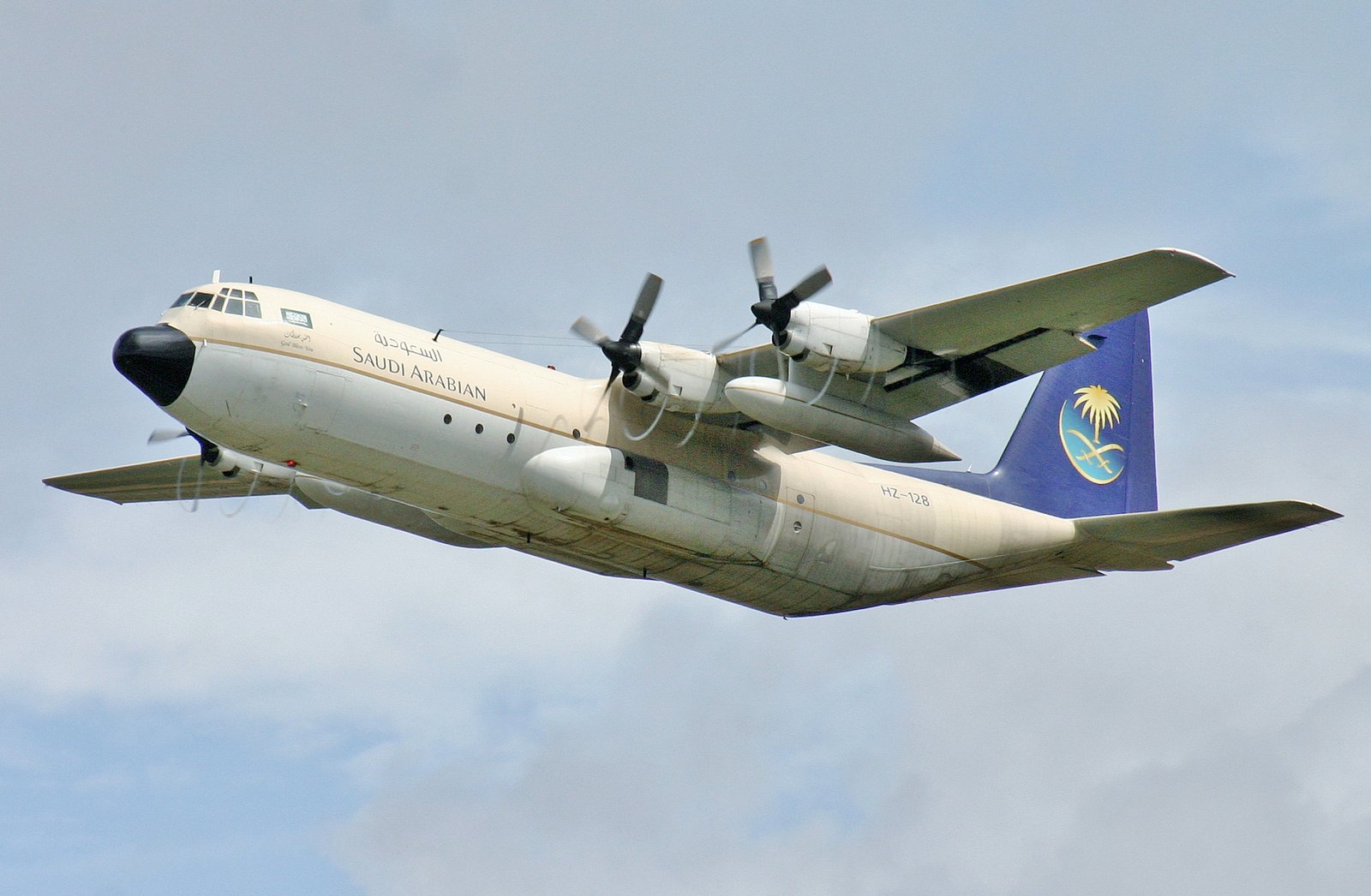
The Lockheed L-100 Hercules was developed as the civilian freight derivative of the military C-130 Hercules. Designed to bring heavy-cargo and short-field capabilities to the commercial sector, the L-100 is notable for its tactical-style loading capabilities, featuring a rear cargo ramp and door that allow for the transport of bulky loads and military vehicles into unimproved short strips. The original prototype for the L-100 first flew on April 20, 1964.
Production of the L-100 took place between 1964 and 1992 at the Lockheed-Georgia Company facility in Marietta, Georgia. A total of 114 aircraft were produced during this period. The first production aircraft was delivered to Continental Air Services on September 30, 1965. As the type evolved, Lockheed developed longer-fuselage variants to increase capacity; the L-100-20 entered service in October 1968, followed by the L-100-30 in December 1970.
Technically, the L-100 is powered by four Allison 501-D22A turboprop engines, each producing 4,510 shp (3,360 kW). The aircraft is designed for a crew of three to four, consisting of two pilots, a navigator, and a flight engineer or loadmaster. It possesses a maximum takeoff weight of 155,000 lb and a payload capacity of 51,050 lb. Performance specifications include a cruise speed of 292 knots and a maximum speed of 308 knots at 20,000 feet. While its standard range is 1,334 nmi, it is capable of a ferry range of 4,830 nmi.
In commercial service, the L-100 proved versatile, operating in roles beyond standard freight, including aerial firefighting, medevac, humanitarian relief, oil and gas exploration, mining logistics, and search and rescue. Delta Air Lines utilized the L-100 for short-haul, small-shipment operations until its final flight with the type on September 1, 1973. Although designed as a civil aircraft, several L-100s were later adopted by military operators in countries such as Saudi Arabia, Indonesia, Kuwait, Algeria, and the Philippines.
The legacy of the L-100 is defined by its proof that military tactical transport designs could be successfully adapted for commercial use. While the original production run ended in 1992, the aircraft's influence continues through the LM-100J, a modern civilian freighter based on the C-130J family.